Unlock instant, AI-driven research and patent intelligence for your innovation.

Floating pontoon berthing facility for ferries and ships

a pontoon and berthing facility technology, applied in the field of floating pontoon berthing facilities for ships and ferries, can solve the problems of stern-first maneuvering being more difficult than bow-first maneuvering, affecting the safety of passengers, and causing vessels to rebound in undesirable ways, so as to reduce the number of piles, reduce the damage to the footprint seabed, and reduce the effect of environmental impa

Inactive Publication Date: 2008-04-03
HEBDEN RAYMOND HOWARD +3
View PDF30 Cites 5 Cited by
  • Summary
  • Abstract
  • Description
  • Claims
  • Application Information

AI Technical Summary

Benefits of technology

[0025]An objective of the present invention is to provide a berthing facility for bow / stern-loading ferries that would provide most if not all of the desired attributes referred to in the preceding paragraph, in a cost-effective manner.
[0041]The three sections of upper apron are preferably provided on the berthing facility. The upper level apron directly pivotally connected to the ramp and supported by hydraulic rams on the outboard end, is relatively long and provides the function of adjusting for height differences between upper and lower car decks on the various ferry types. The adjustable secondary upper level apron eliminates the requirement of lifting the entire length of an upper level ramp, as on conventional designs for two-level ferry berthing facilities.
[0042]Preferably, the berthing facility is provided with a two-lane two-level truss-bridge-style vehicle ramp allowing two-level loading with support on a pontoon. This design uses a steel deck plate for both levels of the vehicle ramp with side “H” member truss diagonals and verticals (lacing) to form a strong and rigid span. Such a structural arrangement can easily and economically be used to achieve relatively long spans which are desirable for maintaining gentle slopes for vehicles and passengers at extreme tide conditions. The overall box section provided by the two-level truss ramp is torsionally rigid and strong allowing use of a lift system at the pontoon end, for adjustability to suit different ship freeboards, which effectively provides a single point of end rotation. The latter feature accommodates wave and differential loading movements of the pontoon without inducing significant twisting stresses into the ramp.
[0049]The berthing facility provides a floating concrete pontoon to support a vehicle ramp and fenders. The floating pontoon automatically follows changes in water level without the need for expenditure of lift energy for adjustment by operator or electronic control means. Accordingly, when ships are tied up in the berthing facility there is an essentially fixed relationship between the deck levels of the ship and the pontoon of the berthing facility. Components of the floating berthing facility may be fabricated off-site thus reducing construction time. Further, problems with ground conditions can be minimized since fewer piles are required for positioning of the berthing facility. The overall structure of the berthing facility is stable in the sense that the floating pontoon of the berthing facility is able to accommodate wave action, differential loading movements, and ship impact forces, and the pontoon is torsionally rigid in the sense that there are no swivel joints between concrete modules that are joined together to form the pontoon. Twisting of the pontoon of the berthing facility is resisted by having torsional strength designed into the modules of the pontoon and the joints between the modules.
[0054]Frequently, the primary environmental concern in construction of a berth is the damage caused to fish from pile driving hammers. The berthing facility of the present invention reduces the number of piles required compared to a conventional dedicated ferry berthing facility, thus reducing the damage to the footprint seabed and the environmental impact.

Problems solved by technology

With a conventional vessel configuration in which the bridge, and thus the helm and other vessel controls, is located closer to the bow than to the stern, stern-first maneuvering is typically more difficult than bow-first maneuvering, in part because of reduced visibility aft compared to visibility forward.
Typically, due primarily to visibility limitations, it is necessary to have two operators for such double bridge arrangements, one operator for each bridge.
However, such rubber bumpers tend to cause vessels striking them to rebound in an undesirable manner.
However, if a ferry rebounds with sufficient speed, it could be dangerous for passengers, particularly if they are on foot within the ferry.
A disadvantage of a rigid berthing structure is that it must be massive in order to absorb the berthing impact energy of a ship.
The pilings used to anchor such berthing structures are susceptible to breakage if exposed to excessive transverse load from a berthing ship, said transverse load being applied to the piling remotely from the point of attachment of the piling to the seabed.
Down time and cost for repair of the pilings may be significant.
Damage to a fixed, rigid berthing structure may also result from severe weather conditions.
A floating berth has the advantage that it will dynamically adjust to tidal conditions, however, such floating berths lack the rigidity of a fixed berth.
Further, floating berths may still be susceptible to damage from berthing impact forces.
Further floating terminal suffers from the disadvantage that an extended area is required to accommodate the movement of the large gravity type breasting dolphins as a ship berths at the floating terminal.
Further, this design for a floating terminals suffers from the disadvantage that many moving parts are employed in the dolphin design.
This floating pierhead structure suffers from the disadvantages that the shoreline to pierhead connection does not dynamically adjust with tides, and further, the impact of a berthing ship must be absorbed by the floating pierhead structure itself.
This docking system suffers from the disadvantage that while convenient for foot passenger travel along the dock, the docking system likely would not support heavier service vehicles or the like nor would it support the movement of vehicles onto the boats.
Further, this docking system does not provide the required rigidity and stability for a ferry berth in that a boat impacting on the side of a docking member results in the movement of the docking member.
The system suffers from the disadvantage in that a number of moving parts must be constructed and aligned in the modules thus adding to the expense.
These fenders suffer from the disadvantage that it is not possible to control the rebound forces of a ship off of the fender.
This mooring arm structure suffers from the disadvantage for present purposes that a mating mount for the free end of the second arm must be mounted on the docked vessel.
The mooring arm structure of U.S. Pat. No. 4,697,538 is specifically adapted to moor fore and aft portions of a water vessel to an associated dock and is not adapted to accommodate the potentially large impact forces presented by an incoming ship or ferry.
The method of U.S. Pat. No. 4,137,861, being adapted for the mooring of very large ships, is relatively complicated and expensive in that it incorporates a plurality of mooring winches for hauling the ship towards the terminal, and pressure monitoring means for monitoring the force of a ship against a fender, and a means for discharging the pressure when the pressure in the hydraulic damping means exceeds a predetermined limit.
This ramp suffers from the disadvantage that significant strain is placed on the hydraulic actuators since the actuators must adjust a mass having a long lever arm.
Accordingly, the floating member cannot serve as a means for service vehicles to access the sides of a vessel in the berth.
This ramp suffers from the disadvantage that a connection between the shore and a berthed ship that automatically and passively adjusts to changes in water level is not provided.
The loading ramp suffers from the disadvantages that the ferry must be specially designed to accept the loading ramp and that only a single access ramp is provided.
A disadvantage of the mooring and ramp system is that the vessel must have a mating piece installed on the vessel to mate with the mooring system.
While various prior berth designs have some degree of isolated merit, none fully meets all objectives of a satisfactory berth for ferries and ships.

Method used

the structure of the environmentally friendly knitted fabric provided by the present invention; figure 2 Flow chart of the yarn wrapping machine for environmentally friendly knitted fabrics and storage devices; image 3 Is the parameter map of the yarn covering machine
View more

Image

Smart Image Click on the blue labels to locate them in the text.
Viewing Examples
Smart Image
  • Floating pontoon berthing facility for ferries and ships
  • Floating pontoon berthing facility for ferries and ships
  • Floating pontoon berthing facility for ferries and ships

Examples

Experimental program
Comparison scheme
Effect test

Embodiment Construction

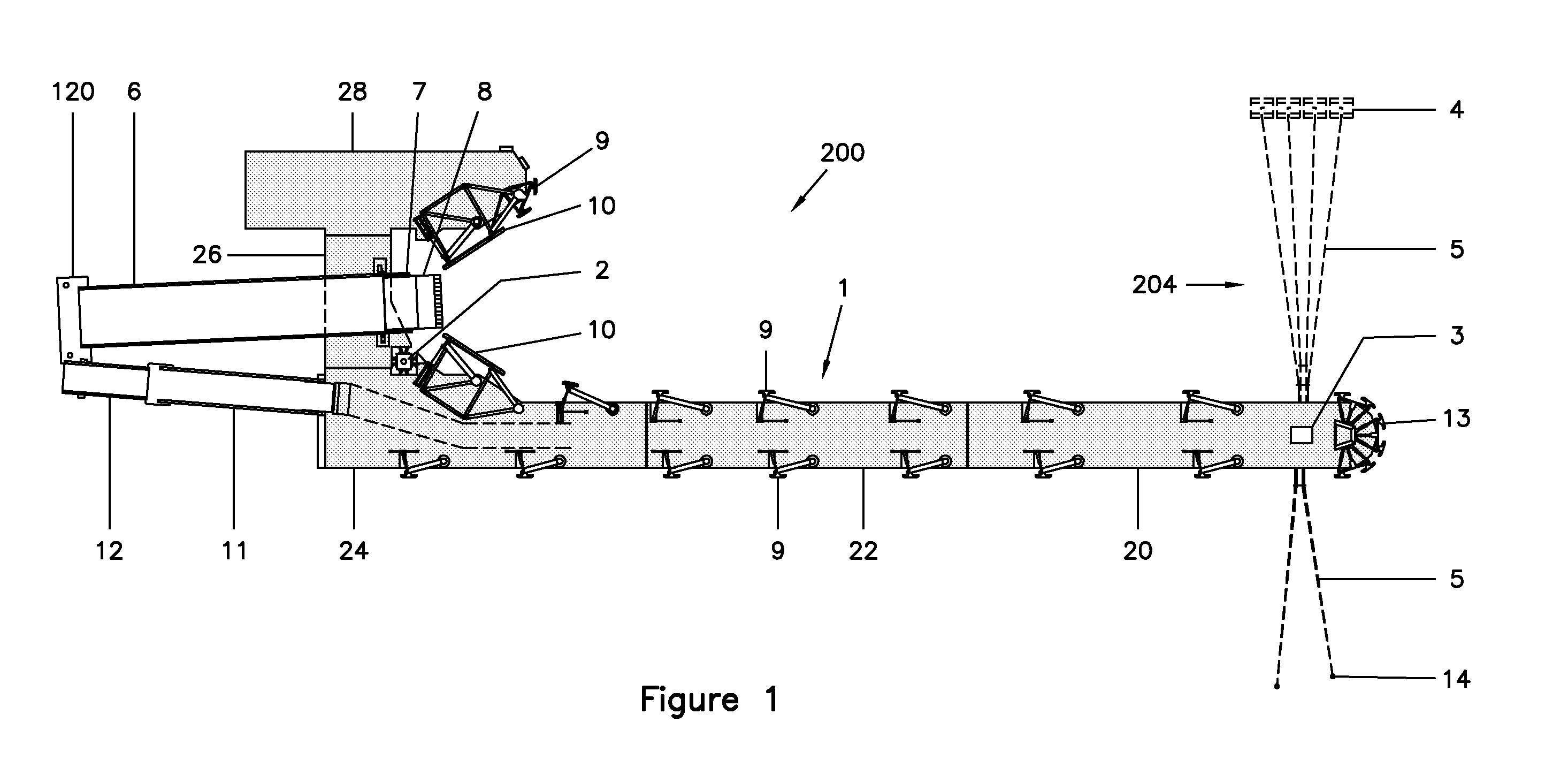
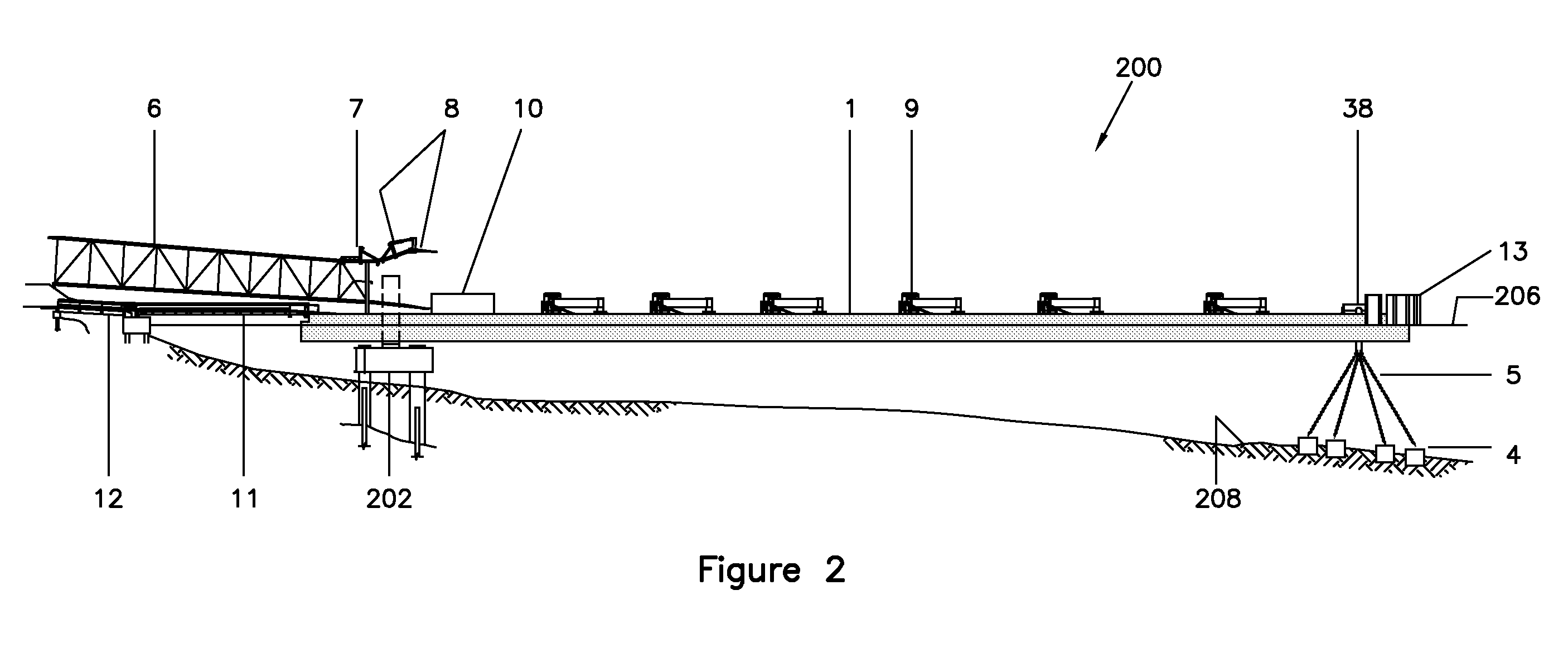
[0073]The embodiment described in what follows and shown schematically in the drawings is suitable for accommodating bow / stern-loading ferries having a length of roughly 550 feet; a gross tonnage of roughly 19,000 tons; and two pairs of bow / stern vehicle access ports, an upper pair and a lower pair. A typical such ferry would have a capacity of roughly 470 automobiles, and roughly 2,100 passengers and crew. In the drawings, the water surface is identified by reference number 206 and the seabed is identified by reference number 208. As shown in FIGS. 1 and 2, a berthing facility 200 includes a generally J-shaped floating pontoon 1, a pylon assembly 202 securing the near-shore end of the pontoon 1; an anchoring assembly 204 securing the outer end of the pontoon 1; and a vehicle loading and unloading ramp 6 and a service ramp span 11, each of the ramp 6 and span 11 running from the shore to the near-shore end of the pontoon 1. The distal end of the pontoon 1 is curved and configured to...

the structure of the environmentally friendly knitted fabric provided by the present invention; figure 2 Flow chart of the yarn wrapping machine for environmentally friendly knitted fabrics and storage devices; image 3 Is the parameter map of the yarn covering machine
Login to View More

PUM

No PUM Login to View More

Abstract

A berthing facility for use in moving vehicles between a shore facility and a bow / stern-loading RORO ferry, having a substantially rigid floating pontoon comprising several modules joined one to another, a two-tier vehicle ramp running from the shore to the pontoon, means for pivotally securing the pontoon in the vicinity of the ramp and means for resiliently restraining the pontoon to permit limited controlled pivotal movement about a preferred orientation. The berthing facility also including, hydraulically dampened fenders and wingwalls for dissipating vessel impact force, an integral turning dolphin, apron assemblies for providing continuity of vehicle pathways between the ramp and a ferry, and means for raising and lowering the ramp.

Description

FIELD OF THE INVENTION[0001]The invention relates generally to a berthing facility for ships and ferries, and particularly to a berthing facility for use in loading and unloading of vehicles with bow / stern-loading RORO ferries.BACKGROUND OF THE INVENTION[0002]Ferries are used to transport vehicles and passengers across bodies of water throughout the world. A common general configuration for a passenger / vehicle ferry is the so called “Roll On / Roll Off” design (also identified by the acronyms “RORO” and “ro-ro”). RORO vessels have built-in side, bow and / or stern ports which allow the vehicles to be efficiently “rolled on” and “rolled off” the vessel when in port. (This is in contrast to the more traditional lo-lo (lift on-lift off) vessels which use a crane to load and unload cargo.)[0003]Some RORO type vehicle / passenger ferries have one or more vehicle decks running the length of the vessel, each deck comprising a plurality of vehicle parking lanes, and vehicle access means at the bo...

Claims

the structure of the environmentally friendly knitted fabric provided by the present invention; figure 2 Flow chart of the yarn wrapping machine for environmentally friendly knitted fabrics and storage devices; image 3 Is the parameter map of the yarn covering machine
Login to View More

Application Information

Patent Timeline
no application Login to View More
Patent Type & Authority Applications(United States)
IPC IPC(8): B63B35/44
CPCE02B3/20E01D15/24
Inventor HEBDEN, RAYMOND HOWARDCRAUFORD, RICHARD HAIGH CAMBIERAMSAY, GREGORY HUGH PAULBASNETT, DAVID JOHN
Owner HEBDEN RAYMOND HOWARD