

Impact-resistance-modified filled polycarbonate compositions
a polycarbonate composition and impact resistance technology, applied in the field can solve the problems of increasing the density of thermoplastic molding compositions, inorganic fillers generally having an adverse effect on mechanical properties, etc., and achieves improved flowability, small processing shrinkage, and high stiffness
- Summary
- Abstract
- Description
- Claims
- Application Information
AI Technical Summary
Benefits of technology
Problems solved by technology
Method used
Image

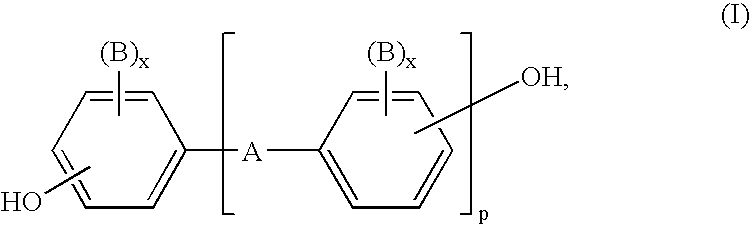
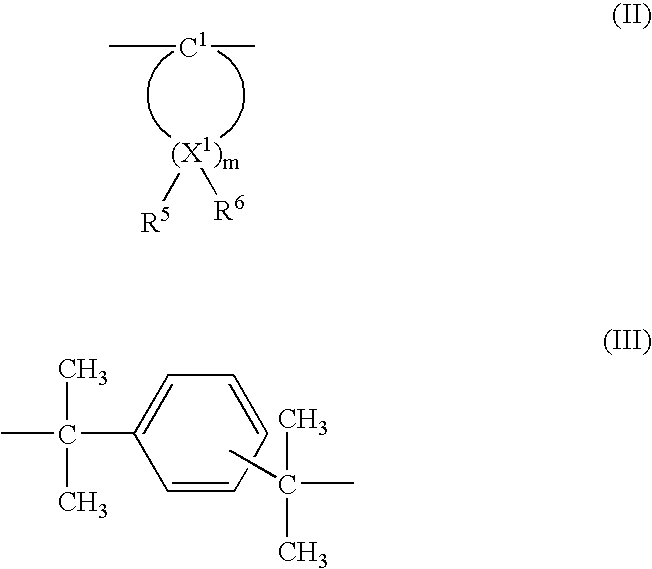
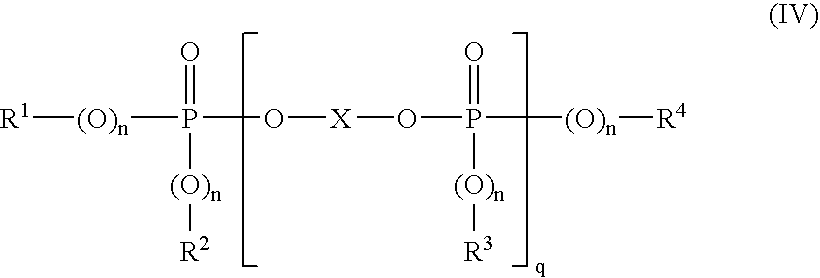
Examples
examples
Component A1
[0108]Linear polycarbonate based on bisphenol A with a weight-averaged molecular weight Mw of 27,500 g / mol (determined by GPC).
Component A2
[0109]Linear polycarbonate based on bisphenol A with a weight-averaged molecular weight Mw of 25,000 g / mol (determined by GPC).
Component B1
[0110]ABS polymer, produced by emulsion polymerization of 43 wt. % (relative to the ABS polymer) of a mixture consisting of 27 wt. % acrylonitrile and 73 wt. % styrene in the presence of 57 wt. % (relative to the ABS polymer) of a polybutadiene rubber crosslinked in particulate manner (mean particle diameter d50=0.35 μm).
Component C1
[0111]The hollow glass beads are made of low-alkali borosilicate glass, i.e. of 5.5 wt. % Na2O, 11.5 wt. % CaO and 4 wt. % B2O3. The hollow glass beads exhibit a density of 0.6 g / cm3 and a mean diameter of 30 μm. The hollow glass beads have an isostatic compressive strength of 124 MPa.
Component C2
[0112]The solid glass beads (Vitrolite 20 manufactured by VitroCo Enterpri...
PUM
| Property | Measurement | Unit |
|---|---|---|
| Percent by mass | aaaaa | aaaaa |
| Percent by mass | aaaaa | aaaaa |
| Percent by mass | aaaaa | aaaaa |
Abstract
Description
Claims
Application Information
 Login to View More