
Amine Compounds
a technology of amine compounds and compounds, applied in the field of amine compounds, can solve the problems of restricting the usefulness of substances as therapeutic agents, undesirable adverse drug reactions, and inability to ameliorate the immunological basis of diseases
- Summary
- Abstract
- Description
- Claims
- Application Information
AI Technical Summary
Benefits of technology
Problems solved by technology
Method used
Image

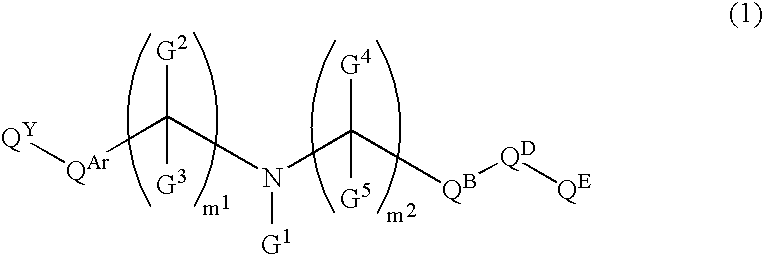
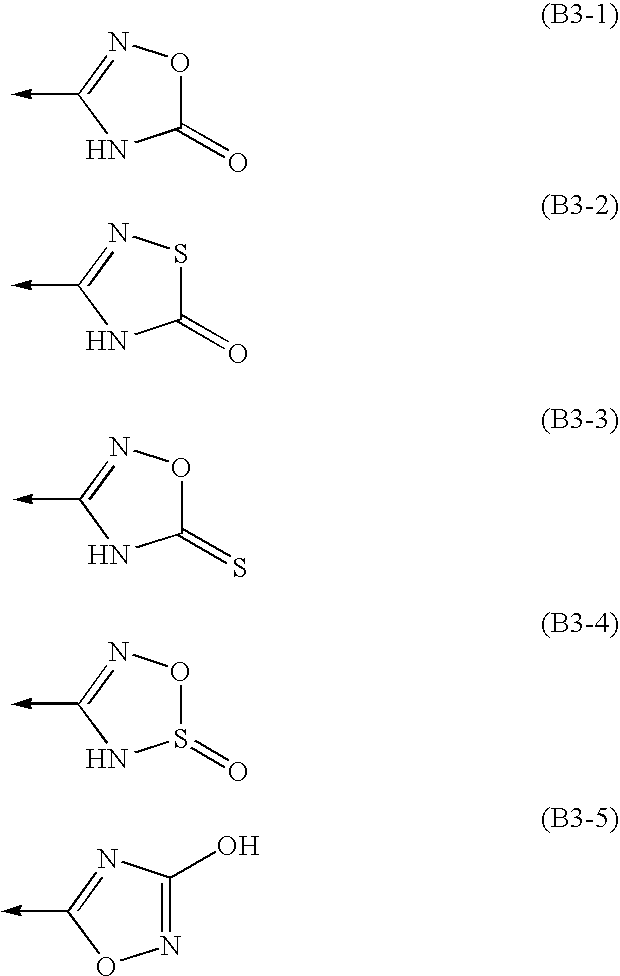
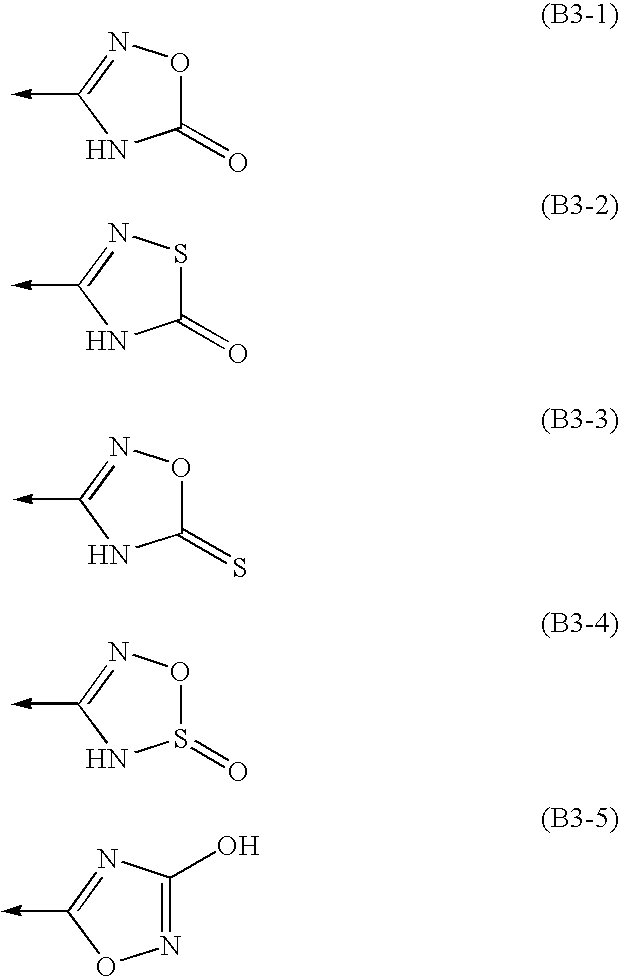
Examples
reference example 1
(1R,4s)-4-aminocyclopentane-2-encarboxylic acid hydrochloric acid salt
[2087]To (1R,4s)-4-(tert-butoxycarbonyl)aminocyclopentane-2-encarboxylic acid (50 mg, manufactured by Fluka), 2 mL of 4N HCl dioxane solution was added. The resultant mixture was stirred for 2 hours at room temperature, and a solvent was distilled away under a reduced pressure. As a result, the titled compound was obtained.
example 1
(1R,4s)-4-(4-((4-phenyl-5-(trifluoromethyl) thiophene-2-yl)methoxy)benzylamino)cyclopentan-2-encarboxylic acid
[2088]To a dichloromethane solution (4 mL) of (1R,4s)-4-aminocyclopentane-2-encarboxylic acid hydrochloric acid salt (50 mg) obtained in Reference Example 1 and 4-((4-phenyl-5-(trifluoromethyl)thiophen-2-yl)methoxy)benzaldehyde (72 mg, Synthetic Product 1), a triacetoxy sodium borohydride (83.9 mg, manufactured by Aldrich) was added. The resultant mixture was stirred for 6 hours at room temperature. After the stirring was ended, a reaction mixture was concentrated under a reduced pressure.
[2089]Next, a chromatography using a Biotage 12M cartridge (as an elution solution, 10:1:0.1 (v / v) of dichloromethane / methanol / 25% ammonia aqueous solution was used) was performed, so that 30.5 mg of the titled compound was obtained. ESI-MS: 474 (M+H), RTime 4.09 min.
[2090]The aforementioned “Synthetic Product 1” compound was synthesized based on a method disclosed in the document of J. Med...
examples 2 to 29
[2091]According to the procedures of Example 1, the same method was performed except that any one of raw compounds as listed in Table 71 was used instead of (1R,4s)-4-aminocyclopentan-2-encarboxylic acid hydrochloride. As a result, the compounds of Examples 2 to 29 listed in Table 71 were obtained.
TABLE 71LCMSExpSyn.SMSuppl.Struct.RtimeMass2AACR4.234903AACR4.224904AACR3.894905AACR3.874766AAMRI3.824627APep3.894908AChe4.094769ATCI3.9049010ATCI3.9150411ATCI5.5748412AACR4.3450213ATCI3.8849014AKAN5.3150015AACR3.8249216AACR3.9049217AACR3.5942618AACR3.9147619ATCI4.2047620AACR4.3450221AAld4.3757722AAld3.5847723AAMRI3.7943224AAMRI3.8248825AACR3.7847626AAld4.3148627AWAKO4.9245228ASIG4.1748029ASIG4.20480
PUM
| Property | Measurement | Unit |
|---|---|---|
| Volume | aaaaa | aaaaa |
| Volume | aaaaa | aaaaa |
| Volume | aaaaa | aaaaa |
Abstract
Description
Claims
Application Information
 Login to View More