Heterocyclic indene derivatives and their radioisotope labeled compounds for imaging beta-amyloid deposition
Inactive Publication Date: 2008-12-04
SEOUL NAT UNIV R&DB FOUND
View PDF2 Cites 11 Cited by
Summary
Abstract
Description
Claims
Application Information
AI Technical Summary
This helps you quickly interpret patents by identifying the three key elements:
Problems solved by technology
Method used
Benefits of technology
Benefits of technology
[0014]The object of the present invention is to provide novel compounds for imaging β-amyloid deposits and precursors for synthesize them. For this, the compounds should be easy to radiolabel, have high β-amyloid binding affinity, and show fast whole body clearance.
[0021]The heterocyclic indene derivative compound of the present invention has enough lipophilicity for BBB penetration resulting in high initial brain uptake and rapid brain washout.
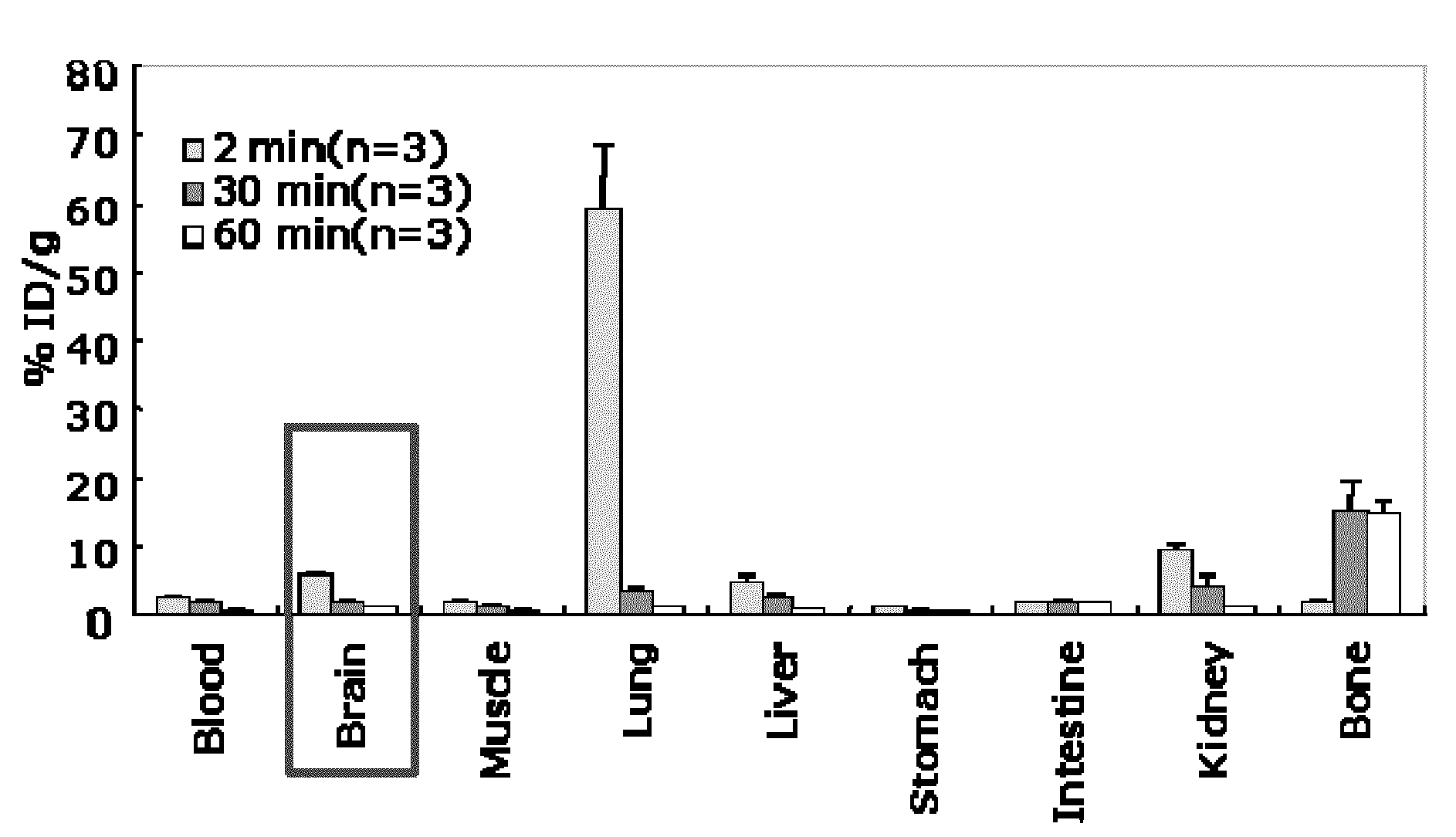
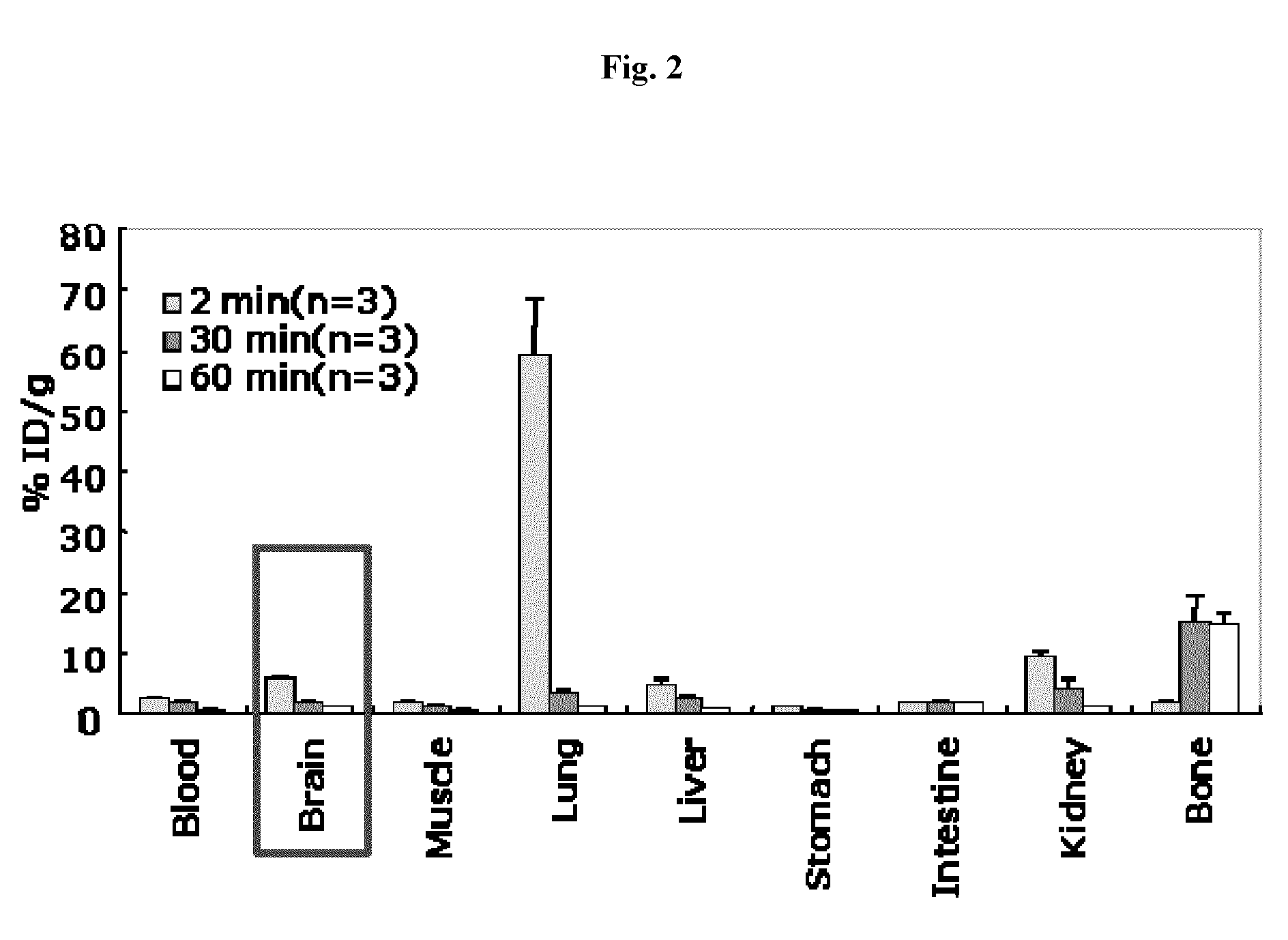
[0037]An important achievement of the present invention is the introduction of benzyl fluoro type 18F which can be metabolized by liver microsomal enzyme rapidly, thus the clearance from the blood consequently from the brain also is rapid. Unbound compounds are metabolized rapidly in the liver and then taken up by the bone or excreted into urine rapidly. Eventually, better images can be obtained by reduced background radioactivity.
[0039]The compounds in the present invention can penetrate BBB easily due to lipophilicity and have high affinities to β-amyloid plaques and tangles which are expressed in the brain of Alzheimer's disease, thus can be used for therapy or diagnosis of Alzheimer's disease.
Problems solved by technology
Alzheimer's disease is characterized by decrease of brain nerve cells resulting in reduced memory and cognitive power.
Although Alzheimer's disease can be confirmed by staining the postmortem brain with Congo red, it cannot be applied to alive human.
However, these compounds were not practically applicable due to low BBB-permeability (Klunk W E, Debnath M L, Pettegrew J W. Development of small molecule probes for the beta-amyloid protein of Alzheimer's disease.
Method used
the structure of the environmentally friendly knitted fabric provided by the present invention; figure 2 Flow chart of the yarn wrapping machine for environmentally friendly knitted fabrics and storage devices; image 3 Is the parameter map of the yarn covering machine
View more
Image
Smart Image Click on the blue labels to locate them in the text.
Viewing Examples
Smart Image
Click on the blue label to locate the original text in one second.
Reading with bidirectional positioning of images and text.
Smart Image
Examples
Experimental program
Comparison scheme
Effect test
example 1
Synthesis of 2-(4′-fluoromethyl)phenyl-1,3-benzothiazole
[0046]To the solution of 2-aminothiophenol (94 μL, 0.9 mmol) in toluene (5 mL), 4-(fluoromethyl)-1-benzenecarbonyl chloride (150 mg, 0.9 mmol) was added. After refluxing for 20 hrs, the reaction mixture was filtered, and the filtrate volume was reduced by evaporating and recrystallized in EtOAc and toluene mixture to afford 2-(4′-fluoromethyl)phenyl-1,3-benzothiazole (138 mg, 0.6 mmol) as a yellowish solid in a yield of 65%. 1H NMR (300 MHz, CDCl3): δ 5.38 (s, 1H, —CH2—), 5.54 (s, 1H, —CH2—), 7.41 (m, 1H), 7.50 (m, 3H), 7.92 (d, 1H, J=7.8 Hz), 8.01-8.14 (m, 3H).
example 2
Synthesis of 2-(4′-fluoromethyl)phenyl-1,3-benzoxazole
[0047]To the solution of 2-aminophenol (95 μL, 0.9 mmol) in toluene (10 mL), 4-(fluoromethyl)-1-benzenecarbonyl chloride (150 mg, 0.9 mmol) was added. After refluxing for 40 hrs, the reaction mixture was filtered, and the filtrate volume was reduced by evaporating. The residue was purified with column chromatography in CH2Cl2 and MeOH (30:1) mixture to afford 2-(4′-fluoromethyl)phenyl-1,3-benzoxazole (38 mg, 0.1 mmol) as a yellowish solid in a yield of 15%. 1H NMR (300 MHz, CDCl3): δ 5.40 (s, 1H, —CH2—), 5.56 (s, 1H, —CH2—), 7.37 (m, 2H), 7.53 (d, 2H, J=7.8 Hz), 7.58 (m, 1H), 7.78 (m, 1H), 8.29 (d, 2H, J=7.8 Hz).
example 3
Synthesis of 2-(4′-fluoromethyl)phenylbenzo[b]thiophene
[0048]To the solution of (2-sulfanylphenyl)methyltriphenylphosphonim bromide (493 mg, 1 mmol) in toluene (10 mL), 4-(fluoromethyl)-1-benzenecarbonyl chloride (123 mg, 1.0 mmol) and Et3N (302 μL, 2.3 mmol) were added. After refluxing for 20 hrs, the reaction mixture was filtered, and the filtrate volume was reduced by evaporating. The residue was purified with column chromatography in CH2Cl2 and MeOH (30:1) mixture to afford 2-(4′-fluoromethyl)phenylbenzo[b]thiophene (125 mg, 0.5 mmol) as a brownish solid in a yield of 50%. 1H NMR (300 MHz, CDCl3): δ 5.40 (s, 1H, —CH2—), 5.56 (s, 1H, —CH2—), 7.33 (t, 2H), 7.39 (d, 2H, J=7.8 Hz), 7.55 (s, 1H), 7.70 (d, 2H, J=7.8 Hz), 7.72-7.84 (m, 2H).
the structure of the environmentally friendly knitted fabric provided by the present invention; figure 2 Flow chart of the yarn wrapping machine for environmentally friendly knitted fabrics and storage devices; image 3 Is the parameter map of the yarn covering machine
Login to View More
PUM
Property
Measurement
Unit
Capacitance
aaaaa
aaaaa
Affinity
aaaaa
aaaaa
Login to View More
Abstract
The invention is directed to heterocyclic indene derivatives useful for β-amyloid plaque imaging, their radiolabeled compounds and their preparation methods. The compounds of the invention are easily labeled with radioisotopes and have high affinities to β-amyloid depositions, thus they facilitate diagnosis of Alzheimer's disease by imaging the distribution of β-amyloid depositions.
Description
CROSS-REFERENCE TO RELATED APPLICATIONS [0001]This application claims priority to Korean Patent Application No. 10-2007-0053777, filed on Jun. 1, 2007, which is hereby incorporated herein by reference in its entirety.TECHNICAL FIELD[0002]The present invention relates to novel heterocyclic indene derivatives for imaging β-amyloid depositions by binding them and consequent radiation from binding site, their radiolabeled compounds, precursors for synthesizing them, and their preparation method.BACKGROUND ART[0003]β-amyloid depositions are found in the brain of Alzheimer's disease patient. Alzheimer's disease is characterized by decrease of brain nerve cells resulting in reduced memory and cognitive power. Plaques or tangles that are formed by aggregation of β-amyloid peptide are found in the Alzheimer's brain. Alzheimer's disease might be suppressed by administration of drugs inhibiting formation of β-amyloid plaques and tangles.[0004]Although Alzheimer's disease can be confirmed by st...
Claims
the structure of the environmentally friendly knitted fabric provided by the present invention; figure 2 Flow chart of the yarn wrapping machine for environmentally friendly knitted fabrics and storage devices; image 3 Is the parameter map of the yarn covering machine
Login to View More
Application Information
Patent Timeline
Application Date:The date an application was filed.
Publication Date:The date a patent or application was officially published.
First Publication Date:The earliest publication date of a patent with the same application number.
Issue Date:Publication date of the patent grant document.
PCT Entry Date:The Entry date of PCT National Phase.
Estimated Expiry Date:The statutory expiry date of a patent right according to the Patent Law, and it is the longest term of protection that the patent right can achieve without the termination of the patent right due to other reasons(Term extension factor has been taken into account ).
Invalid Date:Actual expiry date is based on effective date or publication date of legal transaction data of invalid patent.


 Login to View More