Check patentability & draft patents in minutes with Patsnap Eureka AI!

RFID interrogator

Inactive Publication Date: 2009-01-08
CAMBRIDGE RESONANT TECH
View PDF26 Cites 5 Cited by
  • Summary
  • Abstract
  • Description
  • Claims
  • Application Information

AI Technical Summary

Benefits of technology

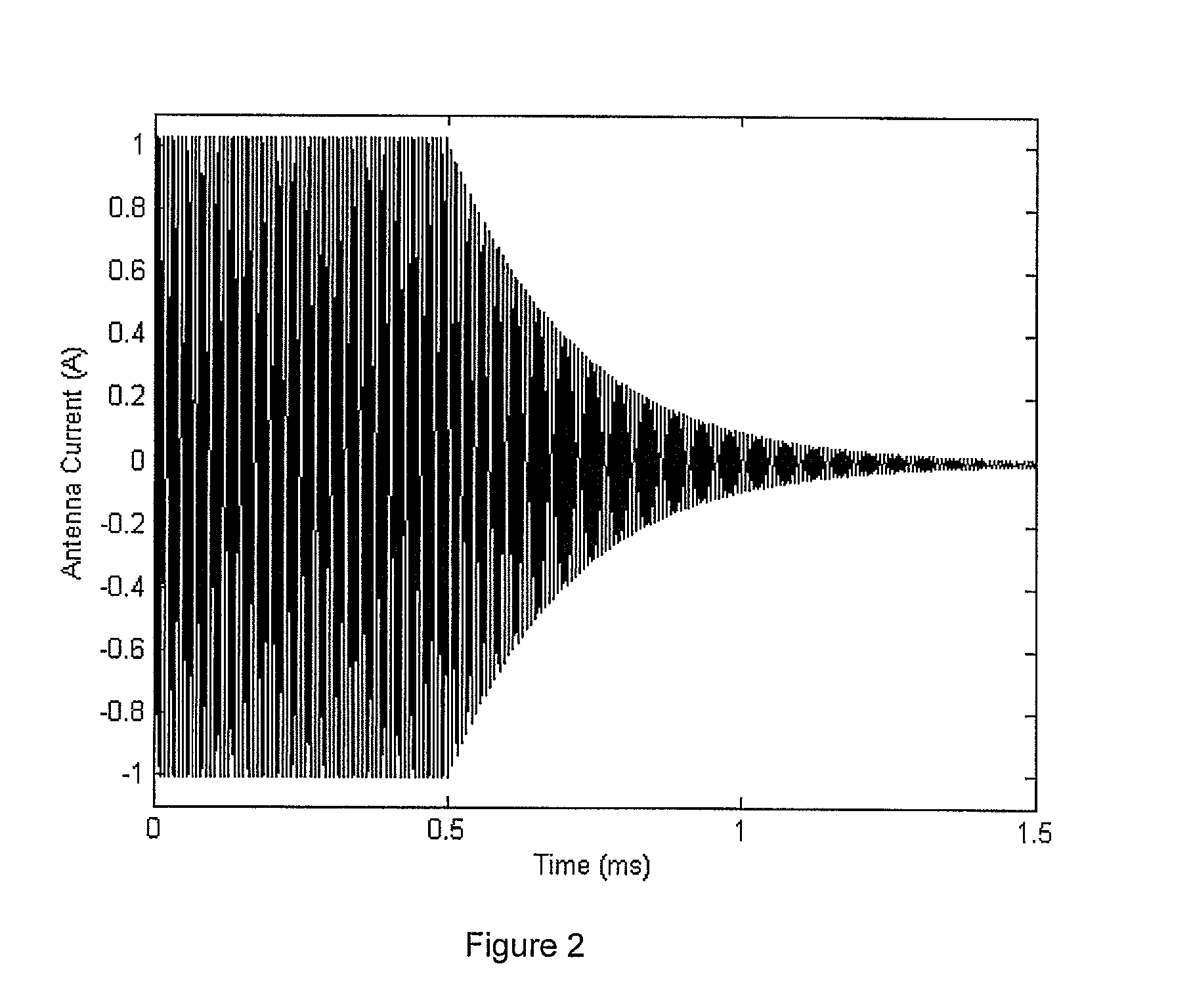
[0008]In embodiments the field generated by an RFID interrogator may be modulated at a high rate without the energy loss associated with dissipation of the resonance energy at each modulation cycle.
[0028]10. An system that measures the timing of the stimulus pulses relative to the antenna current in normal operation and then uses this to calculate the timing for turn on. This may be used to improve the smoothness of the turn on waveform.

Problems solved by technology

Their use increases the efficiency of energy transfer between the two circuits, which would otherwise be much lower, severely limiting the range of operation.
A high Q resonator may not provide sufficient speed of response to allow amplitude modulations at the required rate simply through turn off and turn on of the stimulus.
The drawback of these prior art methods are that the turn on / off time may still be limited, and also they involve the dissipation of the resonance energy at each modulation.

Method used

the structure of the environmentally friendly knitted fabric provided by the present invention; figure 2 Flow chart of the yarn wrapping machine for environmentally friendly knitted fabrics and storage devices; image 3 Is the parameter map of the yarn covering machine
View more

Image

Smart Image Click on the blue labels to locate them in the text.
Viewing Examples
Smart Image
  • RFID interrogator
  • RFID interrogator
  • RFID interrogator

Examples

Experimental program
Comparison scheme
Effect test

Embodiment Construction

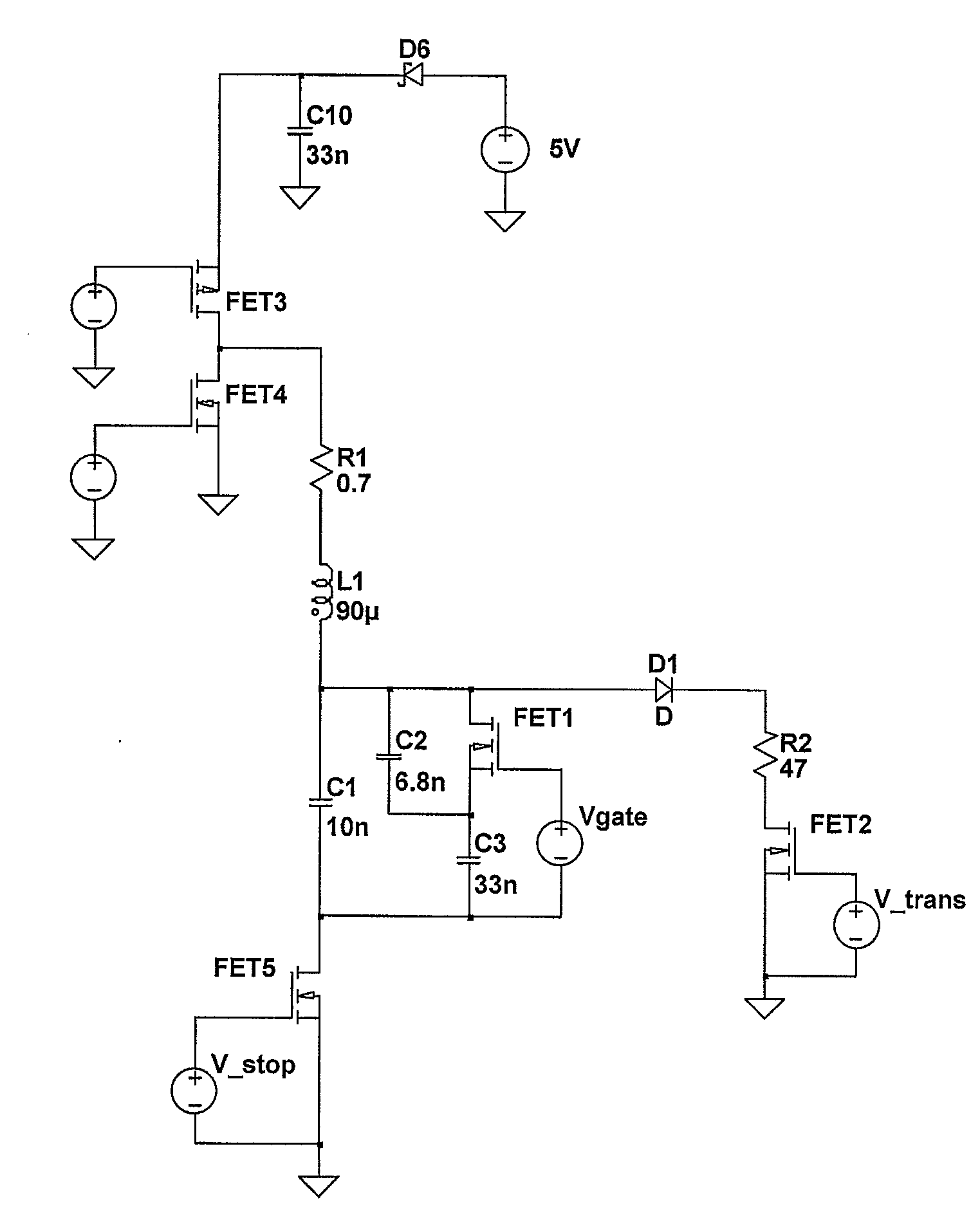
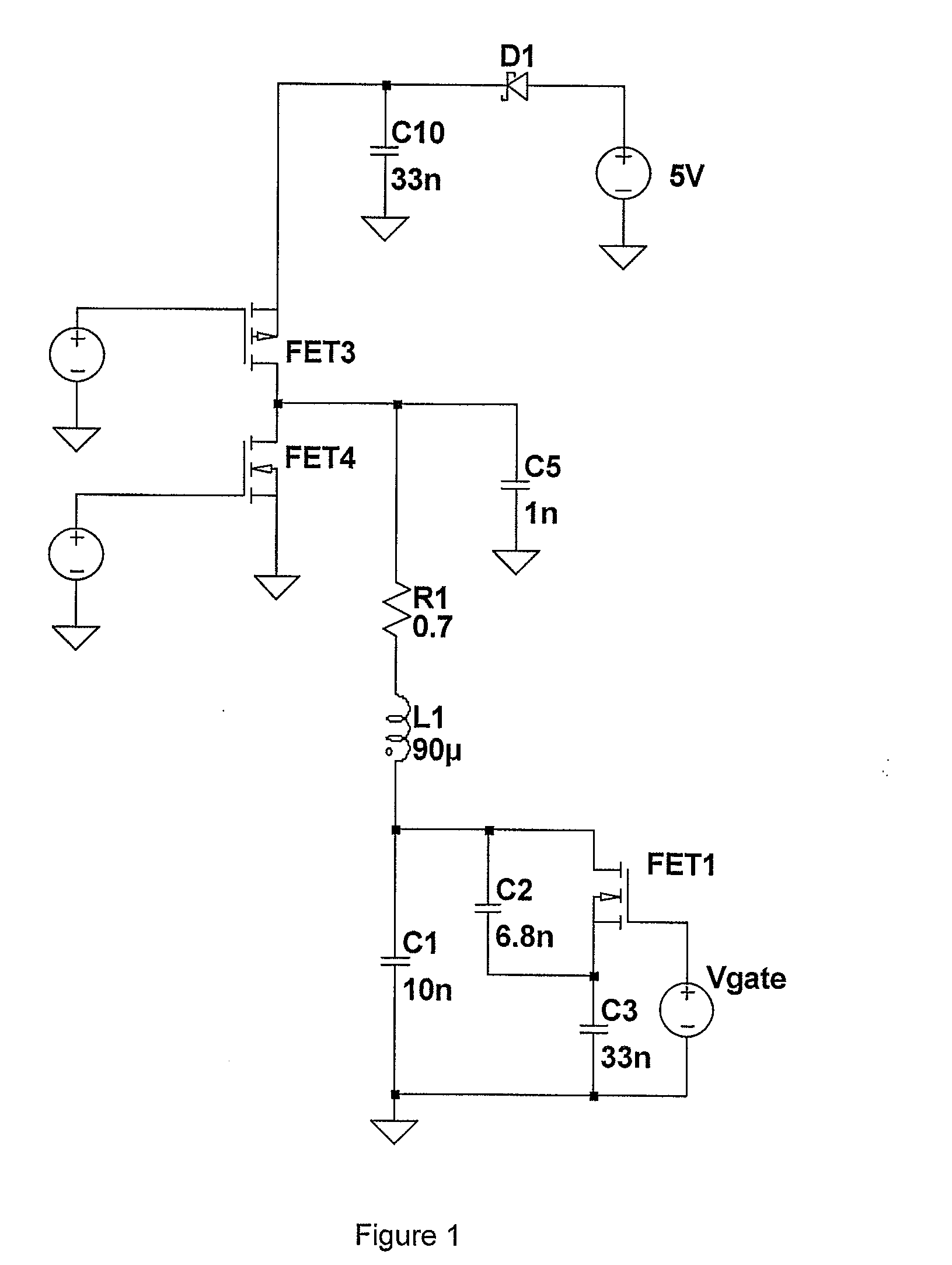
[0037]FIG. 1 shows an embodiment of an RFID interrogator incorporating a nonlinear resonator. The resonator comprises an antenna with inductance 90 mH and series resistance of 0.7Ω, giving a Q at 125 kHz of approximately 100. The antenna is connected to a capacitive network C1, C2, C3 and MOSFET FET1. The capacitive network has two distinct states with the FET1 on and FET1 off. When FET1 is on the total capacitance is 43 nF, since C2 is shorted out, whereas when FET1 is off the total capacitance is 15.6 nF. FET1 is turned on or off depending on the amplitude of the waveform at the source potential, relative to the fixed gate voltage V gate. The duty cycle of the FET1 on state varies with the resonance amplitude, which naturally adjusts to allow the resonator to match the 125 kHz stimulus frequency. The amplitude of the resonator is controlled through V gate, increasing as this voltage is reduced to negative voltages.

[0038]The stimulus to the resonator is supplied through the complem...

the structure of the environmentally friendly knitted fabric provided by the present invention; figure 2 Flow chart of the yarn wrapping machine for environmentally friendly knitted fabrics and storage devices; image 3 Is the parameter map of the yarn covering machine
Login to View More

PUM

No PUM Login to View More

Abstract

Embodiments of the invention relate to the field of RFID interrogators, particularly RFID interrogators that combine low loss with high rates of communication from the interrogator to a tag. We describe a transmitter comprising a resonant circuit and a driver coupled to drive said resonant circuit, wherein said resonant circuit includes a resonance regeneration system such that during amplitude modulation of a resonant signal in said resonant circuit when an amplitude of said resonant signal is reduced energy from said reduction is stored and when said amplitude is increased said stored energy is used to regenerate said resonance signal.

Description

FIELD OF INVENTION[0001]Embodiments of the invention relate to the field of RFID interrogators, particularly RFID interrogators that combine low loss with high rates of communication from the interrogator to a tag.BACKGROUND TO THE INVENTION[0002]In an RFID system resonant circuits are generally used in both the reader and the transponder. Their use increases the efficiency of energy transfer between the two circuits, which would otherwise be much lower, severely limiting the range of operation. Optimal read range may be achieved when the reader is stimulated at its resonance frequency, and this also matches the resonant frequency of the transponder.[0003]The inventor's earlier patent applications PCT / GB2006 / 050436 and PCT / GB2006 / 050440 outline methods that allow the use of a high Q antenna in an RFID reader. These methods prevent the conventional problems of a high Q resonant system associated with a narrow bandwidth. Firstly, a resonator is described that naturally tunes to the st...

Claims

the structure of the environmentally friendly knitted fabric provided by the present invention; figure 2 Flow chart of the yarn wrapping machine for environmentally friendly knitted fabrics and storage devices; image 3 Is the parameter map of the yarn covering machine
Login to View More

Application Information

Patent Timeline
no application Login to View More
IPC IPC(8): H04Q5/22H04B1/02H03B1/04
CPCG06K7/0008H04B1/02H03K17/162
Inventor HILL, NICHOLAS PATRICK ROLAND
Owner CAMBRIDGE RESONANT TECH
Features
  • R&D
  • Intellectual Property
  • Life Sciences
  • Materials
  • Tech Scout
Why Patsnap Eureka
  • Unparalleled Data Quality
  • Higher Quality Content
  • 60% Fewer Hallucinations
Social media
Patsnap Eureka Blog
Learn More