Preparation of uretdione polyisocyanates
- Summary
- Abstract
- Description
- Claims
- Application Information
AI Technical Summary
Problems solved by technology
Method used
Image

Examples
examples
[0065]The NCO content of the resins described in the examples and comparative examples was determined by titration in accordance with DIN 53 185.
[0066]The dynamic viscosities were determined at 23° C. using a VT 550 viscometer from Haake, Karlsruhe. It was ensured by means of measurements at different shear rates that the flow behaviour of the respective polyisocyanates prepared according to the invention and also that of the comparative products corresponds to that of ideal newtonian fluids. Indication of the shear rate can therefore be omitted.
[0067]The figures for “mol %” or “molar ratio of various structural types” are based on NMR-spectroscopic measurements. They are always based, unless indicated otherwise, on the sum of the structural types formed by the modification reaction (oligomerization) from the previously free NCO groups of the isocyanates to be modified.
[0068]13C-NMR measurements were carried out on DPX 400, AVC 400 or DRX 700 instruments from Bruker, Karlsruhe, Del....
examples 1 and 2
According to the Invention, and also 3 and 4, Comparative Examples
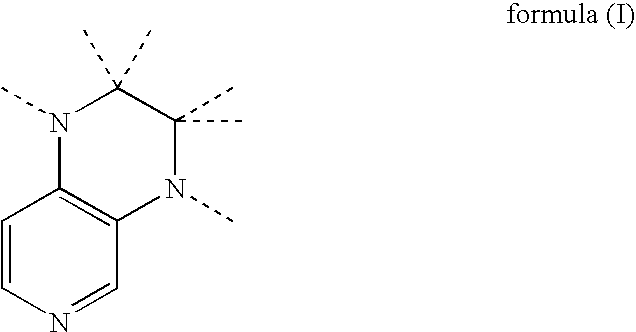
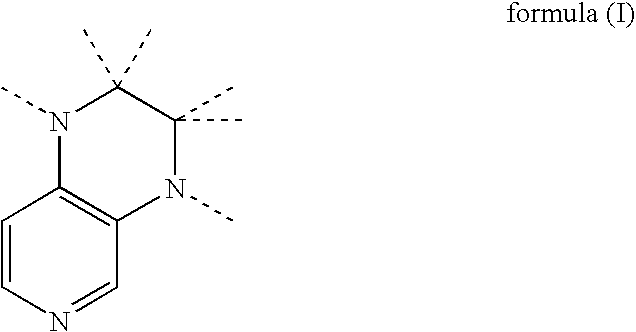
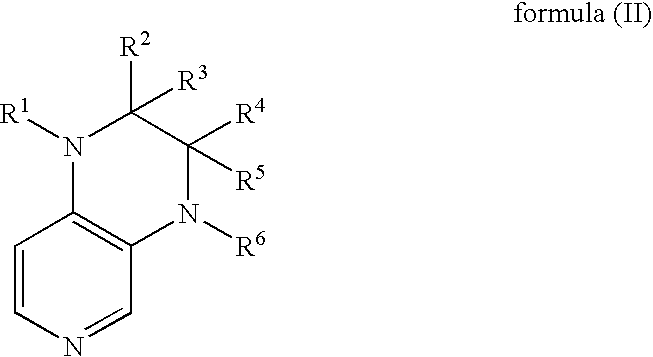
[0072]10 g of freshly degassed HDI (Examples 1 and 3) or IPDI (Examples 2 and 4) were in each case stirred at 23° C. under nitrogen in the presence of 2 mol % of catalyst (III) (Examples 1 and 2) or N,N,-dimethylaminopyridine (DMAP) (Examples 3 and 4) by means of a magnetic stirrer bar in glass vessels closed by means of a septum, with the progress of the reaction being checked at regular intervals by measurement of the index of refraction (at 20° C. and the frequency of the light of the D line of the sodium spectrum: nD20) of the reaction mixture (cf. Table 1). After 135 minutes, the reaction mixture was analysed by means of NMR spectroscopy. After 24 hours, the reaction mixtures from Examples 1 and 2 were highly viscous and could no longer be stirred by means of a magnetic stirrer bar, while those from Examples 3 and 4 were still readily stirrable. The behaviour of the mixtures from Examples 3 and 4 demonstrates the...
example 5
, According to the Invention
[0073]Catalyst: (III) (0.24 mol %, based on HDI); reaction temperature: 40° C.
[0074]400 ml of HDI were placed in a double-walled flange vessel which was maintained at 40° C. by means of an external circuit and was provided with stirrer, reflux condenser, connected to an inert gas unit (nitrogen / vacuum) and thermometer and degassed. After admission of nitrogen, 1.5 g of catalyst In were added and the mixture was stirred at 40° C. for the time indicated in Table 2. The index of refraction of the mixture (nD20) rose to 1.4760. The reaction mixture was subsequently worked up without prior deactivation of the catalyst. The work-up was carried out by vacuum distillation in a thin film evaporator of the sort-path evaporator (SPE) type provided with upstream prevaporiser (PV) (distillation data: pressure: 0.08 mbar, PV temperature: 140° C., MV temp.: 150° C., distillation time: 1 h), with unreacted monomer being separated off together with the active catalyst as ...
PUM
| Property | Measurement | Unit |
|---|---|---|
| Content | aaaaa | aaaaa |
Abstract
Description
Claims
Application Information
 Login to View More
 - R&D
- Intellectual Property
- Life Sciences
- Materials
- Tech Scout
- Unparalleled Data Quality
- Higher Quality Content
- 60% Fewer Hallucinations
Browse by: Latest US Patents, China's latest patents, Technical Efficacy Thesaurus, Application Domain, Technology Topic, Popular Technical Reports.
© 2025 PatSnap. All rights reserved.Legal|Privacy policy|Modern Slavery Act Transparency Statement|Sitemap|About US| Contact US: help@patsnap.com