

Semiconductor device including memory cell having charge accumulation layer
a memory cell and semiconductor technology, applied in the direction of pulse automatic control, pulse technique, instruments, etc., can solve the problem of enlarge the circuit area
- Summary
- Abstract
- Description
- Claims
- Application Information
AI Technical Summary
Benefits of technology
Problems solved by technology
Method used
Image



Examples
first embodiment
[0048]A semiconductor device according to a first embodiment of the invention will be described below. FIG. 1 is a block diagram showing a configuration of a part of a NAND type flash memory according to the first embodiment.
[0049]
[0050]Referring to FIG. 1, the NAND type flash memory 1 includes a memory cell array 2, a row decoder 3, a voltage generating circuit 4, and a control circuit 5.
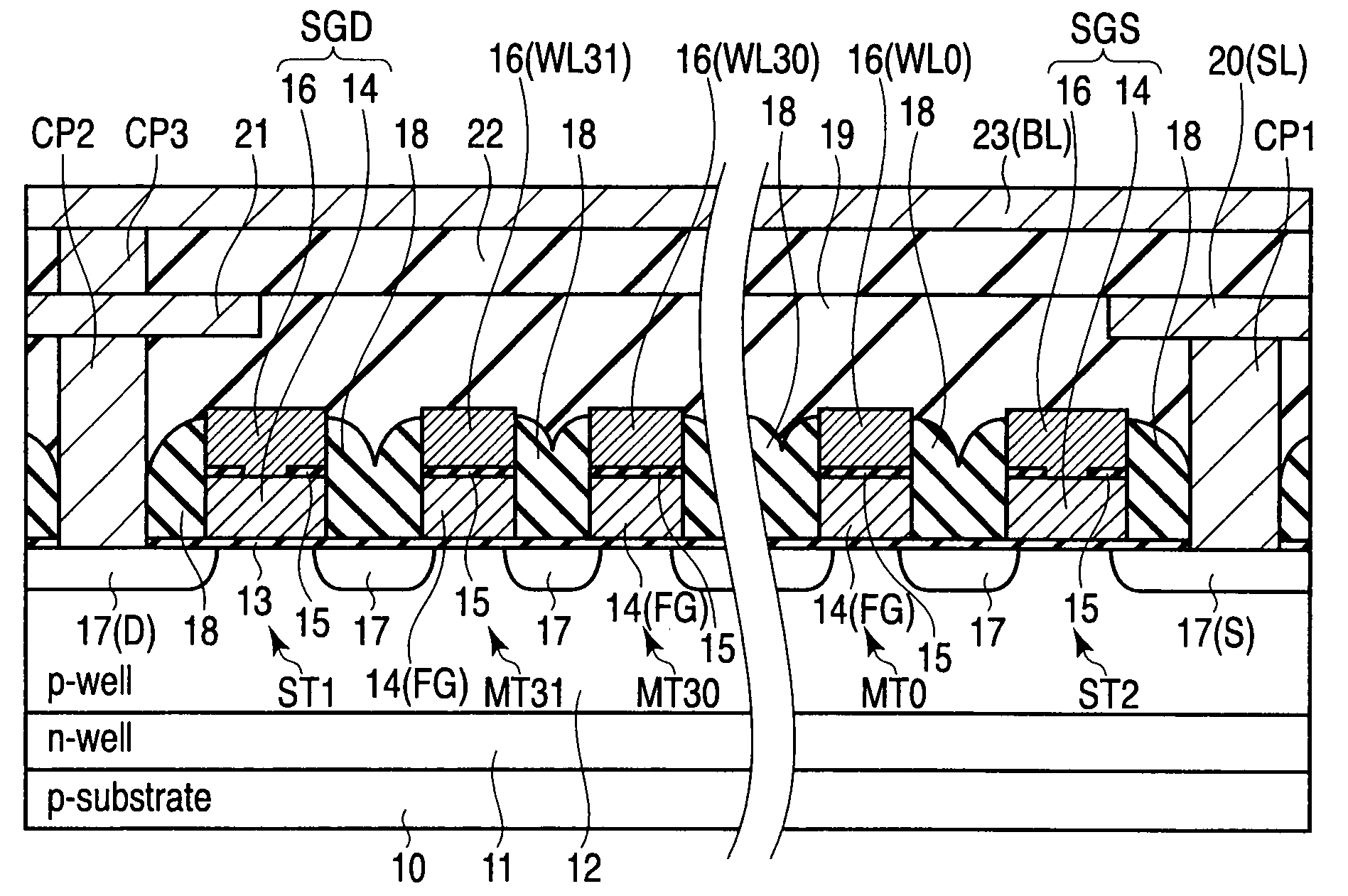
[0051]The memory cell array 2 includes plural memory cell transistors MT, and the data can be retained in each of the memory cell transistors MT. Each of the memory cell transistors MT includes a stacked gate in which a charge accumulation layer and a control gate are stacked. The charge accumulation layer can retain charges. The control gate is formed on the charge accumulation layer. In each memory cell transistor MT, the control gate is connected to a word line WL, a drain is electrically connected to a bit line BL, and a source is electrically connected to a source line SL.
[0052]The row decoder...
second embodiment
[0210]A semiconductor device according to a second embodiment of the invention will be described. In the second embodiment, a three-phase clock is used in the configuration according to the first embodiment. Only the points different from the first embodiment will be described below.
[0211]FIG. 33 is a circuit diagram showing a charge pump circuit 6 of the second embodiment. In FIG. 33, respective broken lines indicate that the MOS transistors TR located therein have the same dimensions, respectively. As shown in FIG. 33, the charge pump circuit 6 of the second embodiment differs from the charge pump circuit 6 according to the first embodiment in the following points. A clock φ3-1 is input into the other electrode of the capacitor element Cj connected to the node Nj (j=1, 4, and 7). A clock φ3-2 is input into the other electrode of the capacitor element C(j+1) connected to the node N(j+1). A clock φ3-3 is input into the other electrode of the capacitor element C(j+2) connected to the...
third embodiment
[0213]A semiconductor device according to a third embodiment of the invention will be described. In the third embodiment, a four-phase clock is used in the configuration according to the first embodiment. Only the points different from the first embodiment will be described below.
[0214]FIG. 35 is a circuit diagram showing a charge pump circuit 6 of the third embodiment. In FIG. 35, respective broken lines indicate that the MOS transistors TR located therein have the same dimensions, respectively. As shown in FIG. 35, the charge pump circuit 6 of the third embodiment differs from the charge pump circuit 6 according to the first embodiment in the following points. A clock φ4-1 is input into the other electrode of the capacitor element Cj connected to the node Nj (j=1 and 5). A clock φ4-2 is input into the other electrode of the capacitor element C(j+1) connected to the node N(j+1). A clock φ4-3 is input into the other electrode of the capacitor element C(j+2) connected to the node N(j...
PUM
 Login to View More
 Abstract
Description
Claims
Application Information
 Login to View More