[0013]According to a different aspect, an object of the present invention is to produce an absorbent article, in particular, although not exclusively, a baby diaper or incontinence diaper, with at least one
elastic component which is easier and more pleasant to wear and which offers increased comfort and increased fit and adaptability to the
body shape of the user.
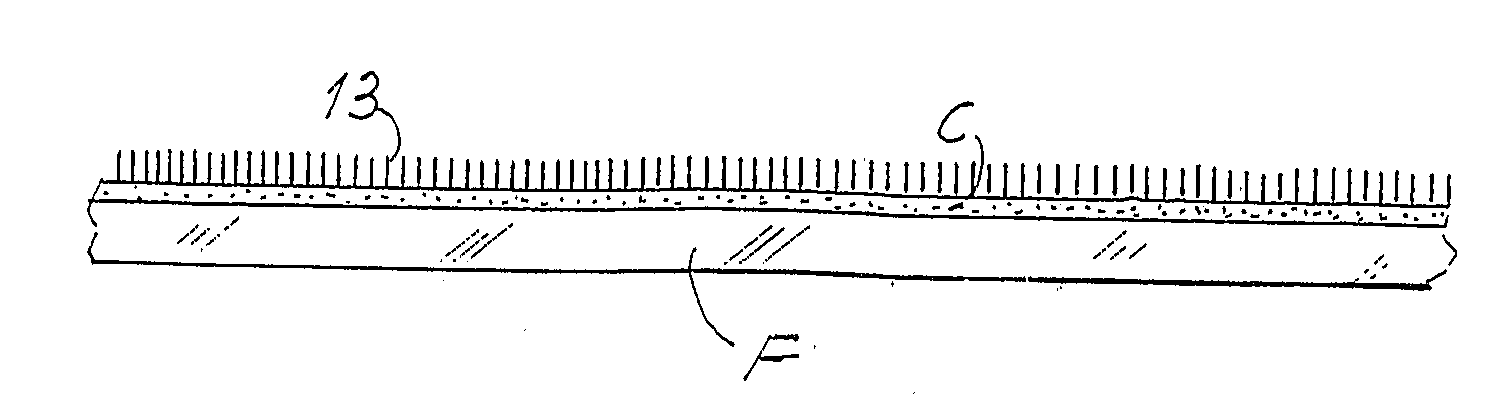
[0016]Therefore, contrary to conventional elastic films, according to the invention the
coating is obtained with very short fibers, which are bonded to the film being positioned orthogonally to the surface of the film. In this way the
fiber does not form an obstruction to elongation of the film, does not break when the film is elongated and does not form wrinkles if the film is elongated and coated with the fibers in conditions of elastic elongation. However, flocking preferably takes place without subjecting the film to pre-stretching.
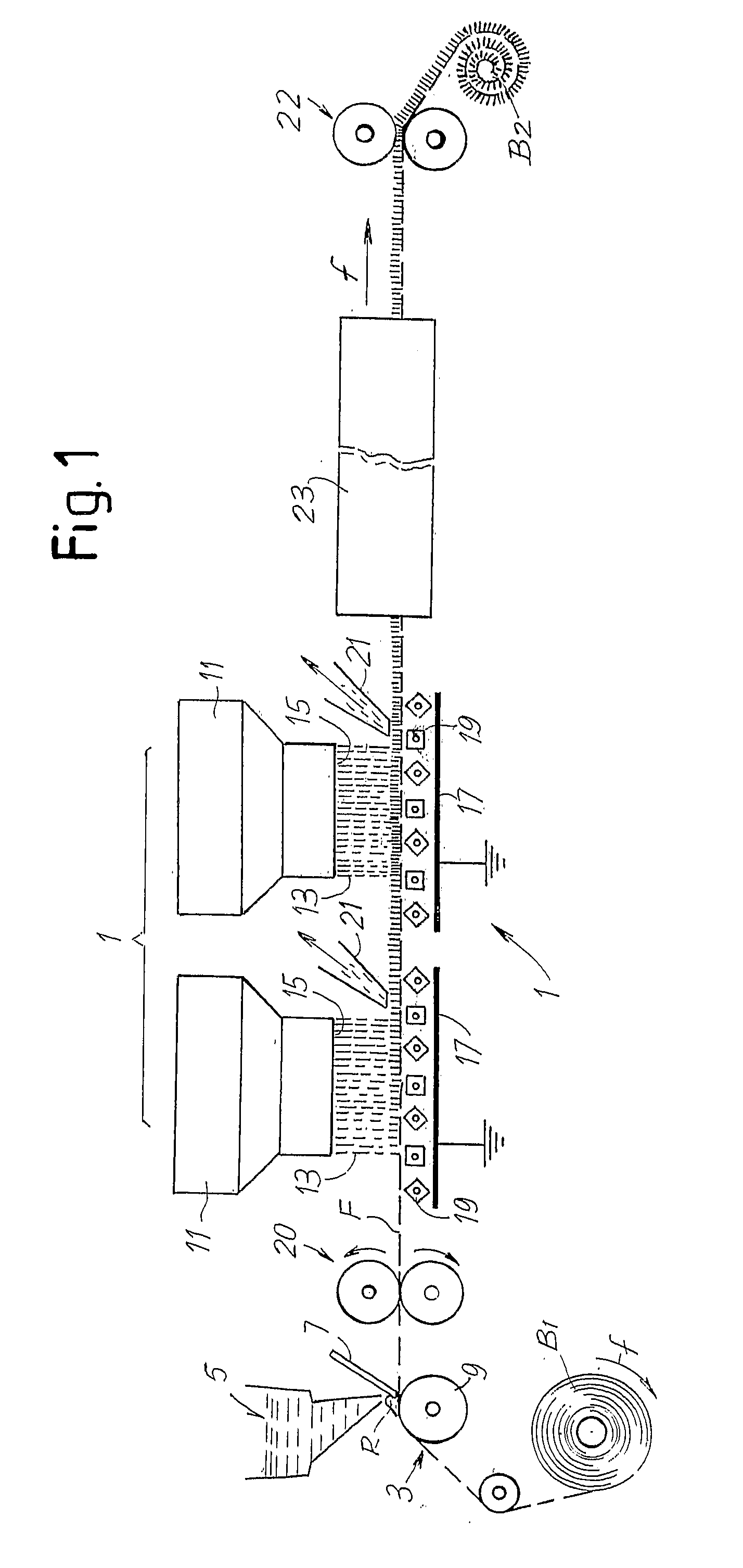
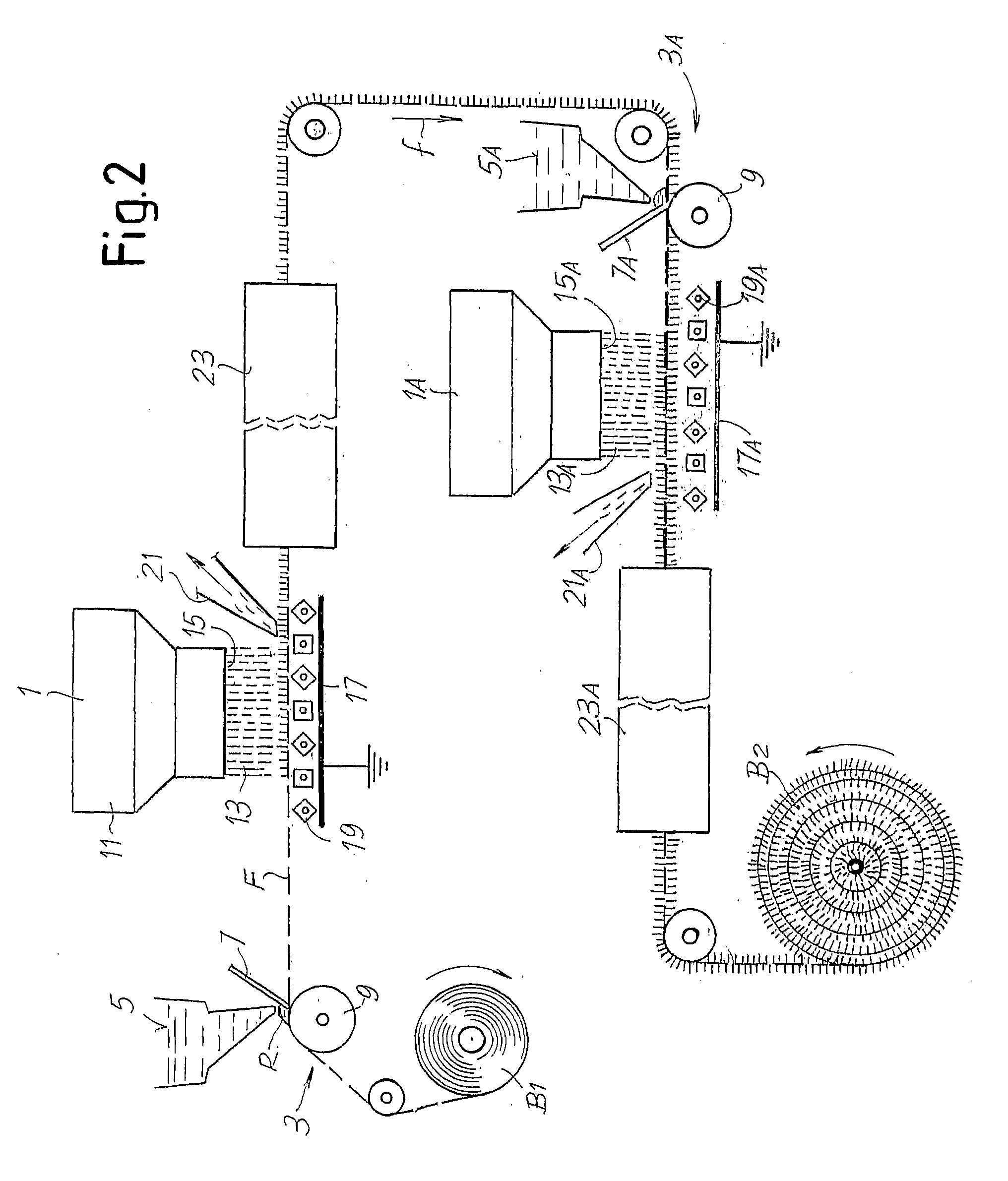
[0017]Advantageously, the fibers are bonded to the film with a bonding material, such as a polymerizable resin or an
adhesive. This material has the property of having an elasticity of its own when dried, cross-linked or polymerized. Alternatively, it is possible to use materials which, once applied to the polymer film, give rise to a discontinuous distribution, typically in the form of a grid, rather than in the form of a continuous layer.
Hot melt adhesives with this property are known and used in the production of absorbent articles. As the
adhesive does not deposit in the form of a continuous film or layer, but is microporous, the fragments of
adhesive form small islands, which can also be in contact with one another, to which the fibers bond. Therefore, stretching of the film in general causes extremely modest deformation of the adhesive /
fiber assembly.
[0018]In this way the bonding layer, whether a resin or an adhesive, follows the elongation of the
composite material and returns to its initial condition, recovering elastic deformation, without forming wrinkles and breaking.
[0019]The bonding material, being applied in a fluid or paste state, has substantially isotropic elastic properties, i.e. equal in all directions. On the other hand, the film to which the fibers are applied by flocking can have properties of elasticity differentiated in the various directions. For example, it can have increased elasticity in
machine direction, i.e. in the direction of feed of the film, than in cross direction. Conversely, and preferably, the film can have properties of elasticity substantially comparable in the two directions, cross and
machine. This simplifies its subsequent use as semi-finished product for the production of finished articles, such as baby diapers, training pants for children or the like.
[0020]Elastic film is intended as a film which, in the
principal direction of elongation or in several principal directions of elongation (e.g. in
machine direction and cross direction) has a capacity of deformation by elongation and subsequent
recovery of the original length adequate for use as a component in garments such as baby diapers or the like. Typically, according to an advantageous embodiment, the elasticity of the
plastic film and of the bonding material of the fibers is such that the
composite material can undergo a fatigue cycle to 80% of elongation, recording a maximum permanent deformation of 20% or less.


 Login to View More
  Login to View More