However, the
digital signal processing techniques now used in many audio receivers has become more capable and thus more complex over time.
The computational complexity required to perform this highly complex
digital signal processing, at any one of a number of varying sample rates, has therefore exploded.
This trend in computational complexity has become compounded by the higher sample rates such as those for
HDMI audio signals, especially if the complex
digital signal processing is to also be carried out at those high sample rates.
As such, the
limiting factor in modern high performance digital audio systems is the processor
cycle count required for this complex processing, considering that the sample rates can be as high as 192 kHz.
However, the input frequency does not always have such a convenient relationship to the
digital signal processing or output frequency.
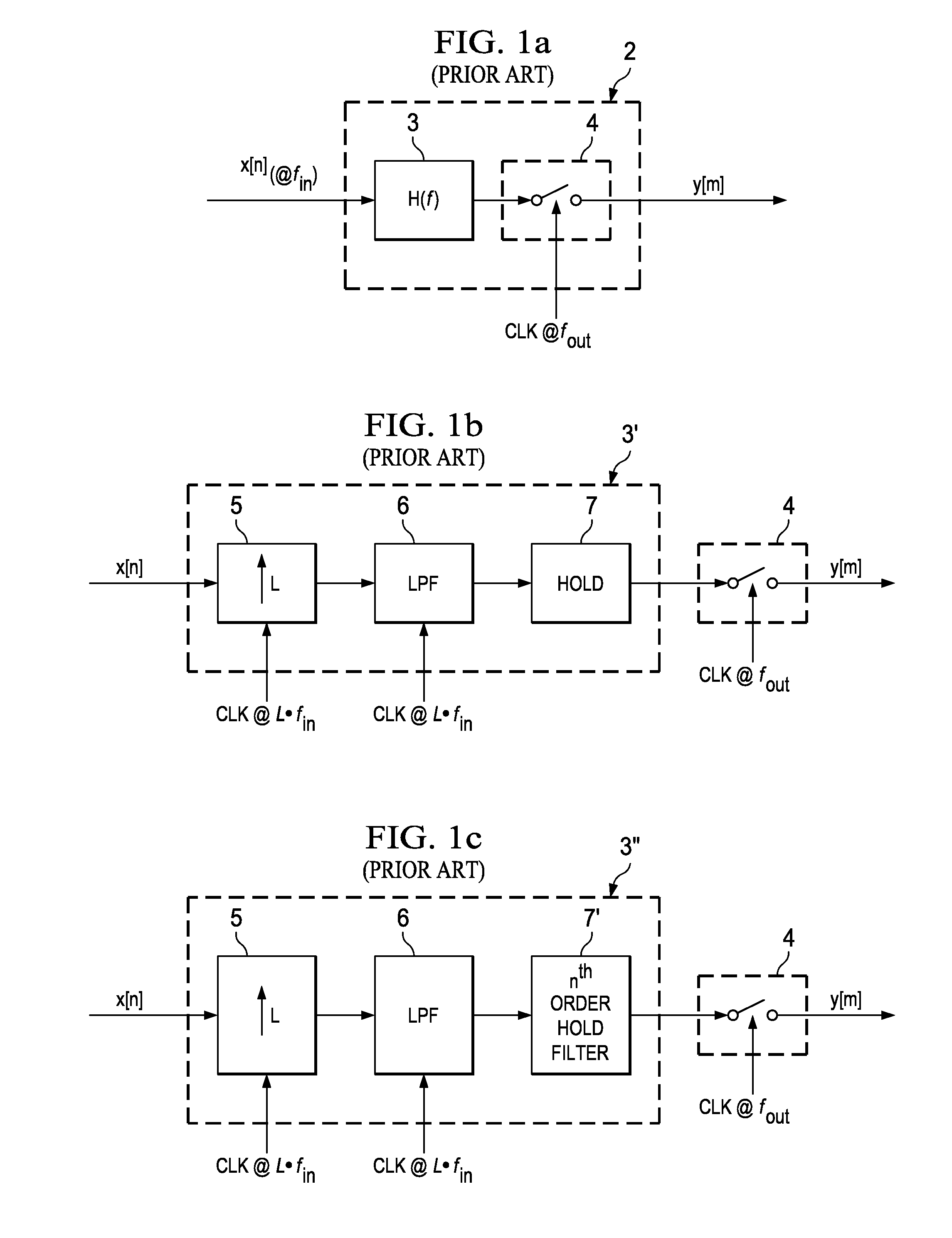
While this conceptual approach is effective in performing asynchronous
sample rate conversion, its direct implementation is not practical, because the filter
transfer function H(f) must necessarily be very sharp.
Of course, such an extremely high sample rate is impractical to realize.
This complexity is, of course, expensive to implement.
Furthermore, the time-domain error, or “
jitter” resulting from the selection of the closest sample, which in effect is “
rounding off” in time, can adversely affect the
system performance.
However, it has been observed, according to this invention, that this conventional arrangement requires substantial computational complexity if the ratio R exceeds unity (i.e. in the downsampling case), primarily because the
cutoff frequency of filter 6, relative to its sample rate of L·fin, must follow the output sample rate fout, which requires its
cutoff frequency to change with changes in the output sample rate.
Not only does the number of taps in the FIR realization increase, but because the sampling rate of this filter increases proportionally with the ratio R, the computational complexity per output sample of the filter itself increases with the square of the increase in the ratio R. In addition, this computational complexity is further increased by the necessity to recalculate filter coefficients with changes in the output sample rate, or to store those coefficient values in memory in advance.
In addition, the
decimation filter of this approach becomes extremely complex if the input sample rate is low relative to the output sample rate (i.e., in the case of strong
upsampling).
This complexity is because the stopbands of the
decimation filter must block those images of the input signal that are at a lower rate than the eventual output sample rate (L·finout).


 Login to View More
  Login to View More