Physical quantity measuring apparatus utilizing optical frequency domain reflectometry, and method for simultaneous measurement of temperature and strain using the apparatus
- Summary
- Abstract
- Description
- Claims
- Application Information
AI Technical Summary
Benefits of technology
Problems solved by technology
Method used
Image

Examples
first embodiment
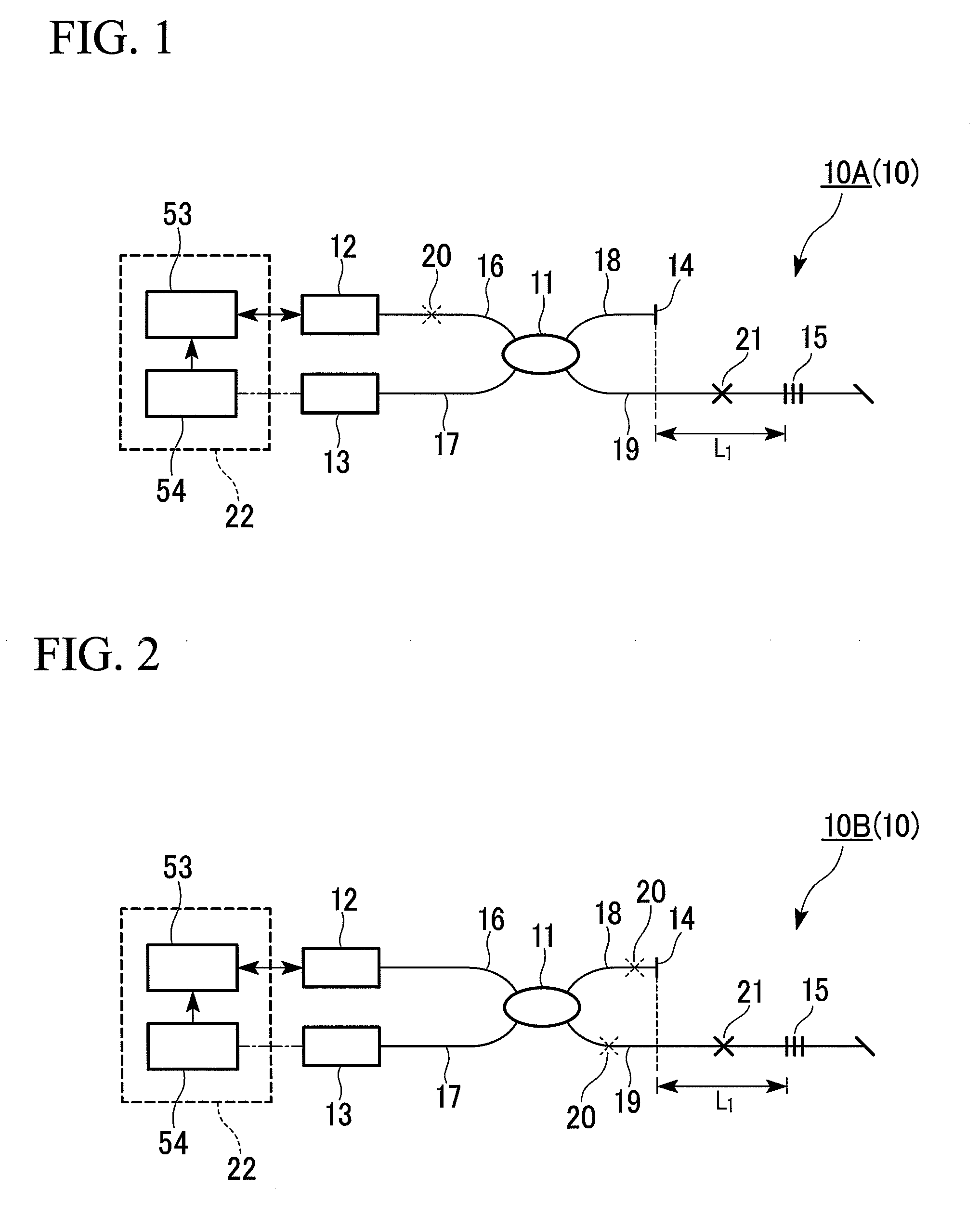
[0069]FIG. 1 is a schematic configuration view showing a first embodiment of a physical quantity measuring apparatus utilizing optical frequency domain reflectometry (hereinafter abbreviated as ‘OFDR’) of the invention.
[0070]A physical quantity measuring apparatus utilizing OFDR 10A (10) of this embodiment broadly includes a tunable laser 12 that emits measuring light; a first polarization-maintaining fiber 16 with one end thereof connected with the tunable laser 12; a polarization-maintaining coupler 11 connected with another end of the first polarization-maintaining fiber 16; a second polarization-maintaining fiber 18 with one end thereof connected with the polarization-maintaining coupler 11 and another end being a referential reflecting end 14; a third polarization-maintaining fiber 19 with one end thereof connected with the polarization-maintaining coupler 11; a sensor 15 consists of a fiber Bragg grating formed at the core of the third polarization-maintaining fiber 19; a four...
second embodiment
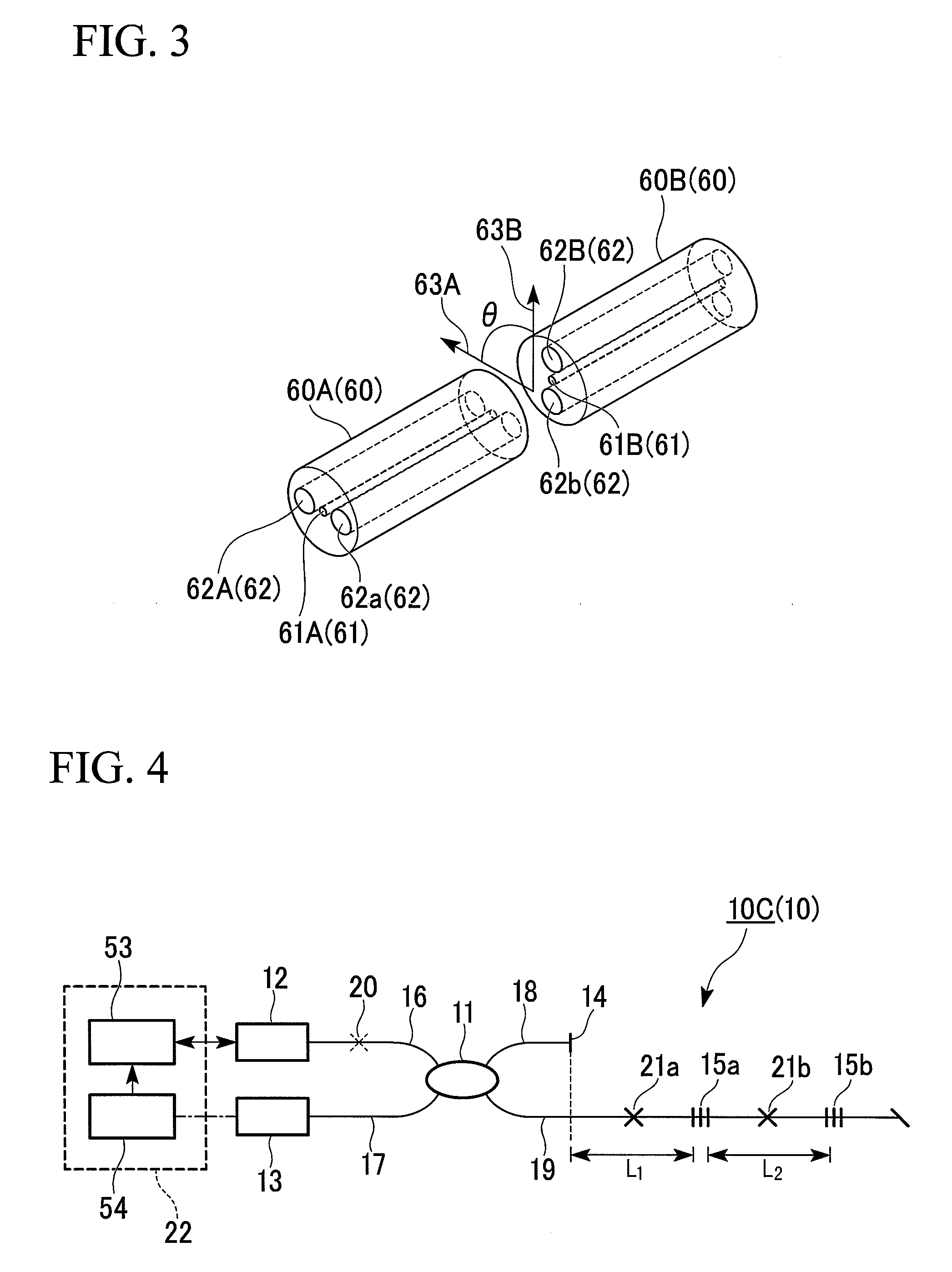
[0104]FIG. 4 is a schematic configuration view showing a second embodiment of the physical quantity measuring apparatus utilizing OFDR of the invention. A physical quantity measuring apparatus utilizing OFDR 10C (10) of this embodiment differs from the first embodiment in that a plurality of sensors 15 (in FIG. 4, two sensors 15a and 15b) are arranged on the third PM fiber 19.
[0105]The physical quantity measuring apparatus utilizing OFDR 10C of this embodiment further includes a second optical path-length adjuster 21b (21), provided midway in the fiber length between adjacent sensors (first sensor 15a and second sensor 15b). Therefore, optical path-lengths of Bragg reflected lights from two orthogonal polarization axes at the first sensor 15a and at the second sensor 15b can be made constant respectively. That is, when an interference signal between Bragg reflected lights from the first sensor 15a and the second sensor 15b, and reflected light from the referential reflecting end, is...
third embodiment
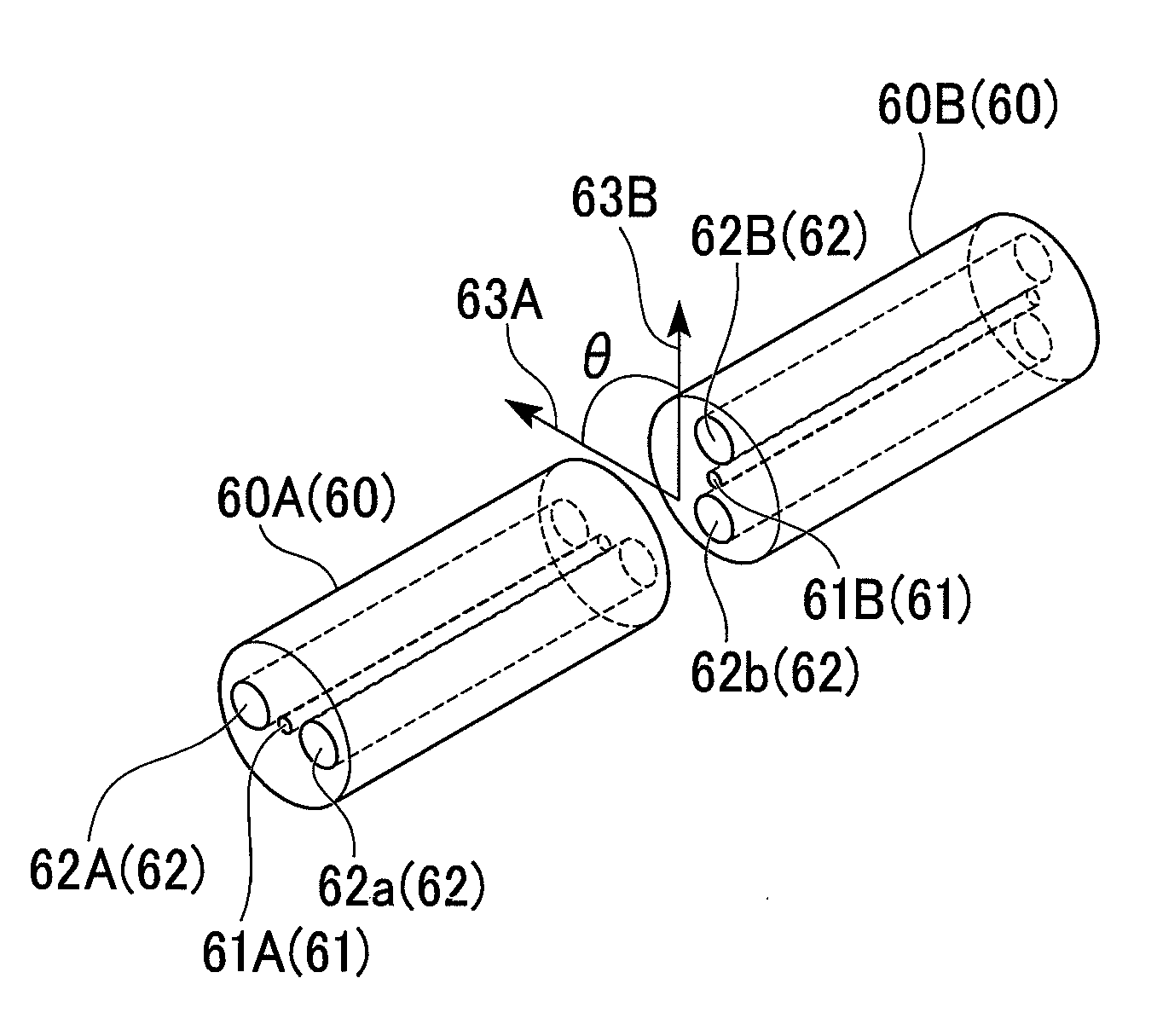
[0107]In the physical quantity measuring apparatus utilizing OFDR 10 according to the first and second embodiments described above, the third PM fiber 19 where the sensors 15 are arranged is preferably consists of a PM fiber with a large difference in the effective refractive indices of the two orthogonal polarization axes (birefringence).
[0108]This increases the difference in sensitivity to temperature and strain in the two orthogonal polarization axes, and enables temperature and strain to be simultaneously measured with high accuracy. More specifically, it is preferable that the difference in the effective refractive indices of the two orthogonal polarization axes is not less than 4.4×10⁻⁴. By satisfying this value, as shown by the results of examples described below, the shift characteristics difference of Bragg wavelength to sensor temperature change can be made greater than −5.0×10⁻⁴ nm / ° C. As a result, remarkably high accuracy measurements of temperature and strain can be ob...
PUM
 Login to View More
 Abstract
Description
Claims
Application Information
 Login to View More
 - R&D
- Intellectual Property
- Life Sciences
- Materials
- Tech Scout
- Unparalleled Data Quality
- Higher Quality Content
- 60% Fewer Hallucinations
Browse by: Latest US Patents, China's latest patents, Technical Efficacy Thesaurus, Application Domain, Technology Topic, Popular Technical Reports.
© 2025 PatSnap. All rights reserved.Legal|Privacy policy|Modern Slavery Act Transparency Statement|Sitemap|About US| Contact US: help@patsnap.com