[0009]The present invention overcomes the problems inherent in the prior art and provides a distinct advance in the state of the art. The present invention provides methods and immunogenic composition(s) for reducing the incidence of and / or severity of enteric disease caused by PCV2, or PCV2 in combination with another enteric disease causing
pathogen. Unless defined otherwise, all technical and scientific terms used herein have the same meanings as commonly understood by one of ordinary skill in the art to which this invention belongs.
[0010]The invention takes
advantage of the unexpected benefit provided by immunogenic compositions against PCV2, wherein enteric diseases and clinical signs or symptoms associated with those diseases are reduced in incidence and / or severity by administration of the PCV2 immunogenic compositions. This benefit is even more unexpected because the PCV2 immunogenic composition can be, and preferably is administered via an injection, yet still provides the beneficial
impact described above. In order to reduce the incidence or severity of enteric disease clinical signs or symptoms, the present invention demonstrates that administering an immunogenic composition against PCV2 or vaccinating against PCV2, preferably prior to PCV2 infection, effectively reduces the incidence of and / or severity of the clinical signs or symptoms of enteric disease. In addition to reducing the incidence of and / or severity of enteric disease clinical signs or symptoms, the incidence and severity of PCV2 is also reduced, thereby contributing to improving the overall health of swine having such
vaccination(s). Furthermore, the incidence of and / or severity of enteric disease clinical signs or symptoms caused by PCV2 in combination with another enteric disease causing
organism are reduced when vaccinating against PCV2. This effect can be increased when the other disease causing
organism is also vaccinated against.
[0011]It was surprisingly found that those animals infected with an enteric
pathogen and PCV2 exhibited a significant increase in clinical symptoms of enteric disease. In
Salmonella / PCV2 infections,
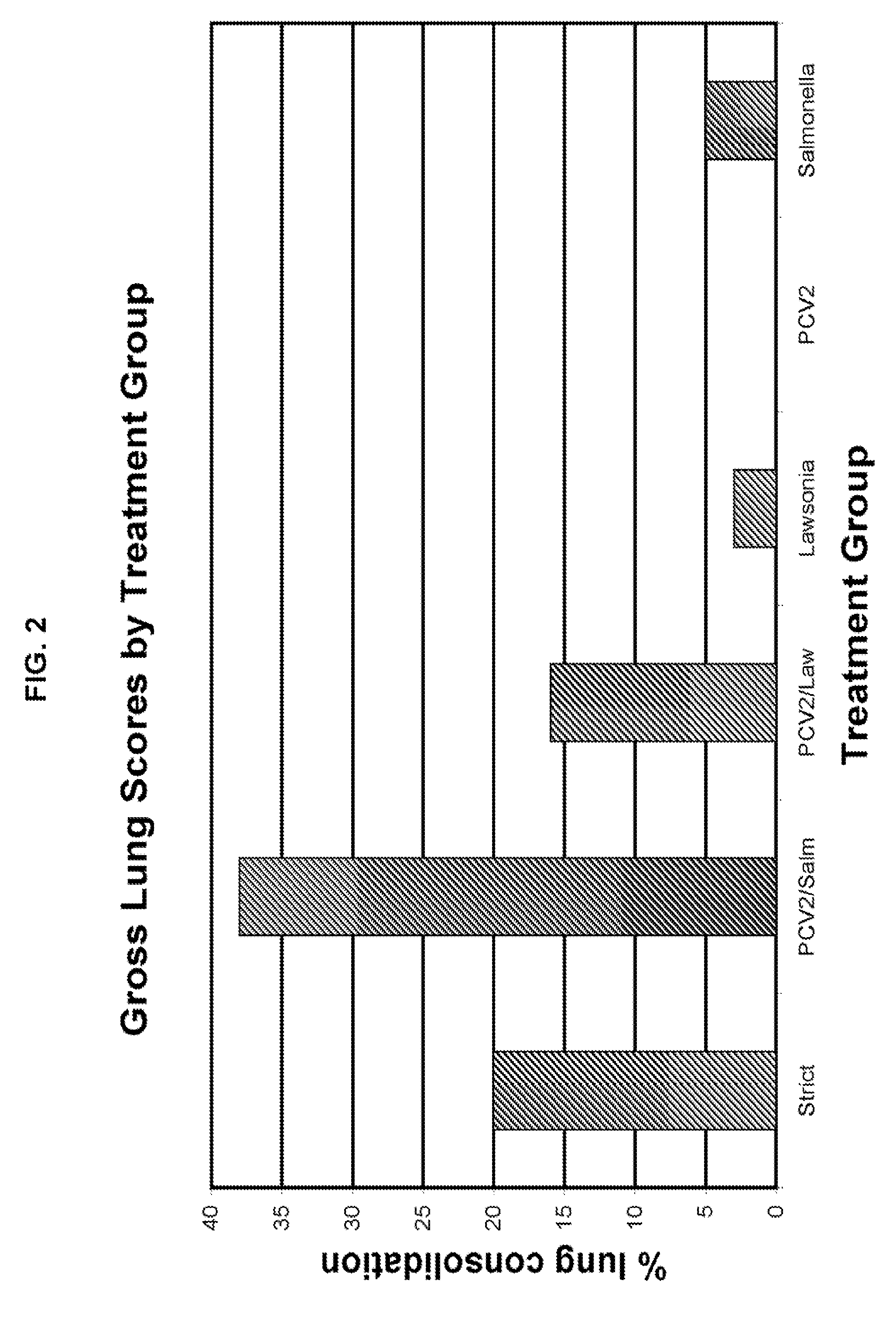
lung lesions were enhanced at least 33% in comparison to those animals infected with
Salmonella alone.
Lung lesions were enhanced at least 13% in animals infected with Lawsonia / PCV2 compared to those infected with Lawsonia alone.
[0035]An “immunological or immune response” to a composition or vaccine is the development in the host of a cellular and / or
antibody-mediated immune response to the composition or vaccine of interest. Usually, an “immune response” includes but is not limited to one or more of the following effects: the production or activation of antibodies, B cells,
helper T cells,
suppressor T cells, and / or cytotoxic T cells and / or yd T cells, directed specifically to an
antigen or antigens included in the composition or vaccine of interest. Preferably, the host will display either a therapeutic or protective immunological response such that resistance to new infection will be enhanced and / or the clinical severity of the disease reduced. Such protection will be demonstrated by either a reduction in number or severity of, or lack of one or more of the symptoms associated with PCV2 infections as described above.
[0038]In a preferred embodiment of the present invention, an immunogenic composition that induces an immune response and, more preferably, confers
protective immunity against the clinical signs of enteric disease, is provided.
[0051]In yet another aspect of the present invention, a method of reducing the incidence of or lessening the severity of enteric disease is provided. Generally the method comprises the step of administering an effective amount of a PCV2 antigen to an animal, preferably a swine. Preferably, the administration is intradermal, intratracheal, intravaginal, intramuscular, intranasal, intravenous, intravascular, intraarterial, intraperitoneal, oral,
intrathecal, subcutaneous, intracutaneous, intracardial, intralobal, intramedullar, or intrapulmonar. Preferably, the antigen comprises PCV2 ORF2, and more preferably Circoflex. Even more preferably, the administration occurs before
exposure to or infection by PCV2. In some preferred forms, an effective amount of a second non-PCV2 antigen is also administered to the animal, although such administration does not have to be concurrent with the administration of the PCV2 antigen. Preferably, this other antigen is associated with enteric disease.



 Login to View More