
Method for removing phosphorus
- Summary
- Abstract
- Description
- Claims
- Application Information
AI Technical Summary
Benefits of technology
Problems solved by technology
Method used
Image

Examples
example 1
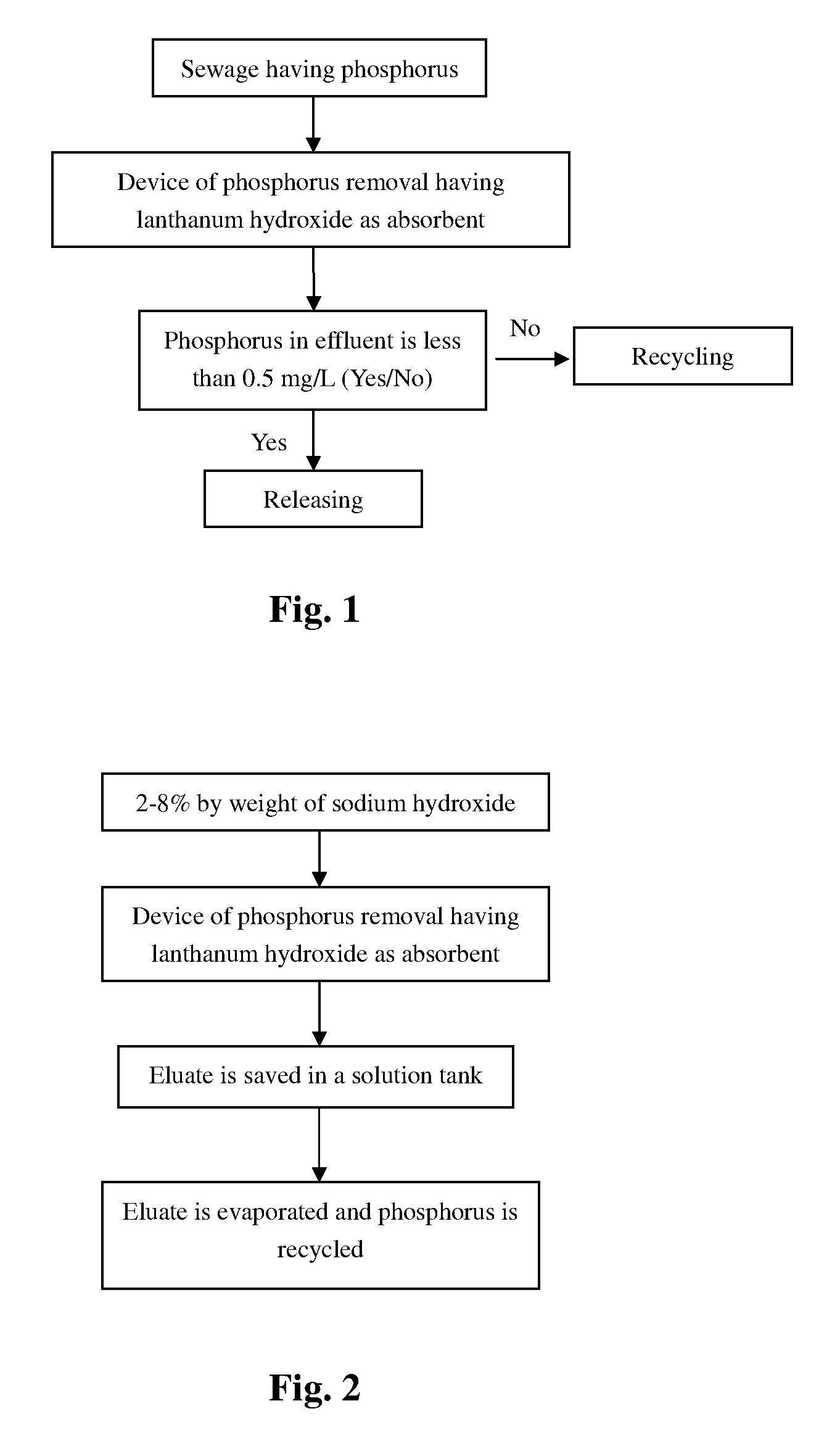
[0039]After treated with biological method, water quality of effluent from a sewage treatment plant was as follows: phosphorus, between 0.6 and 1.5 mg / L; SS, between 3.5 and 20.5 mg / L. According to one embodiment of the invention, a method for removing phosphorus is described as below:
[0040]1) After large suspended particles were removed by pretreatment, sewage having phosphorus flowed through a device for removing phosphorus from the bottom up. The device was an absorption column, at the bottom of which quartz sands were disposed, and lanthanum hydroxide as an absorbent was disposed on the quartz sands.
[0041]2) During the course of flowing through the device for removing phosphorus, phosphorus in the sewage was adhered to and fixed on the surface of lanthanum hydroxide.
[0042]3) The retention time of the sewage in the device was 5 min, and if the phosphorus content of the effluent was less than 0.5 mg / L, the effluent was allowed to enter a clean water tank.
[0043]4) When the phosphor...
example 2
[0046]After treated with biological method, water quality of effluent from a sewage treatment plant was as follows: phosphorus, 3 mg / L; SS, between 3.5 and 20.5 mg / L. According to one embodiment of the invention, a method for removing further phosphorus is described as below:
[0047]1) After large suspended particles were removed by pretreatment, sewage having phosphorus flowed through a device for removing phosphorus from the bottom up. The device was an absorption tank, at the bottom of which quartz sands were disposed, and lanthanum hydroxide as an absorbent was disposed on the quartz sands.
[0048]2) During the course of flowing through the device for removing phosphorus, phosphorus in the sewage was adhered to and fixed on the surface of lanthanum hydroxide.
[0049]3) The retention time of the sewage in the device was 10 min, and if the phosphorus content of the effluent was less than 0.5 mg / L, the effluent was allowed to enter a clean water tank.
[0050]4) When the phosphorus content ...
example 3
[0053]Water quality of sewage was as follows: phosphorus, 5 mg / L; SS, between 3.5 and 20.5 mg / L. According to one embodiment of the invention, a method for removing further phosphorus is described as below:
[0054]1) After large suspended particles were removed by pretreatment, sewage having phosphorus flowed through a device for removing phosphorus from the bottom up. The device was an absorption tank, at the bottom of which quartz sands were disposed, and lanthanum hydroxide as an absorbent was disposed on the quartz sands.
[0055]2) During the course of flowing through the device for removing phosphorus, phosphorus in the sewage was adhered to and fixed on the surface of lanthanum hydroxide.
[0056]3) The retention time of the sewage in the device was 20 min, and if the phosphorus content of the effluent was less than 0.5 mg / L, the effluent was allowed to enter a clean water tank.
[0057]4) When the phosphorus content of the effluent was more than 0.5 mg / L, which meant lanthanum hydroxid...
PUM
| Property | Measurement | Unit |
|---|---|---|
| Time | aaaaa | aaaaa |
| Time | aaaaa | aaaaa |
| Time | aaaaa | aaaaa |
Abstract
Description
Claims
Application Information
 Login to View More