
Hybrid referenceless and multibaseline prf-shift magnetic resonance thermometry
a magnetic resonance and multi-baseline technology, applied in the field of magnetic resonance thermometry, can solve the problems of inaccurate temperature estimates, sensitive to rapid anatomical phase variations, and erroneous baseline phase subtraction
- Summary
- Abstract
- Description
- Claims
- Application Information
AI Technical Summary
Benefits of technology
Problems solved by technology
Method used
Image

Examples
Embodiment Construction
1. MRI System and PRF Thermometry
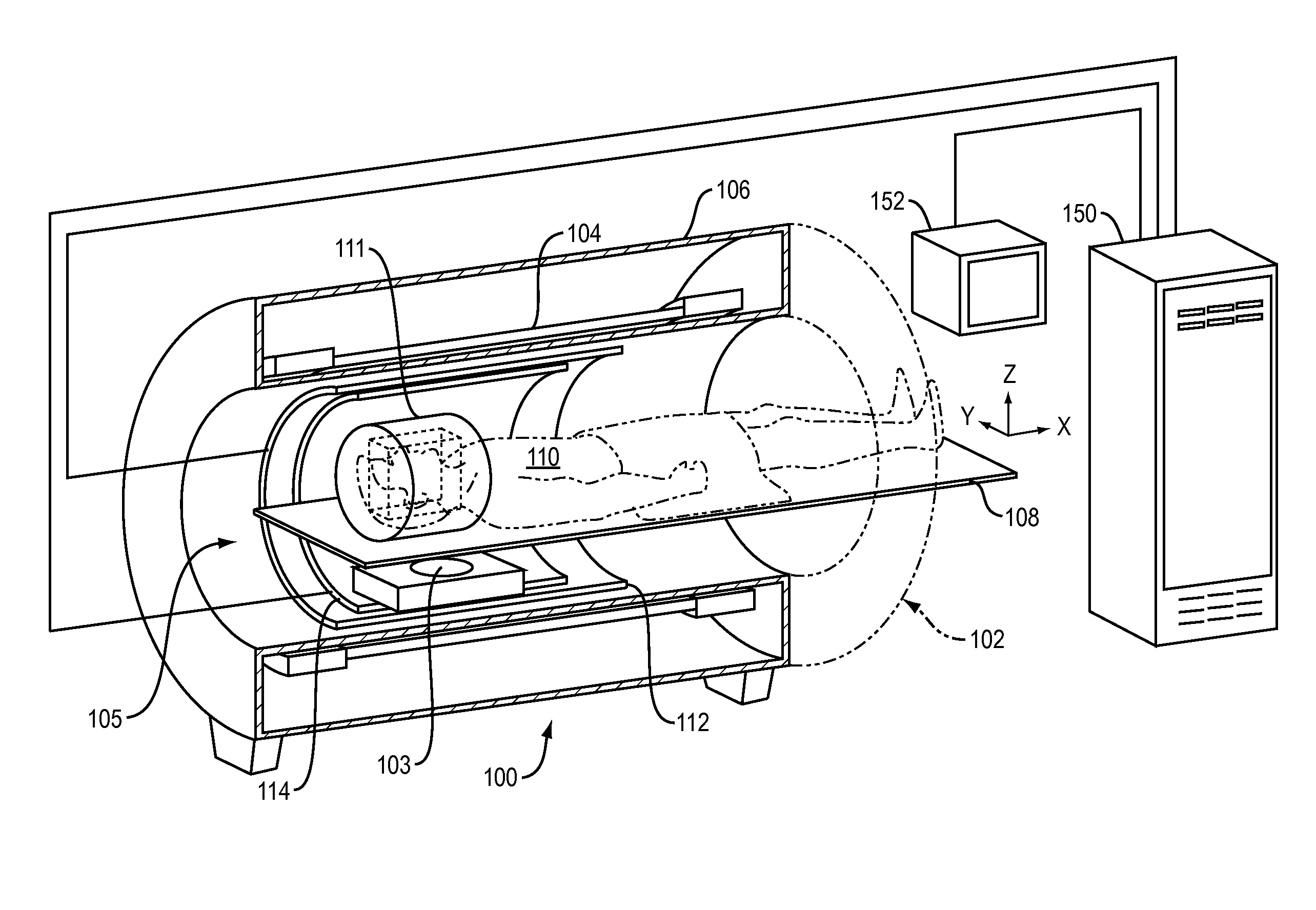
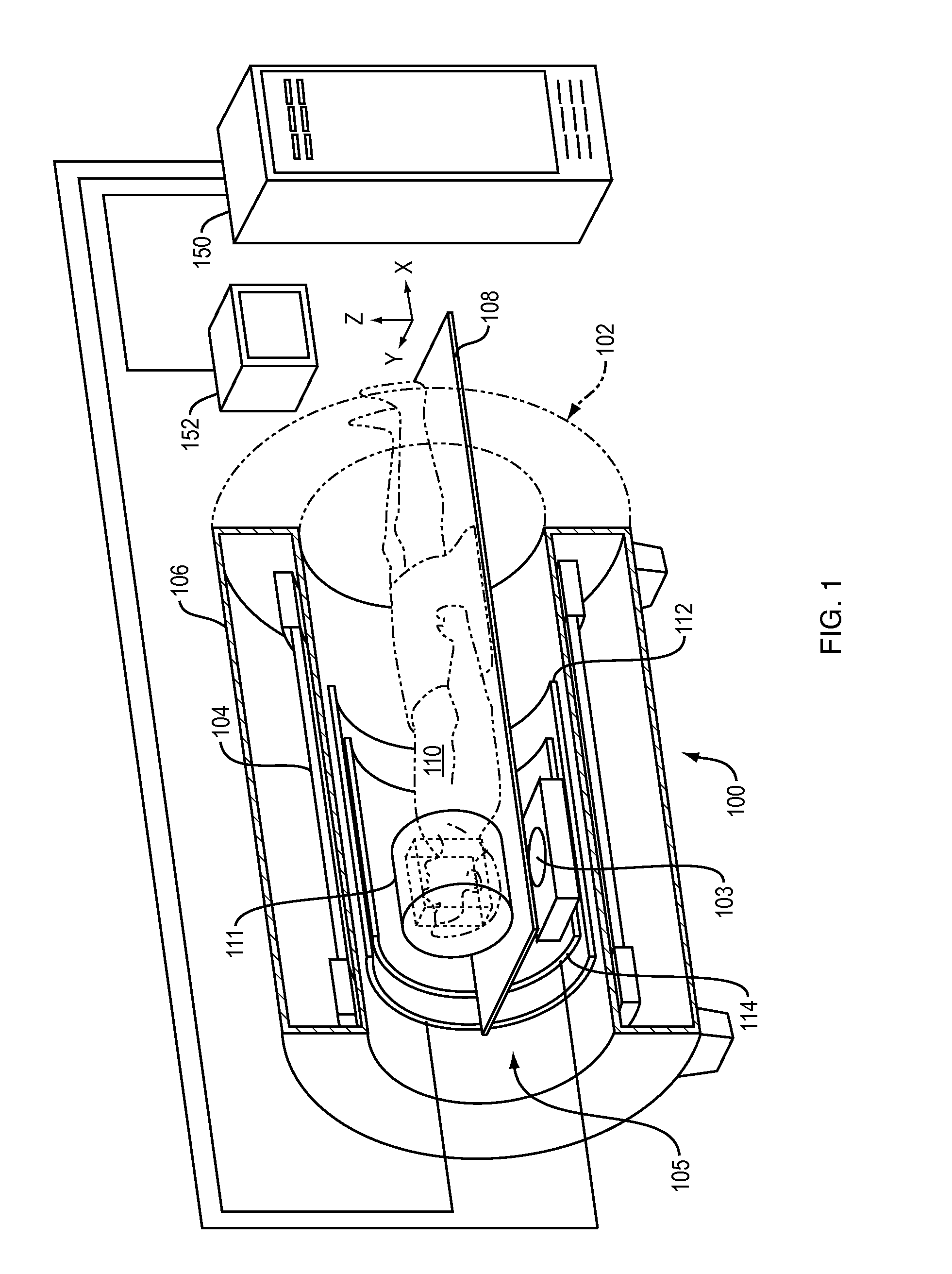
[0032]MRI systems in which the techniques described herein may be implemented are well-known in the art; an exemplary system is shown in FIG. 1. The illustrated system 100 comprises an MRI machine 102 and, when an MR-guided thermal procedure is being performed, a thermal therapy device 103 that may be disposed within the bore of the MRI machine 102. The thermal therapy device 103 may be, for example, an ultrasound transducer, an RF or microwave ablation device, a laser, or any other device adapted to heat a target tissue, and may be configured either for placement outside the patient or for insertion into the patient's body. The MRI machine 102 typically comprises a cylindrical electromagnet 104, which generates a static magnetic field within a bore 105 of the electromagnet 104. The electromagnet 104 may be enclosed in a magnet housing 106. A support table 108, upon which a patient 110 lies during treatment, is disposed within the magnet bore 105. Th...
PUM
 Login to View More
 Abstract
Description
Claims
Application Information
 Login to View More