
Virulent oncolytic herpes simplex virus strains engineered to counter the innate host response
a technology of oncolytic and modified herpes simplex, which is applied in the direction of dsdna viruses, immunological disorders, antibody medical ingredients, etc., can solve the problems of inability to propagate a productive infection through surrounding normal, terminally differentiated tissue, and severe limitation of the function of viral genes to shield the virus, so as to inhibit the host-acquired immune response and maintain the effect of anti-interference function
- Summary
- Abstract
- Description
- Claims
- Application Information
AI Technical Summary
Benefits of technology
Problems solved by technology
Method used
Image

Examples
example 1
Determination of Us11 as an Interferon Resistance Gene
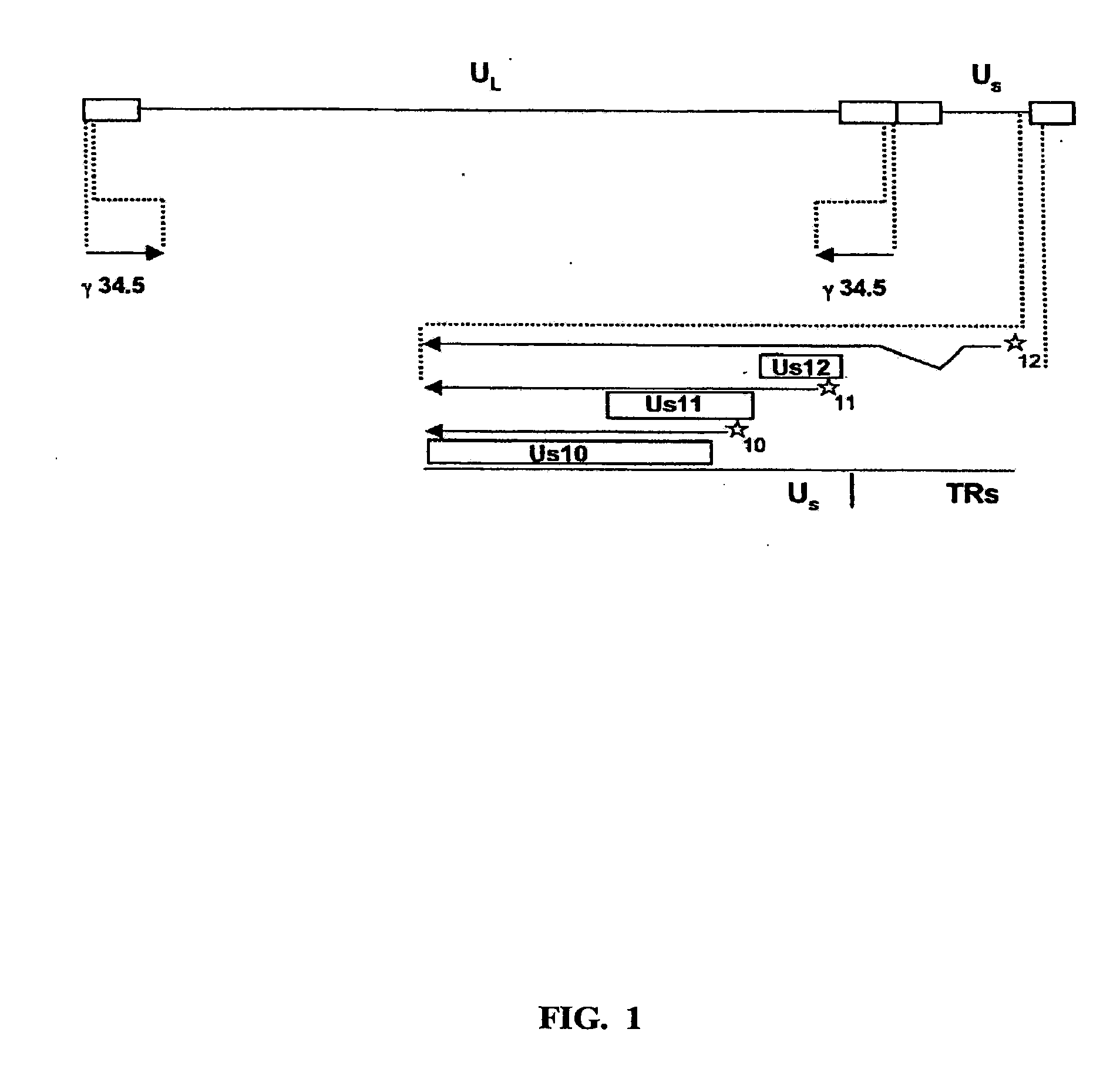
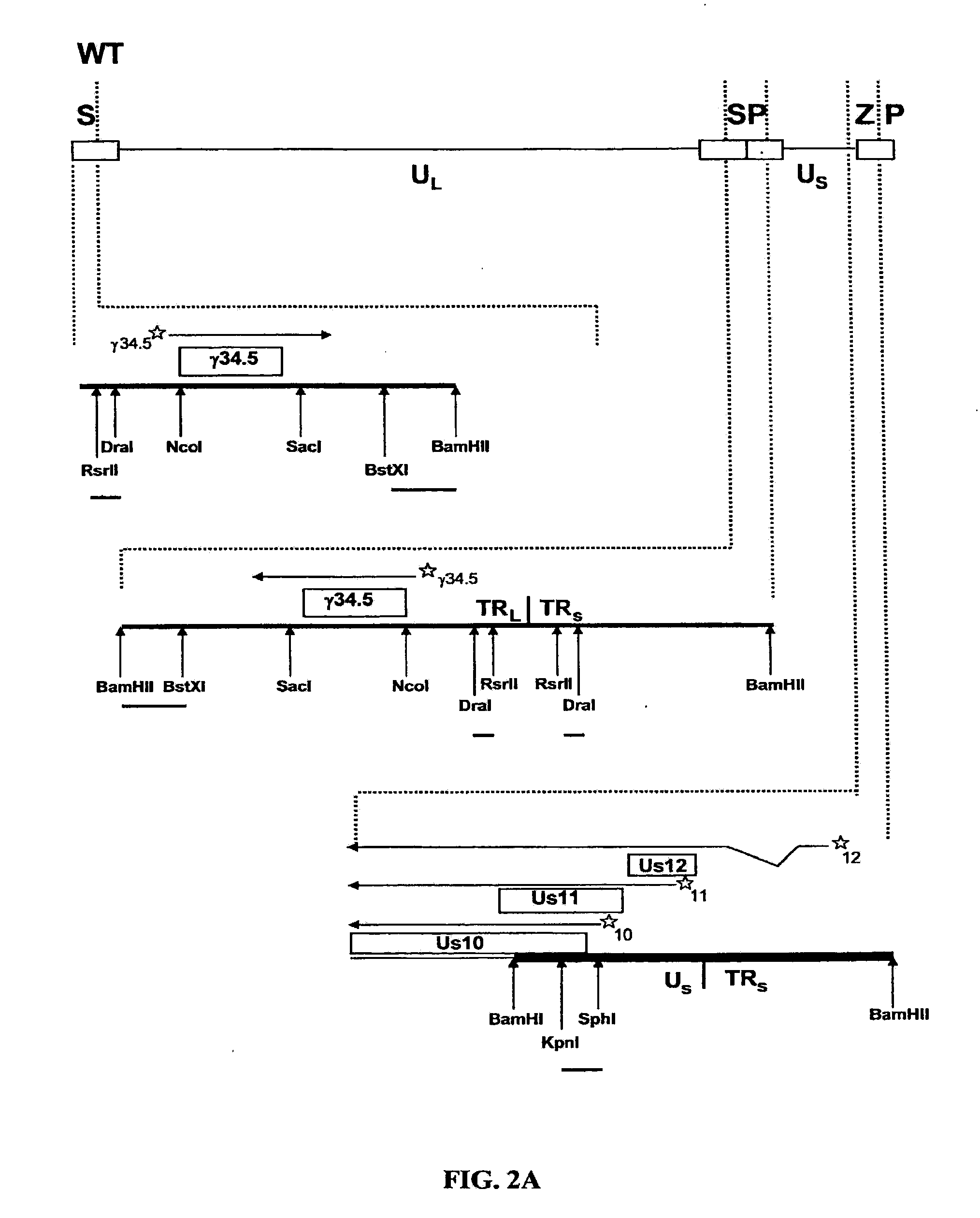
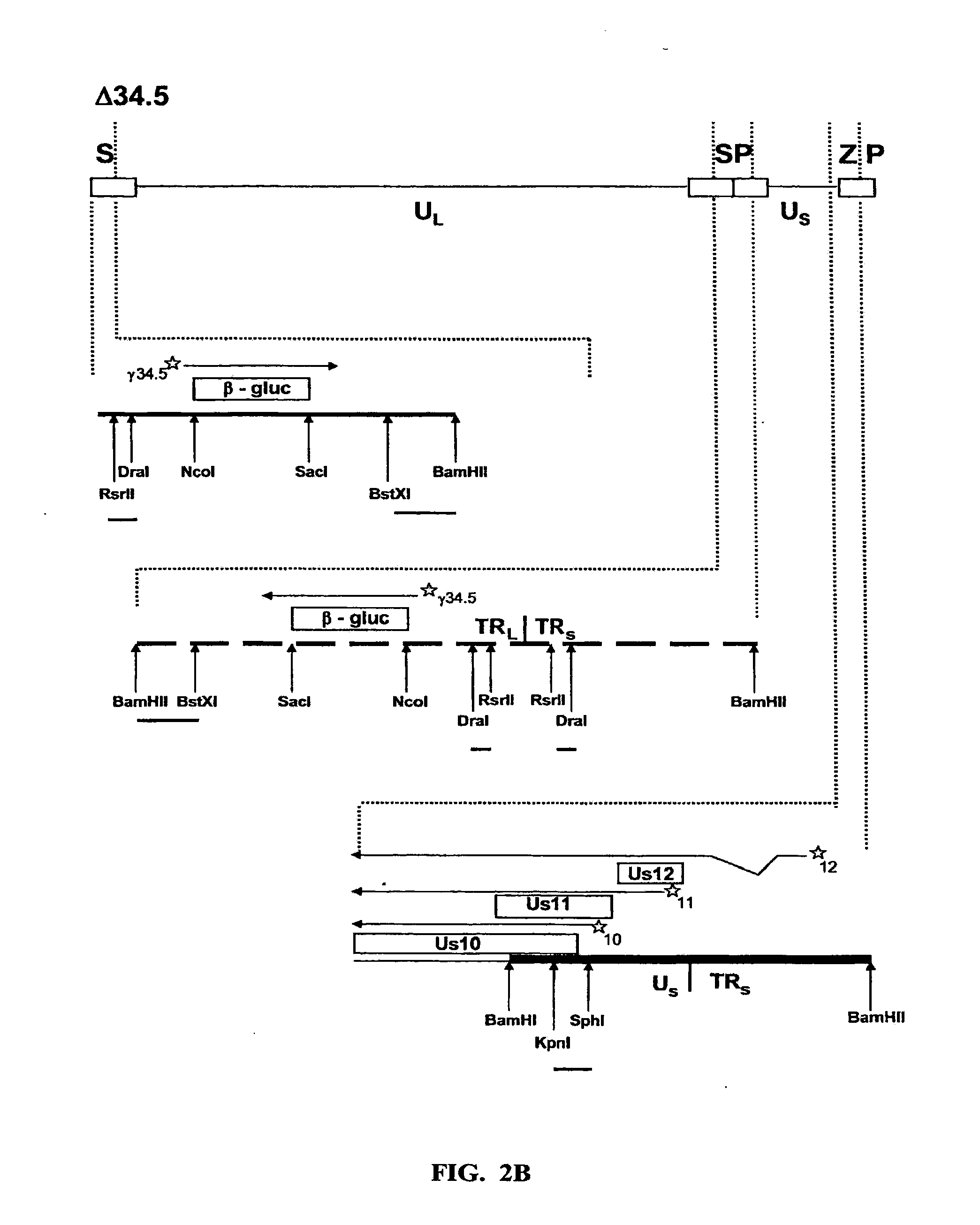
[0051]To ascertain the importance of the Us11 gene product in the ability of HSV-1 to replicate in IFNα treated cells, a panel of previously constructed mutant herpes simplex viruses were employed (Mulvey et al., “Regulation of eIF2α Phosphorylation By Different Functions That Act During Discrete Phases In The HSV-1 Lifecycle,”J Virol 77:10917-10928 (2003), which is hereby incorporated by reference in its entirety). The wild-type HSV-1 genome, shown as a line diagram in FIG. 1, is 152 Kb in length and is composed of a unique long segment (UL), a unique short segment (Us), shown as solid lines, and inverted terminal repeat (TR) regions, shown as open rectangles, that flank the Us and UL components. Dotted lines indicate an expanded view of a region. The location and orientation of both copies of the γ134.5 virulence gene are indicated. The γ134.5 gene is contained within the repetitive components that flank the UL segment, thus, t...
example 2
IE Expression of Us11 in Absence of the γ134.5 Gene Product Supports Viral Replication in IFN α-Treated Cells
[0057]Prior to evaluating the impact of IFNα treatment on the replication of the mutant viruses in primary FS4 cells, it was observed that commonly used concentrations of IFNα (1000 U / ml) completely inhibited replication of WT HSV-1 in the FS4 cell strain, despite the synthesis of large quantities of viral proteins. Similar findings were reported previously by others working with different strains of fibroblasts and HSV-1. It was noted that treatment with recombinant IFNα or β blocks virus morphogenesis at a late stage and inhibits the release of particles (Chatterjee et al., “Effect of Cloned Human Interferons on Protein Synthesis and Morphogenesis of Herpes Simplex Virus,”J Virol 56:419-425 (1985), which is hereby incorporated by reference in its entirety). To overcome this obstacle, an IFNα concentration (250 U / ml) was first identified that allowed for the completion of th...
example 3
Evaluation of Anti-Tumor Activity of U11-IE Mutant
[0059]To evaluate the ability of the early expressing Us11 mutant to reduce the growth of tumors in vivo, s.c. xenografts of human PC3 prostate carcinoma cells were established in immunocompromised (nude) mice (Taneja et al., “Enhanced Antitumor Efficacy of a Herpes Simplex Virus Mutant Isolated by Genetic Selection in Cancer Cells,”Proc Natl Acad Sci USA 98:8804-8808 (2001), which is hereby incorporated by reference in its entirety). Once the implanted tumors reached ≈50 mm3 in volume, they were challenged by a single injection (2×10⁶ pfu) of either the Δ34.5 virus, the Δ34.5-(IE)Us11 suppressor mutant, or a virus-free lysate prepared from mock infected cells. FIG. 6 shows that Δ34.5 was not effective in reducing the growth of the xenograft (P>0.5 for Δ34.5 vs. mock at 2×10⁶ pfu). The Δ34.5-(IE)Us11 suppressor mutant however, was significantly more effective in inhibiting the growth of PC3 xenografts at this dose than was the Δ34.5 ...
PUM
 Login to View More
 Abstract
Description
Claims
Application Information
 Login to View More