Inhibitor of casein kinase 1delta and casein kinase 1epsilon
Active Publication Date: 2011-12-01
NB HEALTH LAB
View PDF5 Cites 2 Cited by
Summary
Abstract
Description
Claims
Application Information
AI Technical Summary
This helps you quickly interpret patents by identifying the three key elements:
Problems solved by technology
Method used
Benefits of technology
Benefits of technology
[0051]The compound of the present invention can inhibit the activities of casein kinase 1δ and casein kinase 1ε. As a result, the present compound can treat diseases, with the pathological conditions of which the activation mechanism of the casein kinase 1δ or casein kinase 1ε is associated.
[0052]The compound of the present invention and the pharmaceutical agent of the present invention comprising the aforementioned compound as a pharmaceutically active ingredient can be used to treat diseases, with the pathological conditions of which the activation mechanism of the casein kinase 1δ or casein kinase 1ε is associated.
[0053]The compound of the present invention and the pharmaceutical agent of the present invention comprising the aforementioned compound as a pharmaceutically active ingredient have higher selectivity to the casein kinase 1δ and casein kinase 1ε than those of conventional compounds having casein kinase 1 inhibitory activity. As a result, the compound of the present invention and the pharmaceutical agent of the present invention comprising the aforementioned compound as a pharmaceutically active ingredient can be anticipated to have higher clinical efficiency than that of existing compounds, on diseases, with the pathological conditions the activation mechanism of casein kinase 1δ or casein kinase 1ε is associated. At the same time, the compound of the present invention and the pharmaceutical agent of the present invention comprising the aforementioned compound as a pharmaceutically active ingredient can be anticipated to have higher safety than that of existing compounds.
Problems solved by technology
Almost no pharmaceutical agents for directly treating circadian rhythm disorder have been known in prior art techniques.
On the other hand, the development of drugs for improving circadian rhythmsleep disorder (shift work sleep disorder, jet lag syndrome, advanced sleep phase syndrome, and delayed sleep phase syndrome) and the like has not yet been completed.
Also, drug therapy, which is based on the technique of shifting or resetting the phase of circadian rhythm for other sleep disorders (insomnia, sleep-related breathing disorder, central hypersomnia, parasomnia, and sleep-related movement disorder), has not yet been completed.
Also, it has been well known that excessive phosphorylation of this tau protein is deeply associated with aggregation.
In prior art techniques, there have been known almost no pharmaceutical agents for treating central neurodegenerative diseases including Alzheimer's disease, which involve, as a point of action, direct inhibition of the aggregation of a tau protein or amyloid β. In addition, in prior art techniques, drug therapy for impeding the progression of central neurodegenerative diseases based on the concerned mechanism has not yet been completed.
Moreover, in prior art techniques, drug therapy for treating refractorypancreatic cancer based on the concerned mechanism has not yet been completed.
Method used
the structure of the environmentally friendly knitted fabric provided by the present invention; figure 2 Flow chart of the yarn wrapping machine for environmentally friendly knitted fabrics and storage devices; image 3 Is the parameter map of the yarn covering machine
View more
Image
Smart Image Click on the blue labels to locate them in the text.
Viewing Examples
Smart Image
Click on the blue label to locate the original text in one second.
Reading with bidirectional positioning of images and text.
[0131]To a screw-capped test tube, N-[(5-methyl-2-thienyl)carbonyl]glycine (60 mg, 0.3 mmol), 5-methoxy-3-pyridinecarboxaldehyde (45 mg, 0.3 mmol), sodium acetate (25 mg, 0.3 mmol) and acetic anhydride (0.3 mL) were added. The test tube was sealed, and it was then stirred at an external temperature of 90° C. Three hours later, the temperature of the reaction solution was returned to room temperature, and water (1.5 mL) was then added thereto. The obtained mixture was stirred at the same temperature as described above for 1.5 hours. Thereafter, the precipitated crystal was collected by filtration, and it was washed with water (5 mL) and was then dried under reduced pressure, so as to obtain 51 mg of the above-captioned compound.
[0136]To a screw-capped test tube, N-(2-thienylcarbonyl)glycine (56 mg, 0.3 mmol), 5-methoxy-3-pyridinecarboxaldehyde (45 mg, 0.3 mmol), sodium acetate (25 mg, 0.3 mmol) and acetic anhydride (0.3 mL) were added. The test tube was sealed, and it was then stirred at an external temperature of 90° C. Three hours later, the temperature of the reaction solution was returned to room temperature, and water (1.5 mL) was then added thereto. The obtained mixture was stirred at the same temperature as described above for 1.5 hours. Thereafter, the precipitated crystal was collected by filtration, and it was washed with water (5 mL) and was then dried under reduced pressure, so as to obtain 40 mg of the above-captioned compound.
[0141]To a screw-capped test tube, N-(2-thienylcarbonyl)glycine (56 mg, 0.3 mmol), 5-fluoro-3-pyridinecarboxaldehyde (41 mg, 0.3 mmol), sodium acetate (25 mg, 0.3 mmol) and acetic anhydride (0.3 mL) were added. The test tube was sealed, and it was then stirred at an external temperature of 90° C. Three hours later, the temperature of the reaction solution was returned to room temperature, and water (1.5 mL) was then added thereto. The obtained mixture was stirred at the same temperature as described above for 1.5 hours. Thereafter, the precipitated crystal was collected by filtration, and it was washed with water (5 mL) and was then dried under reduced pressure, so as to obtain 56 mg of the above-captioned compound.
the structure of the environmentally friendly knitted fabric provided by the present invention; figure 2 Flow chart of the yarn wrapping machine for environmentally friendly knitted fabrics and storage devices; image 3 Is the parameter map of the yarn covering machine
Login to View More
PUM
Property
Measurement
Unit
Fraction
aaaaa
aaaaa
Fraction
aaaaa
aaaaa
Inhibition
aaaaa
aaaaa
Login to View More
Abstract
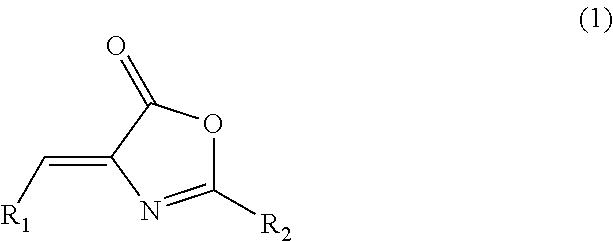
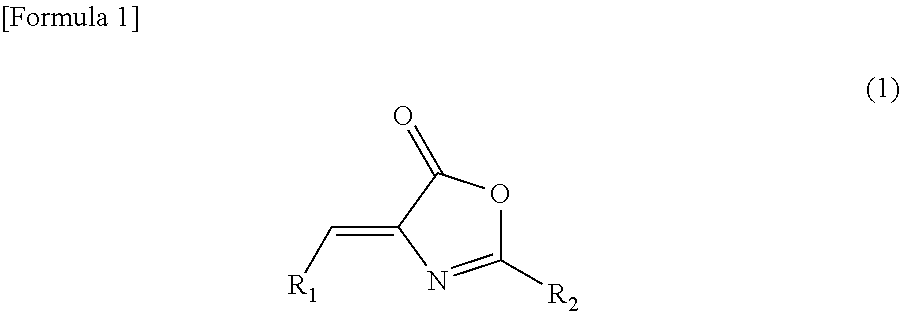
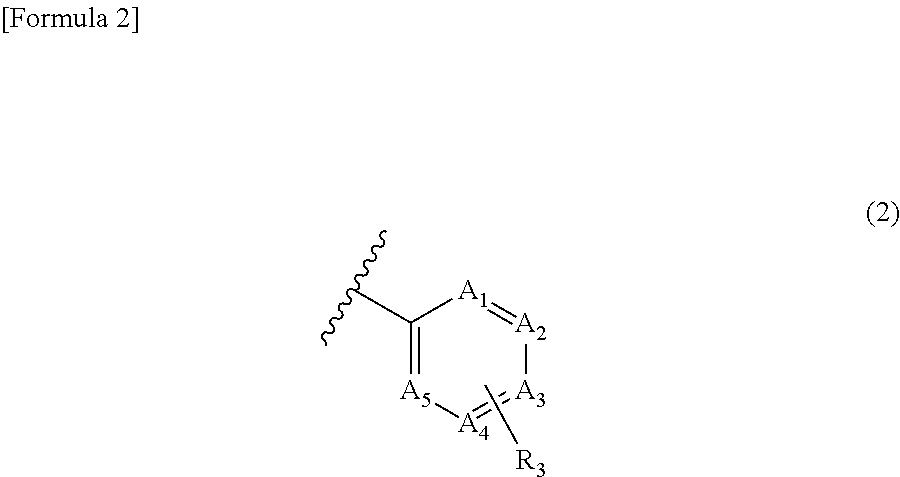
There is provided an inhibitor that inhibits caseinkinase 1δ and caseinkinase 1ε, and thus, there is also provided a pharmaceutical agent useful for the treatment and / or prevention of a disease, with the pathological condition of which the mechanism of activation of caseinkinase 1δ or casein kinase 1ε is associated. Particularly, the above-described inhibitor is used to provide a pharmaceutical agent useful for the treatment of circadian rhythm disorder (including sleep disorder), central neurodegenerative disease, and cancer.An inhibitor of casein kinase 1δ and casein kinase 1ε, which comprises, as an active ingredient, an oxazolone derivative represented by the following general formula (1), a salt thereof, a solvate thereof, or a hydrate thereof:[wherein, in the formula (1), each of R1 and R2 independently represents any one of a substituted or unsubstituted 6-membered or 5-membered heterocyclic group optionally having a condensed ring, a substituted or unsubstituted aromatic hydrocarbon group optionally having a condensed ring, and a substituted or unsubstituted aromatic hydrocarbon lower alkyl group or aromatic hydrocarbon lower alkenyl group optionally having a condensed ring.]
Description
TECHNICAL FIELD[0001]The present invention relates to an inhibitor of casein kinase 1δ and casein kinase 1ε, which comprises, as an active ingredient, an oxazolone derivative, a salt thereof, a solvate thereof, or a hydrate thereof. The present invention relates to a pharmaceutical agent for treating diseases, with the pathological conditions of which the activation of casein kinase 1δ or casein kinase 1ε is associated. The present invention relates to a pharmaceutical agent comprising the inhibitor of casein kinase 1δ and casein kinase 1ε, which is useful for the treatment and / or prevention of, particularly, circadian rhythm disorder (including sleep disorder), central neurodegenerative disease, and cancer, among the diseases, with the pathological conditions of which the activation of casein kinase 1δ or casein kinase 1ε is associated.BACKGROUND ART[0002]Casein kinase 1 belongs to serine / threonine kinase (which phosphorylates a tyrosine residue in some cases). As its isoforms in m...
Claims
the structure of the environmentally friendly knitted fabric provided by the present invention; figure 2 Flow chart of the yarn wrapping machine for environmentally friendly knitted fabrics and storage devices; image 3 Is the parameter map of the yarn covering machine
Login to View More
Application Information
Patent Timeline
Application Date:The date an application was filed.
Publication Date:The date a patent or application was officially published.
First Publication Date:The earliest publication date of a patent with the same application number.
Issue Date:Publication date of the patent grant document.
PCT Entry Date:The Entry date of PCT National Phase.
Estimated Expiry Date:The statutory expiry date of a patent right according to the Patent Law, and it is the longest term of protection that the patent right can achieve without the termination of the patent right due to other reasons(Term extension factor has been taken into account ).
Invalid Date:Actual expiry date is based on effective date or publication date of legal transaction data of invalid patent.



 Login to View More