
Nanonized testosteron formulations for improved bioavailability
a technology of testosterone and formulations, which is applied in the direction of pill delivery, endocrine system disorder, pharmaceutical non-active ingredients, etc., can solve the problems of inconvenient injection, inability to adapt the dose, and more than 10% of patients suffering from pain, so as to reduce the size of the drug
- Summary
- Abstract
- Description
- Claims
- Application Information
AI Technical Summary
Benefits of technology
Problems solved by technology
Method used
Image

Examples
example 1
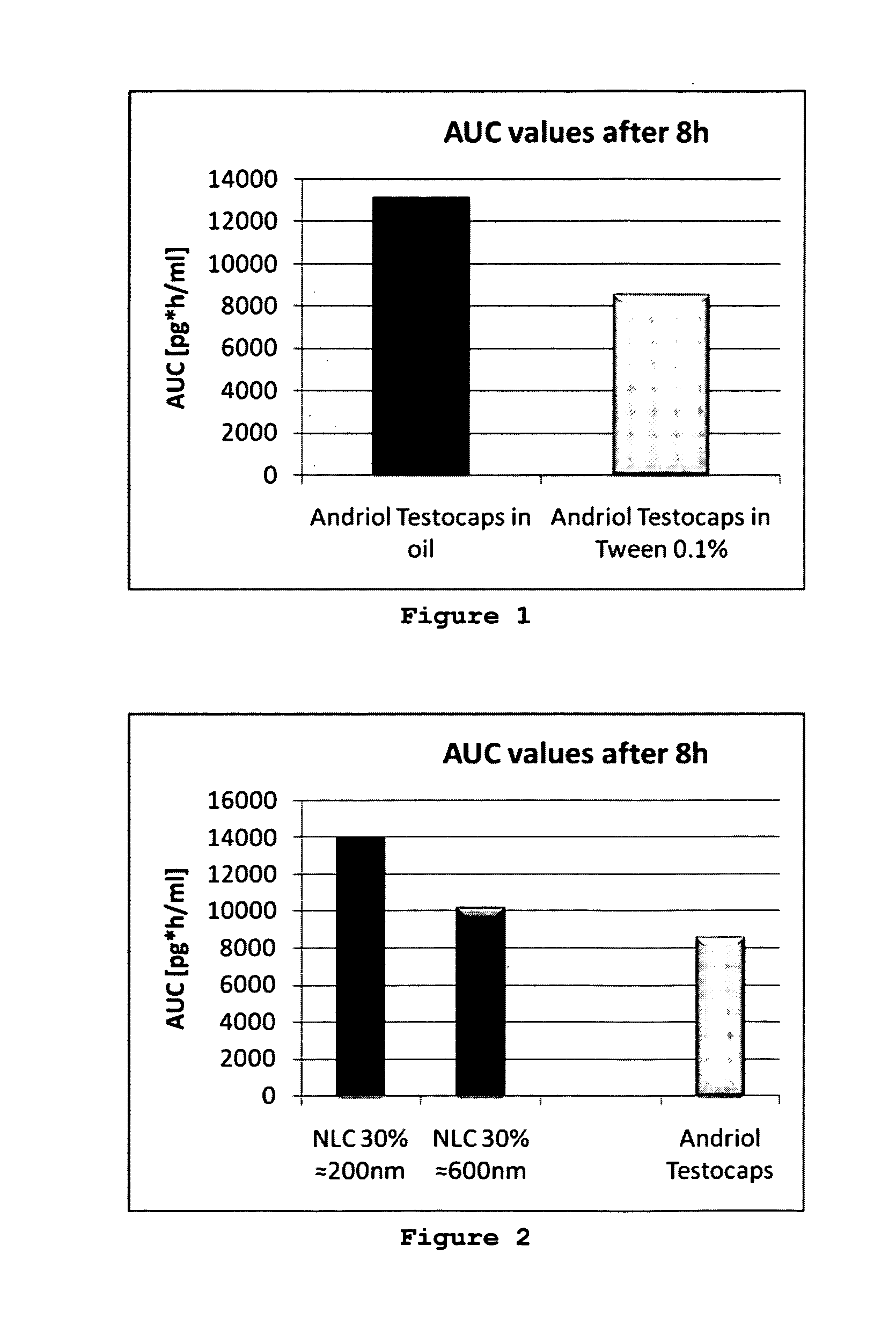
BA of TU from Andriol Testocaps® Dispersed in Oil Compared to TU Dispersed in Surfactant Solution
[0057]The amount of 4 mg TU contained in 33.4 mg oil solution of the capsule was dispersed in surfactant solution (0.1% Tween 80 in water) yielding a total amount of 400 mg, and administered orally to rats. This corresponds to administering Andriol Testocaps® to non-fed patients.
[0058]The second test formulation was the same amount of 4 mg TU contained in 33.4 mg oil solution of the capsule, but this time diluted with the oil of the capsule itself to yield the same amount of 400 mg. One capsule Andriol Terstocaps contains 40 mg TU dissolved in an oil solution with a total amount of about 330 mg. Administering this capsule to humans with the same amount of added oil would mean that the patient has to take about 4 g pure oil, corresponding to the fed state of absorption.
[0059]After oral administration the BA was determined as described in the analytical procedure, yielding an area under th...
example 2
BA of TU Incorporated into Lipid Nanoparticles of Different Size Versus BA of Andriol Testocaps®
[0060]TU was incorporated into lipid nanoparticles. The concentration of the lipid nanoparticles in the aqueous suspension was 10% (w / w). The composition of the NLC was:
Dynasan118 3.5%oleic aicd 3.5%TU 3.0%Tween 80water up to100.0%
[0061]The Tween 80 concentration was 2% in case of 200 nm, and 1% Tween in case of 600 nm NLC.
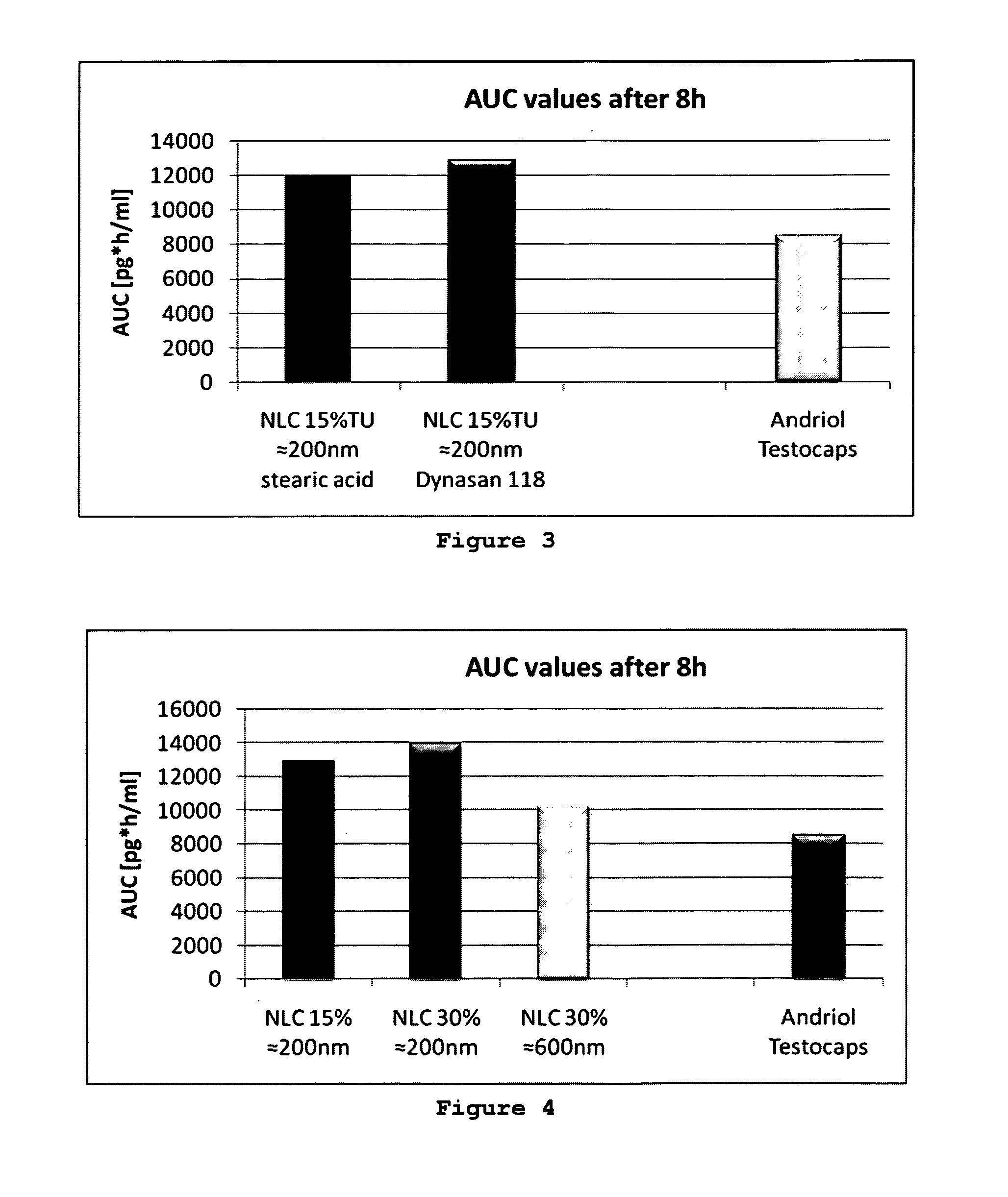
[0062]Different particle sizes of 200 nm and 600 nm were produced by varying the homogenization conditions and the concentration of surfactant. Administered per rat were 133 mg NLC suspension. The BA was 10,208 units for the NLC with 600 nm, and 13,950 units for the 200 nm NLC (FIG. 2)
example 3
Effect of Nature of Solid Lipid on BA of TU Stearic Acid Versus Dynasan 118
[0063]NLC suspension with a lipid particle content of 10% were prepared using different solid lipids, that means stearic acid as a fatty acid and Dynasan 118 as a glyceride. The composition of the NLC was (w / w %):
solid lipid 4.25%oleic aicd 4.25%TU 1.5%Tween 80 2.0%water up to100.0%
[0064]267 mg of the NLC suspensions were administered to rats. The BA of both formulations were similarily high, being 11,976 units for stearic acid and 12,933 for Dynasan 118 (FIG. 3). Obviously there was limited effect of the lipid nature, but the glyceride showed higher BA.
PUM
| Property | Measurement | Unit |
|---|---|---|
| Temperature | aaaaa | aaaaa |
| Fraction | aaaaa | aaaaa |
| Fraction | aaaaa | aaaaa |
Abstract
Description
Claims
Application Information
 Login to View More