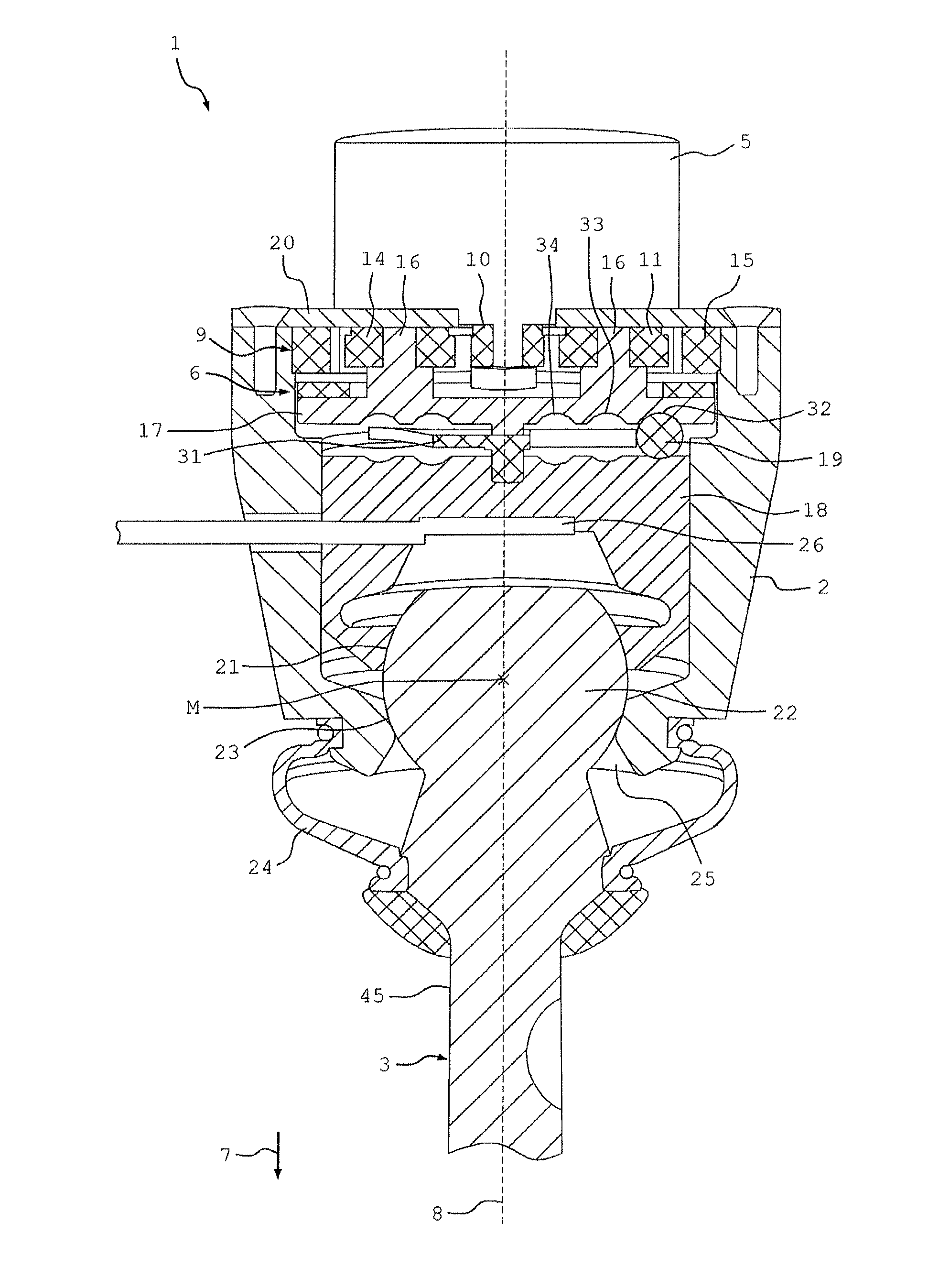
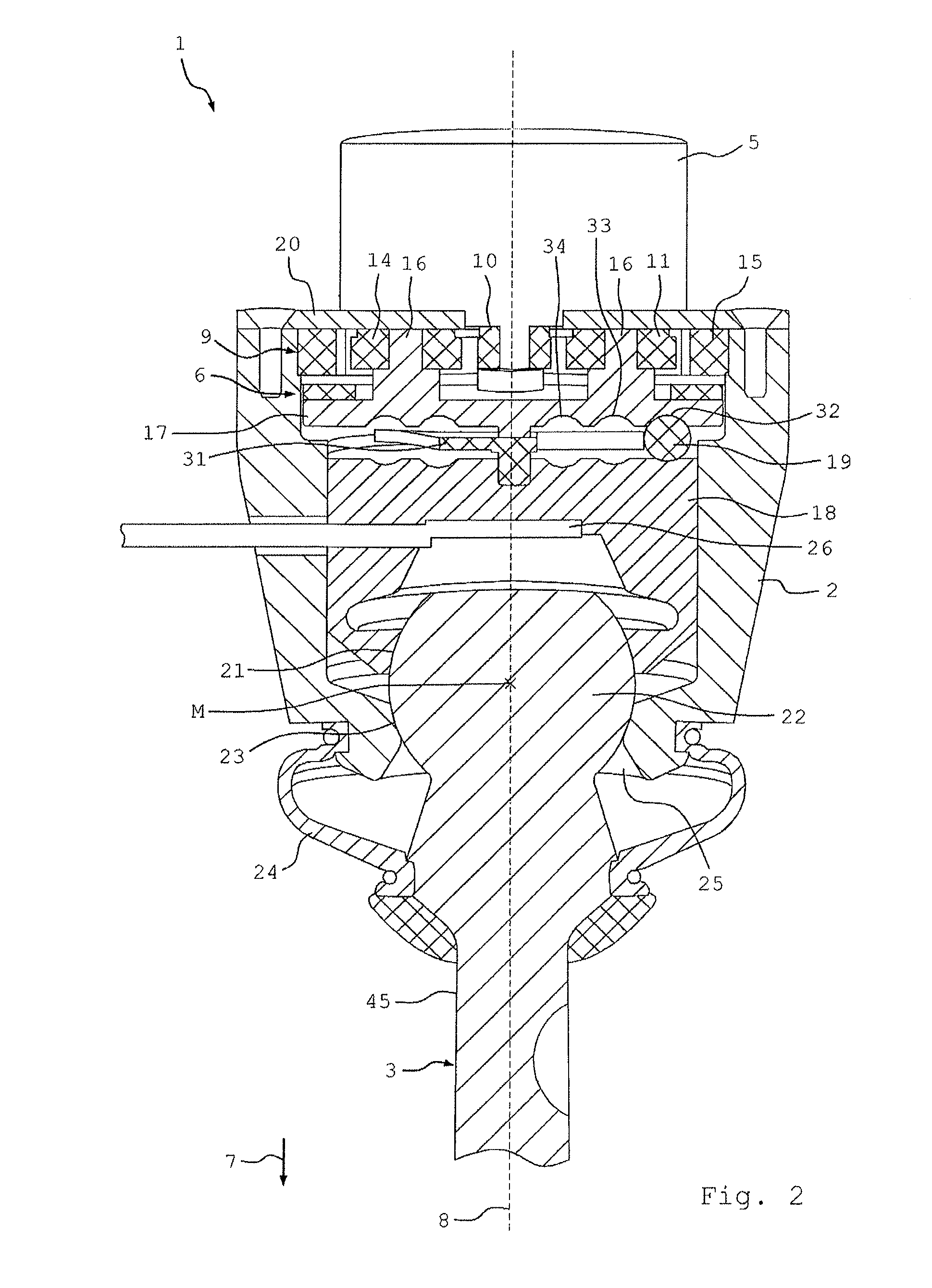
[0013]According to one embodiment of the invention, the second ball socket part comprises a main body and at least one bearing section, which is elastically connected to the main body and by means of which the second ball socket part rests against the joint ball. In this embodiment, a gap formation can be avoided under load even for the second ball socket part.
[0018]The joint ball lies against the ball socket preferably with a
lubricant disposed therebetween. The
lubricant is advantageously introduced into the ball socket. The
lubricant is a traction oil, for example, and in particular increases the
friction coefficient under load.
[0021]The adjusting device can be a hydraulic or electric adjusting device. For example, the adjusting device can comprise piezoelectric elements, by means of which the first ball socket part can be moved relative to the second ball socket part. According to a development of the invention, the adjusting device has a drive and one or at least one transmission, which comprises a first transmission part having ball tracks, which rise in the axial direction and extend curved, in particular in a spiral shape, around a
rotational axis oriented in the axial direction and in each of which at least one ball is guided, and a second transmission part, which is in contact with the balls, which are disposed between the transmission parts in the axial direction, wherein the balls and the first transmission part can be rotated about the
rotational axis relative to each other by means of the drive. If the balls and the first transmission part are rotated about the
rotational axis relative to each other, the balls are moved along the ball tracks, so that the
axial distance between the transmission parts changes as a result of the axial rise of the ball tracks. The adjusting device thus forms an axial
stroke device, which can be driven by the drive and by means of which in particular the first ball socket part can be moved relative to the second ball socket part in the axial direction. This embodiment of the adjusting device can be designed very compact and avoids the leakage problems associated with a hydraulic
system. The drive is preferably a motor, in particular an
electric motor.
[0024]According to one embodiment of the invention, the first transmission part can be driven by the drive, in particular can be rotated by the drive about the rotational axis relative to the balls. The drive is preferably connected to the first transmission part, an additional transmission, which is designed for example as a planetary transmission, being disposed therebetween. A higher
transmission ratio can be achieved by means of the additional transmission. If the additional transmission is designed as a planetary transmission, a relatively flat and compact construction can also be achieved. This enables the use of a relatively small drive, so that the adjusting device can be integrated into the ball and socket joint. While the first transmission part is rotated, the balls run along the ball tracks, wherein the
axial distance between the transmission parts is changed as a result of the ball tracks of the first transmission part rising in the axial direction. Because the ball tracks of the first transmission part are curved around the rotational axis, in particular the distance of the balls from the rotational axis also changes.
[0029]The invention preferably creates a ball and socket joint for high frictional torques that is characterized by a special shape,
material selection, and surface quality. The friction of the joint ball in the ball socket preferably can be self-reinforced by the wedge effect. In particular, the ball and socket joint according to the invention has the following advantages:
[0032]Positive driving dynamics effects can be achieved, in particular during stable straight driving. Furthermore, steering vibrations can be damped and the
pitch behavior of the vehicle can be improved.


 Login to View More
  Login to View More