Unlock instant, AI-driven research and patent intelligence for your innovation.

Primary ultrafine-crystalline alloy, nano-crystalline, soft magnetic alloy and its production method, and magnetic device formed by nano-crystalline, soft magnetic alloy

Inactive Publication Date: 2012-12-20
HITACHI METALS LTD
View PDF3 Cites 31 Cited by
  • Summary
  • Abstract
  • Description
  • Claims
  • Application Information

AI Technical Summary

Benefits of technology

[0006]Accordingly, an object of the present invention is to improve the nano-crystalline, soft magnetic alloys of JP 2007-107095 A and JP 2008-231533 A, providing a primary ultrafine-crystalline alloy containing nuclei of fine crystals with adjusted crystallization, and a nano-crystalline, soft magnetic alloy obtained by heat-treating this primary ultrafine-crystalline alloy for having improved toughness and a good balance of magnetic properties and handling.

Problems solved by technology

Silicon steel is inexpensive and has a high magnetic flux density, but it suffers large core loss at high frequencies, and it cannot easily be made thin.
Co-based amorphous alloys are expensive and have as low saturation magnetic flux density as 1 T or less, providing large parts when used for high-power applications.
In addition, because of thermal instability, the Co-based amorphous alloys change with time, resulting in increased core loss.
However, investigation for the stable mass production of the nano-crystalline, soft magnetic alloy of JP 2007-107095 A having a high saturation magnetic flux density and low coercivity and the amorphous alloy ribbon (also called “primary ultrafine-crystalline alloy”) of JP 2008-231533 A has revealed that they suffer such problems as not encountered in production using small, experimental apparatuses.
For example, in the mass production of wide ribbons for a long period of time, ribbons are easily broken, resulting in low yield, and have poor handleability in rewinding them on reels for shipment, winding them to form cores, etc.
Also, hysteresis remains at 1.5 T or more, adversely affecting their magnetic saturation and alternating magnetic properties.
These problems appear to occur due to the fact that the density of primary fine crystals and the surface structures of ribbons change during production for a long period of time.
However, the characteristics of amorphous alloy ribbons (primary ultrafine-crystalline alloy) for producing nano-crystalline, soft magnetic alloys are not sufficiently evaluated, and the influence of a coarse crystal grain layer on soft magnetic properties is also not sufficiently investigated.

Method used

the structure of the environmentally friendly knitted fabric provided by the present invention; figure 2 Flow chart of the yarn wrapping machine for environmentally friendly knitted fabrics and storage devices; image 3 Is the parameter map of the yarn covering machine
View more

Image

Smart Image Click on the blue labels to locate them in the text.
Viewing Examples
Smart Image
  • Primary ultrafine-crystalline alloy, nano-crystalline, soft magnetic alloy and its production method, and magnetic device formed by nano-crystalline, soft magnetic alloy
  • Primary ultrafine-crystalline alloy, nano-crystalline, soft magnetic alloy and its production method, and magnetic device formed by nano-crystalline, soft magnetic alloy
  • Primary ultrafine-crystalline alloy, nano-crystalline, soft magnetic alloy and its production method, and magnetic device formed by nano-crystalline, soft magnetic alloy

Examples

Experimental program
Comparison scheme
Effect test

example 1

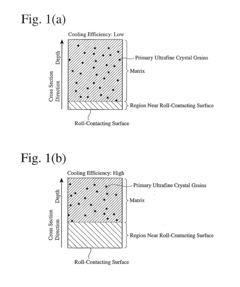
[0100]An alloy melt having a composition (atomic %) of Febal.Cu1.4Si4B14 was quenched in the air by a single-roll method using a copper-alloy-made, cooling roll shown in FIG. 6 under the following conditions, and stripped from the cooling roll at a temperature of 250° C., thereby obtaining a primary ultrafine-crystalline alloy ribbon of 25 mm in width, 20 μm in thickness and 1 km in length having an amorphous matrix, in which primary ultrafine crystal grains having an average particle size of 3 nm were dispersed at a volume fraction of 25%.

[0101]Peripheral speed of cooling roll: 28 m / s,

[0102]Inlet temperature of cooling water to cooling roll: 50° C., and

[0103]Outlet temperature of cooling water from cooling roll: 60° C.

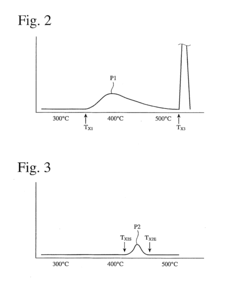
[0104]FIG. 8 shows a DSC curve of this primary ultrafine-crystalline alloy ribbon. A first broad exothermic peak P1 due to nano-crystallization appeared in a wide temperature range from a crystallization initiation temperature TX1 of about 350° C. to a compound precip...

example 2

[0109]To investigate the dependency of soft magnetic properties on heat treatment conditions, an alloy melt having a composition (atomic %) of Febal.Cu1.4Si4B14 was quenched in the air by a copper-alloy-made, cooling roll shown in FIG. 6, at a peripheral speed of 28 m / s, with cooling water having an inlet temperature of 50° C. and an outlet temperature of 60° C., and stripped from the cooling roll at a temperature of 250° C. to produce a primary ultrafine-crystalline alloy ribbon of 25 mm in width and 20 μm in thickness. In an amorphous matrix of this primary ultrafine-crystalline alloy, primary ultrafine crystal grains having an average particle size of 2 nm were dispersed at a volume fraction of 25%.

[0110]This primary ultrafine-crystalline alloy was subject to a high-temperature, short-period heat treatment A shown in FIG. 9, which comprised heating to 460° C. over 15 minutes, and then immediately cooling with air, to obtain a nano-crystalline, soft magnetic alloy A. Also, the sam...

example 3

[0111]Using a copper-alloy-made, cooling roll shown in FIG. 6 (a peripheral speed: 27-32 m / s, an inlet temperature of cooling water: 25-60° C., and an outlet temperature: 33-72° C.), alloy melts each having the composition (atomic %) shown in Table 1 were quenched in the air, and stripped from the cooling roll at a ribbon temperature of 250° C., to produce primary ultrafine-crystalline alloy ribbons of 25 mm in width and 16-25 μm in thickness. The alloy composition of each primary ultrafine-crystalline alloy ribbon, the inlet temperature and outlet temperature of cooling water, the average particle size and volume fraction of primary ultrafine crystal grains, and the ratio of the second exothermic peak are shown in Table 1. In these primary ultrafine-crystalline alloys, primary ultrafine crystal grains having an average particle size of 1-5 nm were dispersed at a volume fraction of 3-30% in an amorphous matrix. The ratio of the second exothermic peak to the total quantity of exother...

the structure of the environmentally friendly knitted fabric provided by the present invention; figure 2 Flow chart of the yarn wrapping machine for environmentally friendly knitted fabrics and storage devices; image 3 Is the parameter map of the yarn covering machine
Login to View More

PUM

PropertyMeasurementUnit
Temperatureaaaaaaaaaa
Fractionaaaaaaaaaa
Login to View More

Abstract

A primary ultrafine-crystalline alloy having a composition represented by the general formula: Fe100-x-y-zAxByXz, wherein A is Cu and / or Au, X is at least one element selected from the group consisting of Si, S, C, P, Al, Ge, Ga and Be, and x, y and z are numbers (by atomic %) meeting the conditions of 0<x≦5, 10≦y≦22, 0≦z≦10, and x+y+z≦25, and a structure in which 5-30% by volume of primary ultrafine crystal grains having an average particle size of 30 nm or less are dispersed in an amorphous matrix; its differential scanning calorimetry (DSC) curve having a first exothermic peak and a second exothermic peak lower than the first exothermic peak between a crystallization initiation temperature TX1 and a compound precipitation temperature TX3; and a ratio of the heat quantity of the second exothermic peak to the total heat quantity of the first and second exothermic peaks being 3% or less.

Description

FIELD OF THE INVENTION[0001]The present invention relates to a nano-crystalline, soft magnetic alloy having a high saturation magnetic flux density and excellent soft magnetic properties suitable for various magnetic devices, and a primary ultrafine-crystalline alloy as an intermediate alloy for producing it, a method for producing a nano-crystalline, soft magnetic alloy, and a magnetic device formed by a nano-crystalline, soft magnetic alloy.BACKGROUND OF THE INVENTION[0002]Soft magnetic materials used for various reactors, choke coils, magnetic pulse power devices, transformers, magnetic cores for motors and power generators, current sensors, magnetic sensors, antenna cores, electromagnetic-wave-absorbing sheets, etc. include silicon steel, ferrite, amorphous alloys, nano-crystalline alloys, etc. Silicon steel is inexpensive and has a high magnetic flux density, but it suffers large core loss at high frequencies, and it cannot easily be made thin. Because of a low saturation magne...

Claims

the structure of the environmentally friendly knitted fabric provided by the present invention; figure 2 Flow chart of the yarn wrapping machine for environmentally friendly knitted fabrics and storage devices; image 3 Is the parameter map of the yarn covering machine
Login to View More

Application Information

Patent Timeline
no application Login to View More
IPC IPC(8): H01F1/01C21D6/00H01F41/02C22C45/02
CPCC21D8/1211C21D2201/03C21D2211/004H01F1/15333C22C45/02H01F1/15308C22C38/00C21D1/18C21D6/001C21D6/005C21D6/008H01F1/15341H01F41/02
Inventor OHTA, MOTOKIYOSHIZAWA, YOSHIHITOMIYAMOTO, TAKUMIHARA, TOSHIO
Owner HITACHI METALS LTD