This helps you quickly interpret patents by identifying the three key elements:
Problems solved by technology
Method used
Benefits of technology
Benefits of technology
The present invention provides a method for making a rubber composition that further increases the activity of a silanecoupling agent, resulting in excellent low-heat-generation properties without compromising the workability of the unvulcanized rubber composition.
Problems solved by technology
However, in these inventions, nothing is taken into consideration relating to kneading conditions.
Method used
the structure of the environmentally friendly knitted fabric provided by the present invention; figure 2 Flow chart of the yarn wrapping machine for environmentally friendly knitted fabrics and storage devices; image 3 Is the parameter map of the yarn covering machine
View more
Image
Smart Image Click on the blue labels to locate them in the text.
Viewing Examples
Smart Image
Click on the blue label to locate the original text in one second.
Reading with bidirectional positioning of images and text.
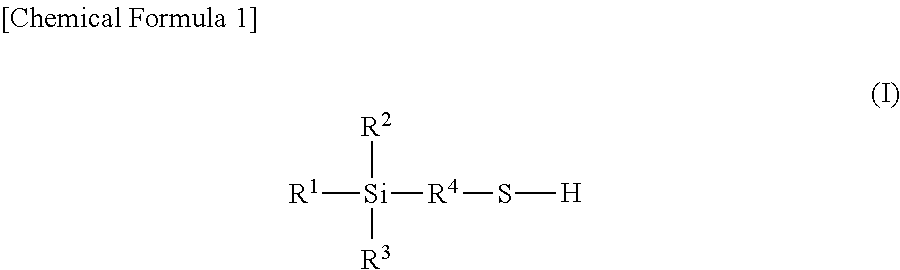
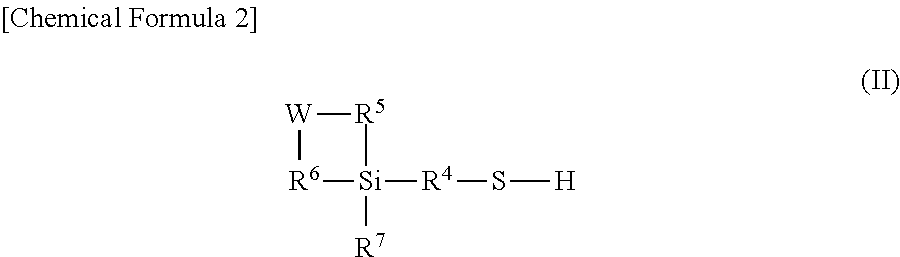
[0081]In a nitrogenatmosphere in a 500-mL four-neck eggplant flask, 23.8 g of 3-mercaptopropyltriethoxysilane, 11.9 g of N-methyldiethanolamine and 0.05 g of titaniumtetra-n-butoxide were dissolved in 200 mL of xylene. This was heated up to 150° C. and stirred for 6 hours. Subsequently, using a rotary evaporator, the solvent was evaporated away at 20 hPa / 40° C., and then via a rotary pump (10 Pa) and a cold trap (dry ice+ethanol), the remaining volatiles were removed to give 24.0 g of 3-mercaptopropyl(ethoxy)-1,3-dioxa-6-methylaza-2-silacyclooctane.
[0083]In a nitrogenatmosphere in a 500-mL four-neck eggplant flask, 23.8 g of 3-mercaptopropyltriethoxysilane, 16.1 g of N-butyldiethanolamine and 0.05 g of titaniumtetra-n-butoxide were dissolved in 200 mL of xylene. This was heated up to 150° C. and stirred for 6 hours. Subsequently, using a rotary evaporator, the solvent was evaporated away at 20 hPa / 40° C., and then via a rotary pump (10 Pa) and a cold trap (dry ice+ethanol), the remaining volatiles were removed to give 28.7 g of 3-mercaptopropyl(ethoxy)-1,3-dioxa-6-butylaza-2-silacyclooctane.
[0085]In a nitrogenatmosphere in a 500-mL four-neck eggplant flask, 23.8 g of 3-mercaptopropyltriethoxysilane, 27.3 g of N-lauryldiethanolamine and 0.05 g of titaniumtetra-n-butoxide were dissolved in 200 mL of xylene. This was heated up to 150° C. and stirred for 6 hours. Subsequently, using a rotary evaporator, the solvent was evaporated away at 20 hPa / 40° C., and then via a rotary pump (10 Pa) and a cold trap (dry ice+ethanol), the remaining volatiles were removed to give 40.0 g of 3-mercaptopropyl(ethoxy)-1,3-dioxa-6-dodecylaza-2-silacyclooctane.
the structure of the environmentally friendly knitted fabric provided by the present invention; figure 2 Flow chart of the yarn wrapping machine for environmentally friendly knitted fabrics and storage devices; image 3 Is the parameter map of the yarn covering machine
Login to View More
PUM
Property
Measurement
Unit
Temperature
aaaaa
aaaaa
Temperature
aaaaa
aaaaa
Temperature
aaaaa
aaaaa
Login to View More
Abstract
A method for producing a rubber composition containing a rubber component (A) of at least one selected from natural rubbers and synthetic dienic rubbers, a filler containing an inorganic filler (B), and a silanecoupling agent (C) of a compound having a mercapto group, wherein the rubber composition is kneaded in multiple stages, in the first stage of kneading, the rubber component (A), all or a part of the inorganic filler (B), and all or a part of the silanecoupling agent (C) are kneaded, then in the first stage or in the subsequent kneading stage, at least one compound selected from an acidic compound (D) and a basic compound (E) is added, and the highest temperature of the rubber composition in the final stage of kneading is from 60 to 120° C.
Description
TECHNICAL FIELD[0001]The present invention relates to a method for producing a rubber composition containing an inorganic filler and having an improved low-heat-generation property.BACKGROUND ART[0002]Recently, in association with the movement of global regulation of carbon dioxide emission associated with the increase in attraction to environmental concerns, the demand for low fuel consumption by automobiles is increasing. To satisfy the requirement, it is desired to reduce rolling resistance relating to tire performance. Heretofore, as a means for reducing the rolling resistance of tires, a method of optimizing tire structures has been investigated; however, at present, a technique of using a low-heat-generating rubber composition for tires has become employed as the most common method.[0003]For obtaining such a low-heat-generating rubber composition, there is known a method of using an inorganic filler such as silica or the like.[0004]However, in incorporating an inorganic filler...
Claims
the structure of the environmentally friendly knitted fabric provided by the present invention; figure 2 Flow chart of the yarn wrapping machine for environmentally friendly knitted fabrics and storage devices; image 3 Is the parameter map of the yarn covering machine
Login to View More
Application Information
Patent Timeline
Application Date:The date an application was filed.
Publication Date:The date a patent or application was officially published.
First Publication Date:The earliest publication date of a patent with the same application number.
Issue Date:Publication date of the patent grant document.
PCT Entry Date:The Entry date of PCT National Phase.
Estimated Expiry Date:The statutory expiry date of a patent right according to the Patent Law, and it is the longest term of protection that the patent right can achieve without the termination of the patent right due to other reasons(Term extension factor has been taken into account ).
Invalid Date:Actual expiry date is based on effective date or publication date of legal transaction data of invalid patent.



 Login to View More