Small molecule-dependent inteins and uses thereof

US20140065711A1Active Publication Date: 2014-03-06PRESIDENT & FELLOWS OF HARVARD COLLEGE

Image

Smart Image Click on the blue labels to locate them in the text.
Viewing Examples
Smart Image
  • Small molecule-dependent inteins and uses thereof
  • Small molecule-dependent inteins and uses thereof
  • Small molecule-dependent inteins and uses thereof

Examples

Experimental program
Comparison scheme
Effect test

examples

Materials and Methods

Yeast Strains and Media

[0091]Media consisted of yeast nitrogen base (Sigma), 4% dextrose, and synthetic drop out supplements lacking uracil (MP Biomedical). Yeast were cultured in liquid medium or on agar plates at 30° C. The yeast strain RDY98 (Erg6del::TRP1 pdr1del::KanMX pdr3::HIS3 ade2-1 trp1-1 his3-11,15 ura3-52 leu2-3,112 can1-100) was provided by Professor Allen Buskirk at Brigham Young University. Protein induction was performed in media consisting of yeast nitrogen base (Sigma), 4% galactose, 4% raffinose, 0.4% dextrose, synthetic drop out supplements lacking uracil (MP Biomedical), and 1% of 100× penicillin-streptomycin solution (Cellgro) at 30° C.

Mammalian Cell Culture

[0092]HEK293 cells were cultured in Dulbecco's modified Eagle medium (DMEM):F12 medium with 10% fetal bovine serum (FBS) and 1% of 100× penicillin-streptomycin solution (Cellgro) according to standard protocols. Transient transfections were performed using Effectene (Qiagen) following th...

the structure of the environmentally friendly knitted fabric provided by the present invention; figure 2 Flow chart of the yarn wrapping machine for environmentally friendly knitted fabrics and storage devices; image 3 Is the parameter map of the yarn covering machine
Login to View More

PUM

PropertyMeasurementUnit
Temperatureaaaaaaaaaa
Fractionaaaaaaaaaa
Login to View More

Abstract

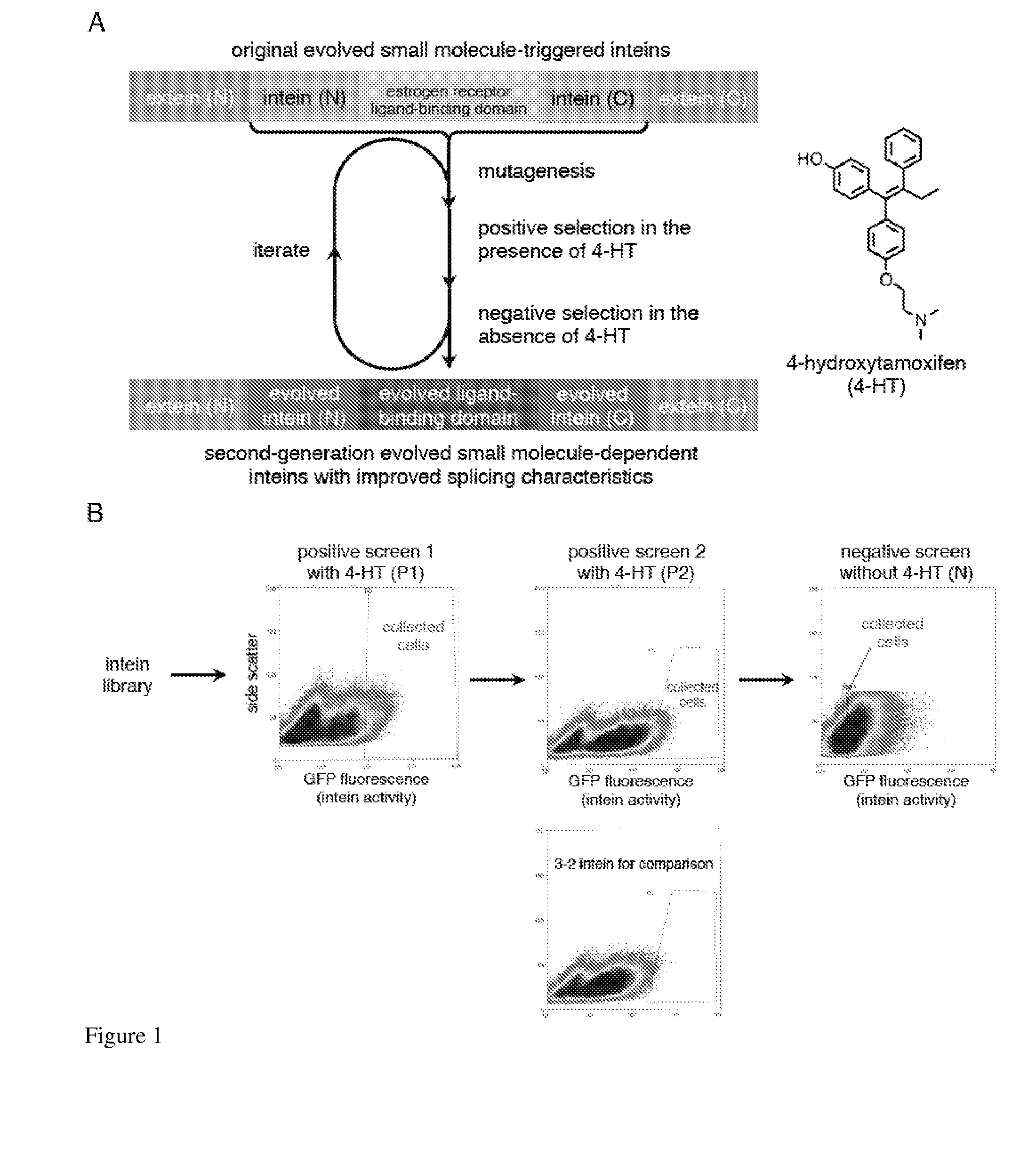
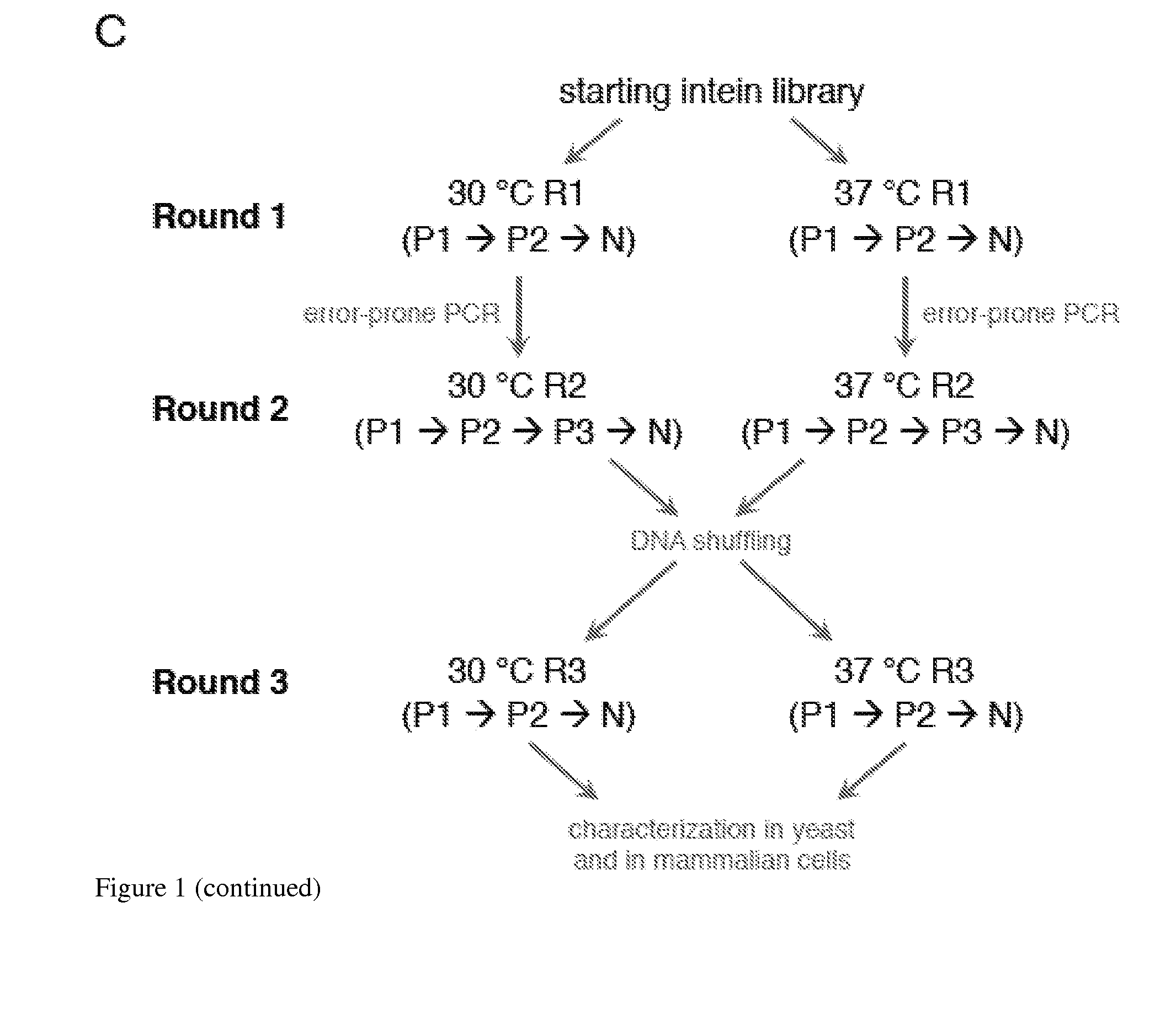
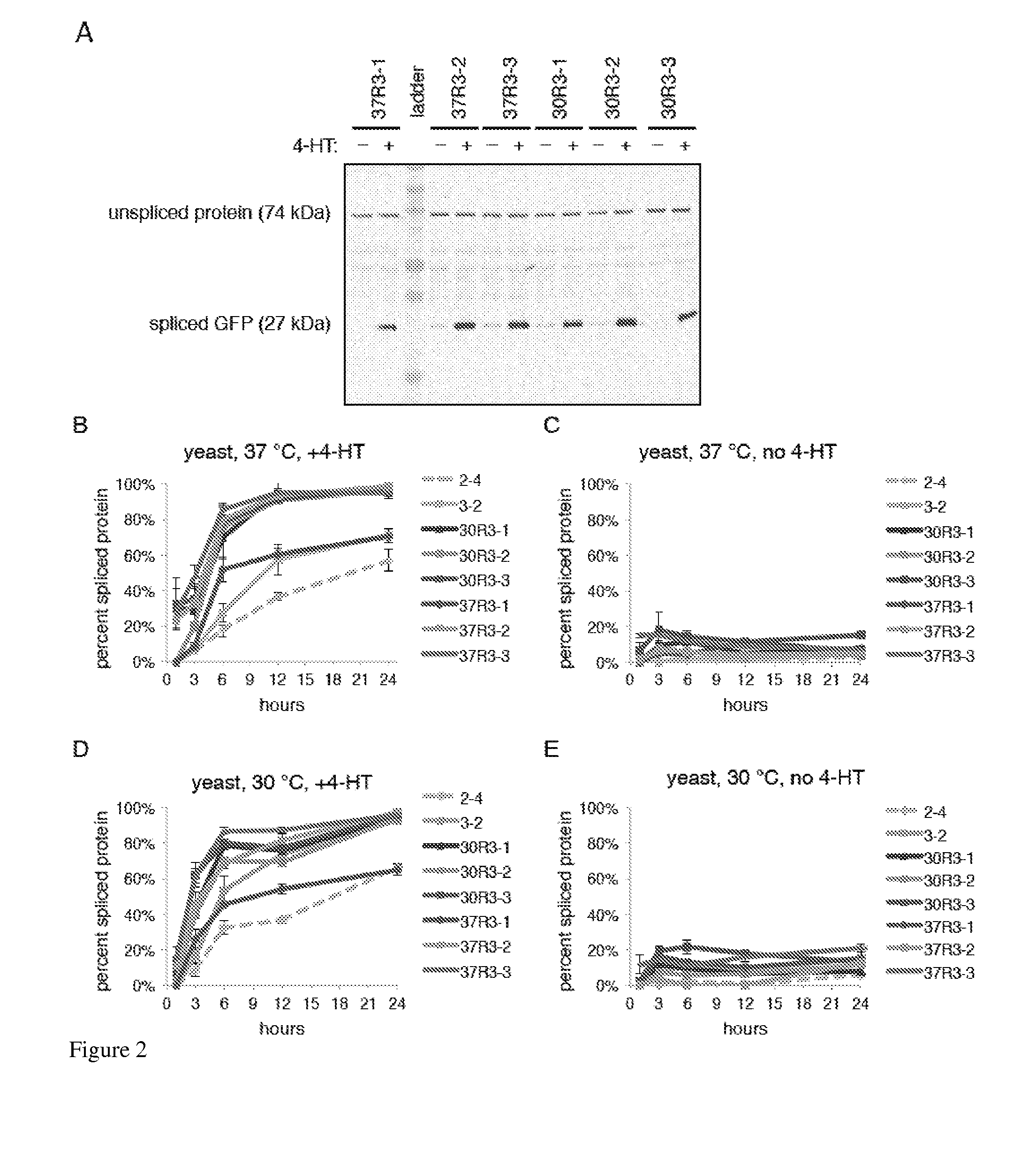
Elucidating the function of proteins in mammalian cells is particularly challenging due to the inherent complexity of these systems. Methods to study protein function in living cells ideally perturb the activity of only the protein of interest but otherwise maintain the natural state of the host cell or organism. Ligand-dependent inteins offer single-protein specificity and other desirable features as an approach to control protein function in cells post-translationally. Some aspects of this invention provide second-generation ligand-dependent inteins that splice to substantially higher yields and with faster kinetics in the presence of the cell-permeable small molecule 4-HT, especially at 37° C., while exhibiting comparable or improved low levels of background splicing in the absence of 4-HT, as compared to the parental inteins. These improvements were observed in four protein contexts tested in mammalian cells at 37° C., as well as in yeast cells assayed at 30° C. or 37° C. The newly evolved inteins described herein are therefore promising tools as conditional modulators of protein structure and function in yeast and mammalian cells.

Description

RELATED APPLICATION[0001]This application claims priority under 35 U.S.C. §119(e) to U.S. provisional patent application, U.S. Ser. No. 61 / 452,020, filed Mar. 12, 2011, entitled “Small Molecule-Dependent Inteins and Uses Thereof,” the entire contents of which are incorporated herein by reference.GOVERNMENT SUPPORT[0002]This invention was made with U.S. Government support under grant R01 GM065400, awarded by the National Institutes of Health (NIH), and grant HR0011-08-1-0085, awarded by the Defense Advanced Research Projects Agency (DARPA). The U.S. government has certain rights in this invention.BACKGROUND OF THE INVENTION[0003]Methods to control protein structure and function inside living cells have proven to be valuable tools to elucidate the roles of proteins in their native biological contexts (Schreiber, 2003; Buskirk and Liu, 2005; Banaszynski and Wandless, 2006). Traditional genetic methods that have been widely used to control protein function by altering expression levels ...

Claims

the structure of the environmentally friendly knitted fabric provided by the present invention; figure 2 Flow chart of the yarn wrapping machine for environmentally friendly knitted fabrics and storage devices; image 3 Is the parameter map of the yarn covering machine
Login to View More

Application Information

Patent Timeline
06 Mar 2014
Publication
US20140065711A1
IPC
C07K14/47
CPC
C07K14/47; C07K14/35; C12N9/52; C07K2319/33; C07K2319/50; C07K2319/60; C07K2319/92; C07K14/195
Inventors
LIU, DAVID R.; PECK, SUN H.