
Method and Apparatus for Extending Service Life of a Battery Source
a technology for extending the service life and battery sources, which is applied in the direction of circuit monitoring/indication, transportation and packaging, instruments, etc., to achieve the effects of extending the time interval between battery replacements, and reducing the cost of replacemen
- Summary
- Abstract
- Description
- Claims
- Application Information
AI Technical Summary
Benefits of technology
Problems solved by technology
Method used
Image

Examples
Embodiment Construction
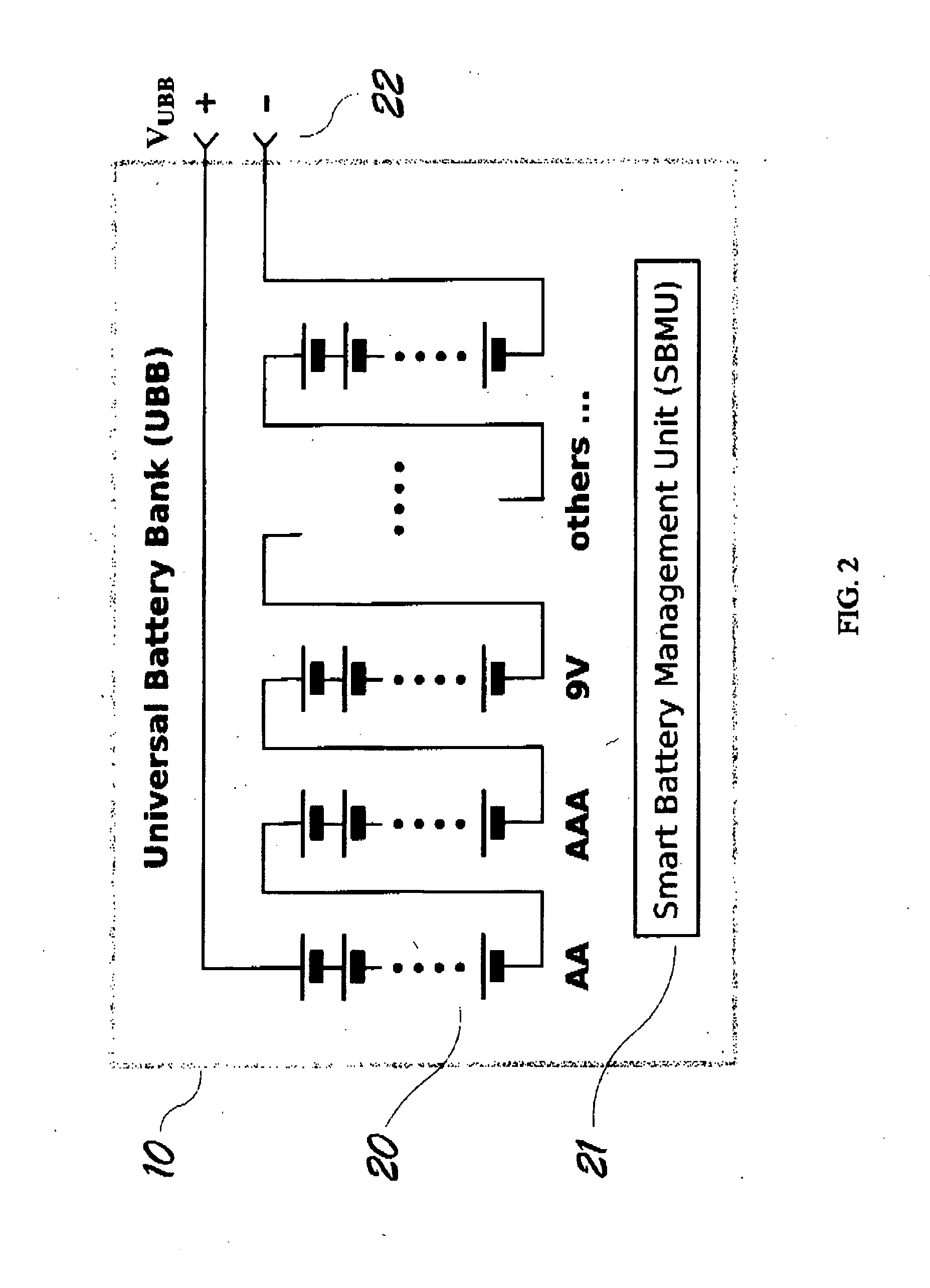
[0019]The present invention discloses a system for utilizing the residual energy in used batteries. The Universal Battery Bank (UBB) collects a plurality of batteries which may be of various sizes and types, and which are all connected in series to provide a variable voltage source. The UBB contains a smart battery management unit that identifies the weak batteries with too low a voltage and detects an over voltage situation. The output of the UBB is used to provide constant current sources and / or constant voltage sources for powering various electronic and electrical appliances. By combining multiple used batteries the system can also be used for extending the usage of the batteries until they are drained almost completely.
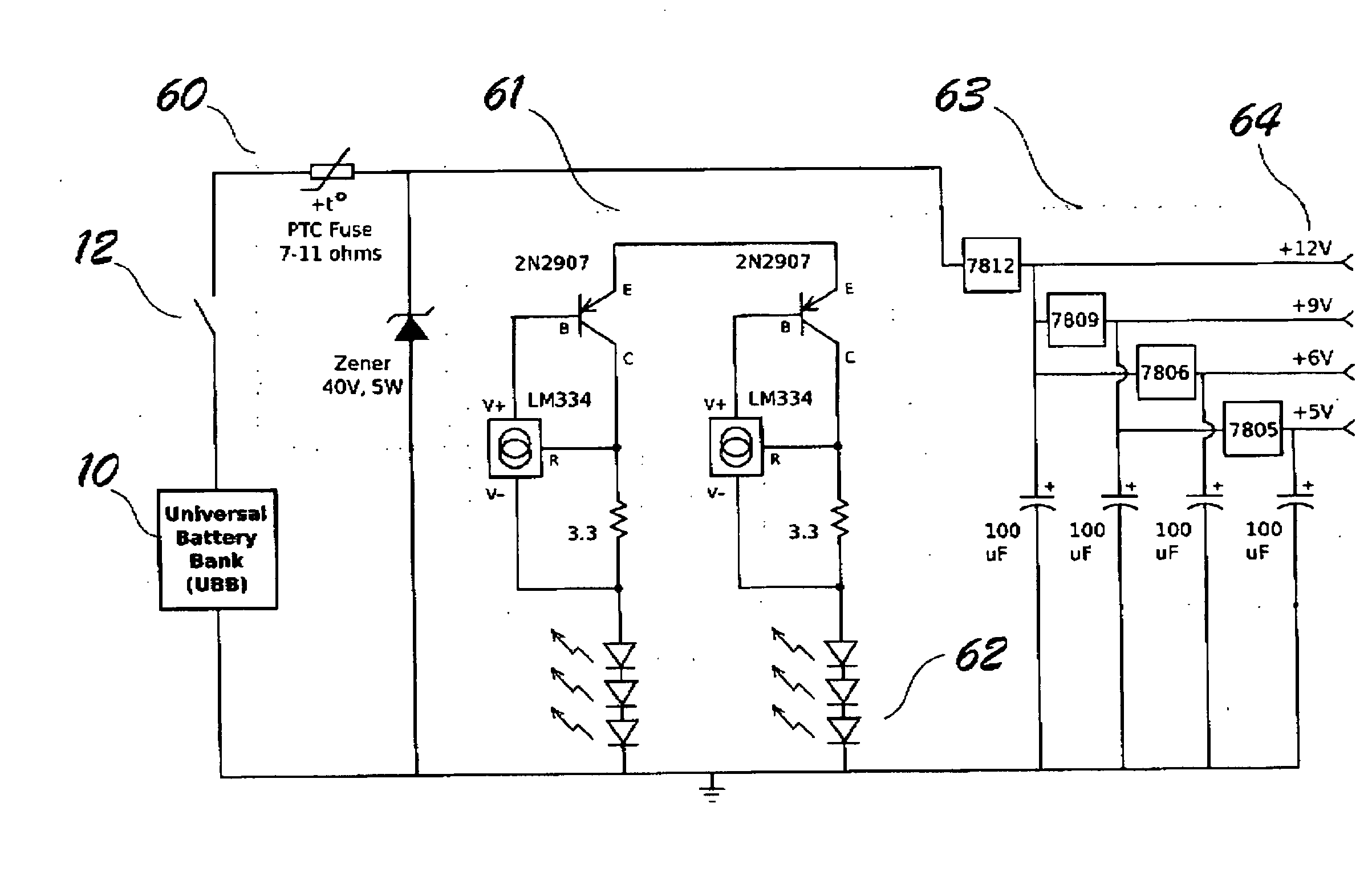
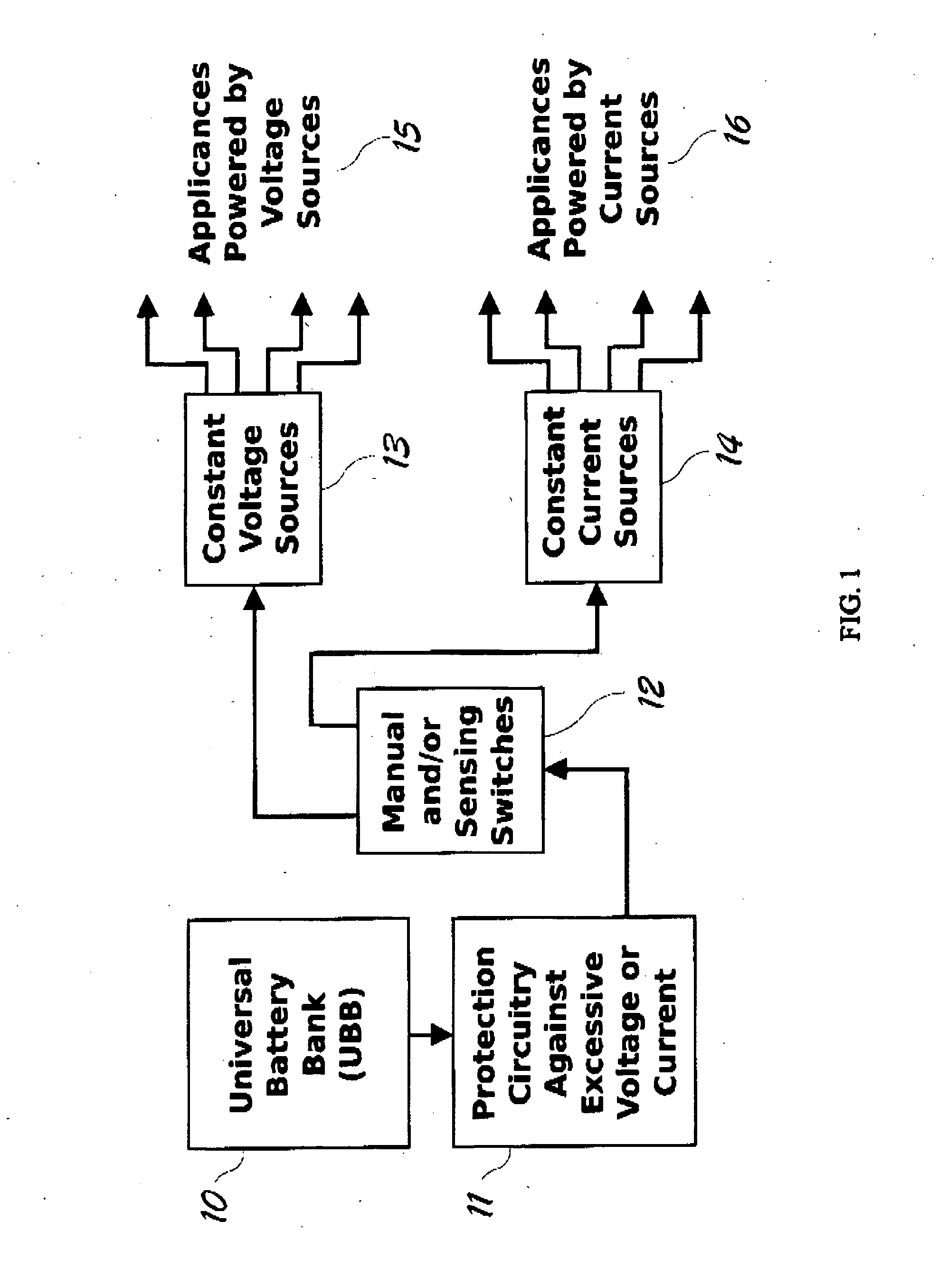
[0020]FIG. 1 shows the block diagram of the system that consists of Universal Battery Bank (UBB) 10, protection circuit guarding against excessive voltage or current 11, manual and / or sensing switches 12, constant voltage sources 13, and constant current sources ...
PUM
 Login to View More
 Abstract
Description
Claims
Application Information
 Login to View More