This helps you quickly interpret patents by identifying the three key elements:
Problems solved by technology
Method used
Benefits of technology
Benefits of technology
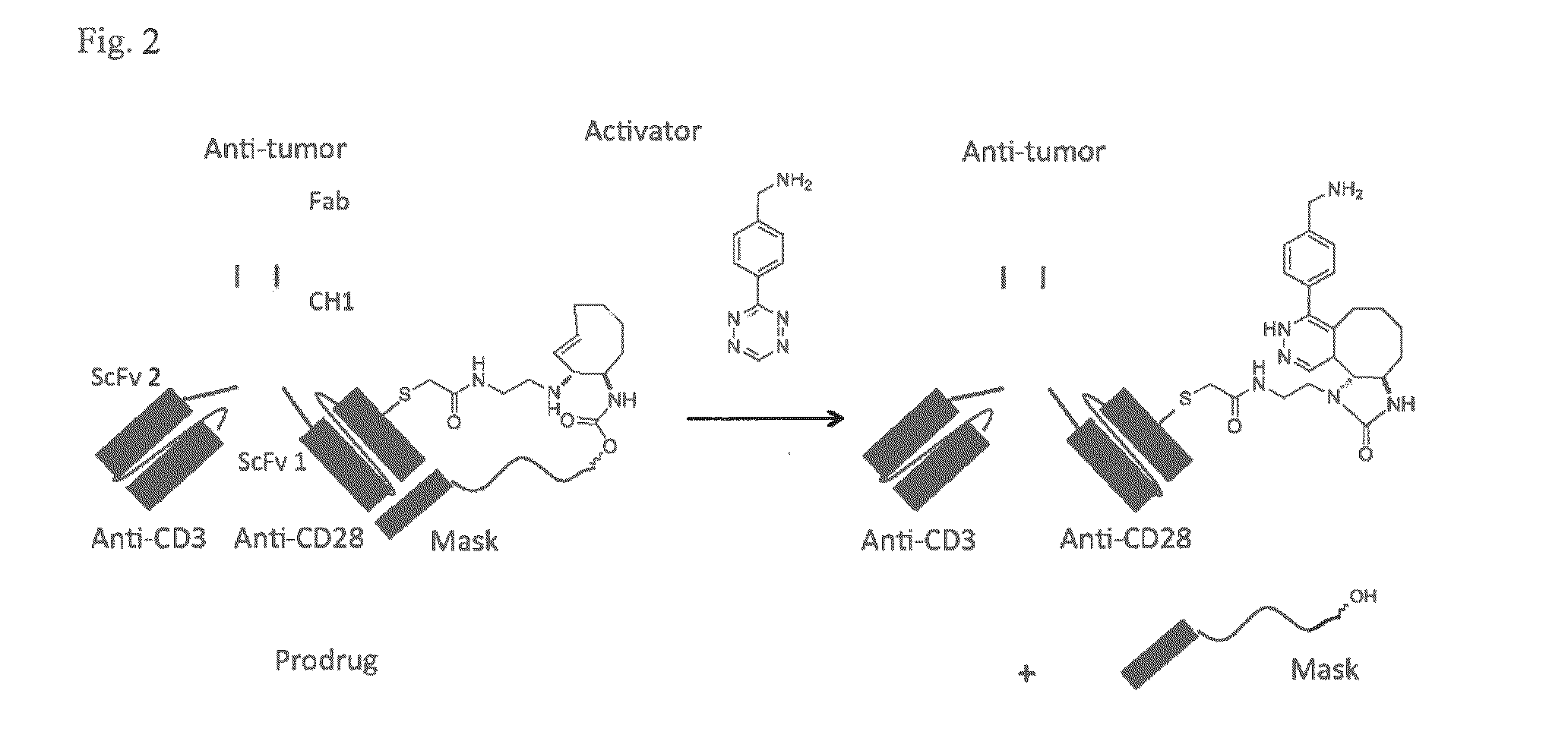
The present invention provides a kit for the administration and activation of a Prodrug, which includes a Masking Moiety linked to a Trigger moiety, which in turn is linked to a Drug. The Trigger moiety includes a dienophile that satisfies a formula. The invention also provides a method of modifying a Masking Moiety into a Prodrug by linking it to a cyclic moiety that satisfies the formula. The Prodrug can be triggered by an abiotic, bio-orthogonal reaction, and the Trigger moiety includes a ring structure that satisfies the formula. The invention also includes a compound comprising a linkage to a Masking Moiety, which can be used in prodrug therapy. The invention also describes the use of a diene, such as tetrazine, as an activator for the release of a substance linked to a compound satisfying the formula. The invention also mentions the use of the inverse electron-demand Diels-Alder reaction between a compound satisfying the formula and a diene, which can be used as a chemical tool for the release of the substance.
Problems solved by technology
However, in many cases a target site of interest lacks a suitable overexpressed enzyme.
Enzymes of non-mammalian origin that meet these needs are likely to be highly immunogenic, a fact that makes repeated administration impossible.
This strategy has met limited success in part because cytotoxic drugs tend to be inactive or less active when conjugated to large antibodies, or proteinreceptor ligands.
Also, these aminoacid-linked drugs cannot escape the cells.
The current antibody-drug conjugate release strategies have their limitations.
This is especially a problem for large constructs like mAb (conjugates).
The penetration can be improved by increasing the mAb dose, however, this approach is limited by dose limiting toxicity in e.g. the liver.
Also, many targets are hampered by ineffective internalization, and different drugs cannot be linked to a mAb in the same way.
Further, it has been proven cumbersome to design linkers to be selectively cleavable by endogenous elements in the target while stable to endogenous elements en route to the target (especially the case for slow clearing full mAbs).
This not only prevents the conjugate from getting to the tumor but can also lead to cytokine storms and T-cell depletion.
However, light based activation is limited to regions in the body where light can penetrate, and is not easily amendable to treating systemic disease such as metastatic cancer.
Such constructs are too toxic to use as such and either the CD3 or the CD28 or both binding domains need to be masked.
Consequently, it can be difficult to achieve therapeutically useful blood levels of the proteins in patients.
The presented Staudinger approach for this concept, however, has turned out not to work well, and its area of applicability is limited in view of the specific nature of the release mechanism imposed by the Staudinger reaction.
Other drawbacks for use of Staudinger reactions are their limited reaction rates, and the oxidative instability of the phosphine components of these reactions.
Method used
the structure of the environmentally friendly knitted fabric provided by the present invention; figure 2 Flow chart of the yarn wrapping machine for environmentally friendly knitted fabrics and storage devices; image 3 Is the parameter map of the yarn covering machine
View more
Image
Smart Image Click on the blue labels to locate them in the text.
Viewing Examples
Smart Image
Click on the blue label to locate the original text in one second.
Reading with bidirectional positioning of images and text.
Smart Image
Examples
Experimental program
Comparison scheme
Effect test
embodiment 1
Additional Embodiment 1
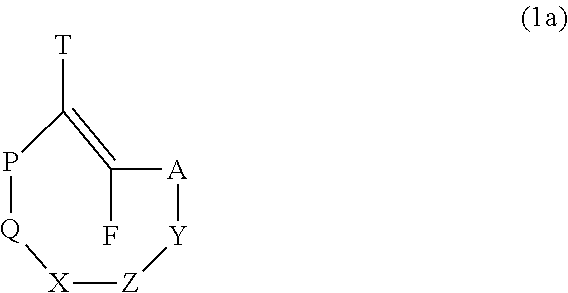
[0188]With reference to formula (1a) and (1b) for Triggers that function via cascade-mediated release or elimination (i.e. cascade mechanism), when p=1 and n=1 it is preferred that LD is linked to TR via N or NH or an aliphatic or aromatic carbon, wherein these atoms are part of the linker; and when p=1 and n=0 it is preferred that MM is linked to TR via N or NH or an aliphatic or aromatic carbon, wherein these atoms are part of DD. It is further preferred that said N and NH moieties comprised in LD or MM are bound to an aliphatic or aromatic carbon of LD or MM.
[0189]With reference to formula (1a) and (1b) for Triggers that function via cascade-mediated release or elimination (i.e. cascade mechanism), when p=0 and n=1 it is preferred that LD is linked to TR via S or O, wherein these atoms are part of the linker; and when p=0 and n=0 it is preferred that MM is linked to TR via S or O, wherein these atoms are part of MM. It is further preferred that said S and O...
embodiment 2
Additional Embodiment 2
[0191]Further preferred activators for use with Triggers based on the cascade mechanism are:
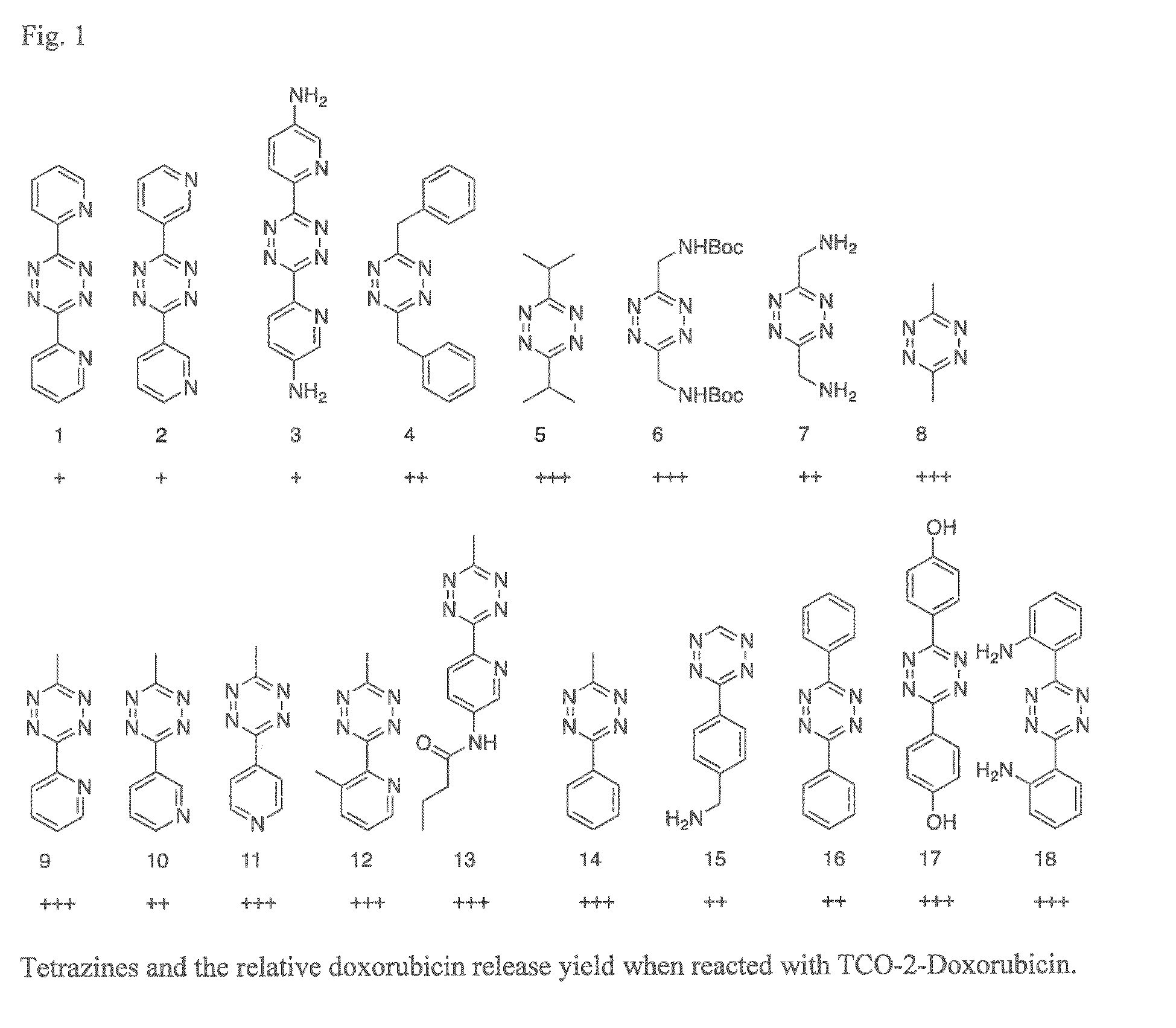
[0192]The 1,2,4,5-tetrazine given in Formula (8c-g), wherein each R1 and each R2 independently are selected from the group consisting of H, alkyl, aryl, CF3, CF2—R′, NO2, OR′, SR′, C(═O)R′, C(═S)R′, OC(═O)R′″, SC(═O)R′″, OC(═S)R′″, SC(═S)R′″, S(═O)R′, S(═O)2R′″, S(═O)2NR′R″, C(═O)O—R′, C(═O)S—R′, C(═S)O—R′, C(═S)S—R′, C(═O)NR′R″, C(═S)NR′R″, NR′R″, NR′C(═O)R″, NR′C(═S)R″, NR′C(═O)OR″, NR′C(═S)OR″, NR′C(═O)SR″, NR′C(═S)SR″, OC(═O)NR′R″, SC(═O)NR′R″, OC(═S)NR′R″, SC(═S)NR′R″, NR′C(═O)NR″R″, NR′C(═S)NR″R″ with each R′ and each R″ independently being H, aryl or alkyl, and R′″ independently being aryl or alkyl.
[0193]Other preferred activators for use with Triggers based on the cascade mechanism are:
[0194]Other preferred activators for use with Triggers based on the strain release mechanism are:
[0195]The Activator can have a link to a Masking Moiety MM such as a peptide, prot...
embodiment 3
Additional Embodiment 3
[0196]Some embodiments satisfy the one of the following formulas:
the structure of the environmentally friendly knitted fabric provided by the present invention; figure 2 Flow chart of the yarn wrapping machine for environmentally friendly knitted fabrics and storage devices; image 3 Is the parameter map of the yarn covering machine
Login to View More
PUM
Property
Measurement
Unit
Mass
aaaaa
aaaaa
Digital information
aaaaa
aaaaa
Time
aaaaa
aaaaa
Login to View More
Abstract
Disclosed is a kit for the administration and activation of a Prodrug. The kit comprises a Masking Moiety linked, directly or indirectly, to a Trigger moiety, which in turn is linked to a Drug, and an Activator for the Trigger moiety. The Trigger moiety comprises a dienophile and the Activator comprises a diene, whereby the dienophile is an eight-membered non-aromatic cyclic alkenylene group, preferably a cyclooctene group, and more preferably a trans-cyclooctene group. The Trigger and the Activator undergo a fast, bio-orthogonal reaction resulting in the release of the Masking Moiety, and activation of the drug.
Description
CROSS-REFERENCES TO RELATED APPLICATIONS[0001]This application claims priority to and hereby incorporates by reference in their entirety PCT application number PCT / NL2013 / 050848 entitled “BIO-ORTHOGONAL DRUG ACTIVATION” filed on Nov. 22, 2013; and European Patent Application EP 12193918.5 entitled “BIO-ORTHOGONAL DRUG ACTIVATION” filed on Nov. 22, 2012.TECHNICAL FIELD[0002]The invention relates to therapeutical methods on the basis of inactivated drugs, such as prodrugs, that are activated by means of an abiotic, bio-orthogonal chemical reaction.BACKGROUND OF THE INVENTION[0003]In the medical arena the use of inactive compounds such as prodrugs which are activated in a specific site in the human or animal body is well known. Also targeted delivery of inactives such as prodrugs has been studied extensively. Much effort has been devoted to drug delivery systems that effect drug release selectivity at a target site and / or at a desired moment in time. One way is to selectively activate ...
Claims
the structure of the environmentally friendly knitted fabric provided by the present invention; figure 2 Flow chart of the yarn wrapping machine for environmentally friendly knitted fabrics and storage devices; image 3 Is the parameter map of the yarn covering machine
Login to View More
Application Information
Patent Timeline
Application Date:The date an application was filed.
Publication Date:The date a patent or application was officially published.
First Publication Date:The earliest publication date of a patent with the same application number.
Issue Date:Publication date of the patent grant document.
PCT Entry Date:The Entry date of PCT National Phase.
Estimated Expiry Date:The statutory expiry date of a patent right according to the Patent Law, and it is the longest term of protection that the patent right can achieve without the termination of the patent right due to other reasons(Term extension factor has been taken into account ).
Invalid Date:Actual expiry date is based on effective date or publication date of legal transaction data of invalid patent.



 Login to View More