Bending control mechanism for endoscope

a control mechanism and endoscope technology, applied in gearing, medical science, diagnostics, etc., can solve the problems of increasing manufacturing costs, reducing productivity, and wire breaking, and achieves reduced bending operational force, improved operability, and simple structure

US20160073856A1Inactive Publication Date: 2016-03-17HOYA CORP
9 Cites 9 Cited by

Patent Information

Authority / Receiving Office
US · United States
Patent Type
Applications(United States)
Current Assignee / Owner
Publication Date
2016-03-17
Estimated Expiration
Not applicable · inactive patent

Smart Images

  • Figure 1
    Figure 1
  • Figure 2
    Figure 2
  • Figure 3
    Figure 3
Patent Text Reader

Abstract

A bending control mechanism for an endoscope, provided with a control body and a bendable section including an insertion section, the bending control mechanism includes a pulley which is rotatably provided in the control body, and a wire connected between the pulley and the bendable section. An outer peripheral profile of the pulley, onto which the wire is wound, includes a non-circular section including a small-radius section having a small radius from a rotational axis of the pulley, and a large-radius section having a radius from the rotational axis that is larger than the small radius. The wire is wound onto the large-radius section at an initial winding stage at which the bendable section is at a non-bending position. The wire is wound onto the small-radius section at a stage where the bendable section is bent by a maximum amount.
Need to check novelty before this filing date? Find Prior Art

Description

BACKGROUND OF THE INVENTION

[0001] 1. Field of the Invention

[0002] The present invention relates to a bending control mechanism of an endoscope.

[0003] 2. Description of the Related Art

[0004] In an endoscope in which a bendable section that forms an insertion section can be controllably bent, a bending control mechanism, in which a bending control member is provided on a control body that connects onto a base end of the insertion section and by which the bending angle of the bendable section can be changed by pulling or loosening wires that are connected to a pulley by rotating the pulley by operating the bending control member, is heavily used (used very frequently). The pulling state of the wires is altered by increasing / decreasing the winding amount of the wires on the pulley in accordance with the rotation of the pulley. In such a type of bending control mechanism, since the resistance against a bending operation increases as the amount of bending of the bendable section increases, in...

Examples

Embodiment Construction

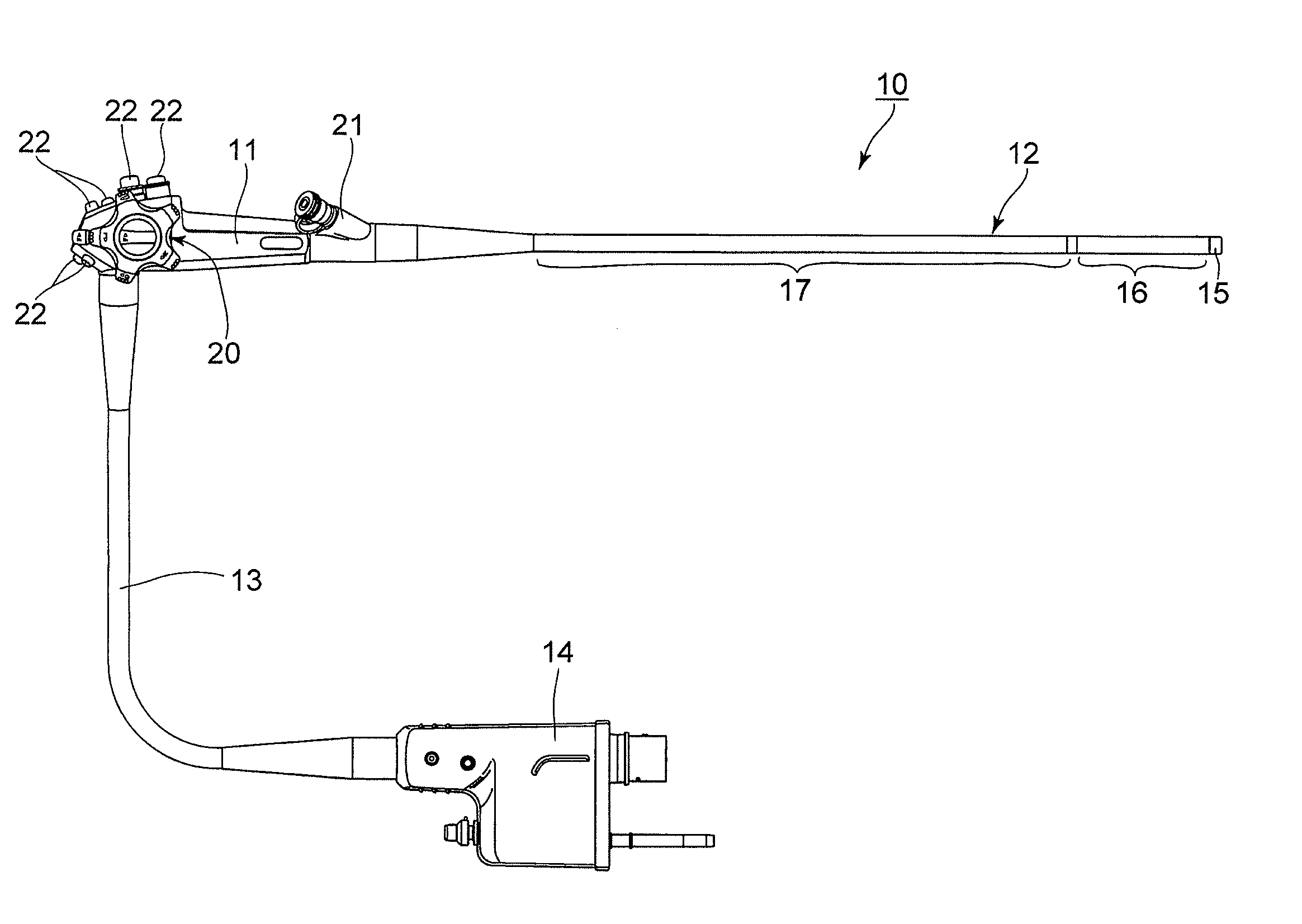
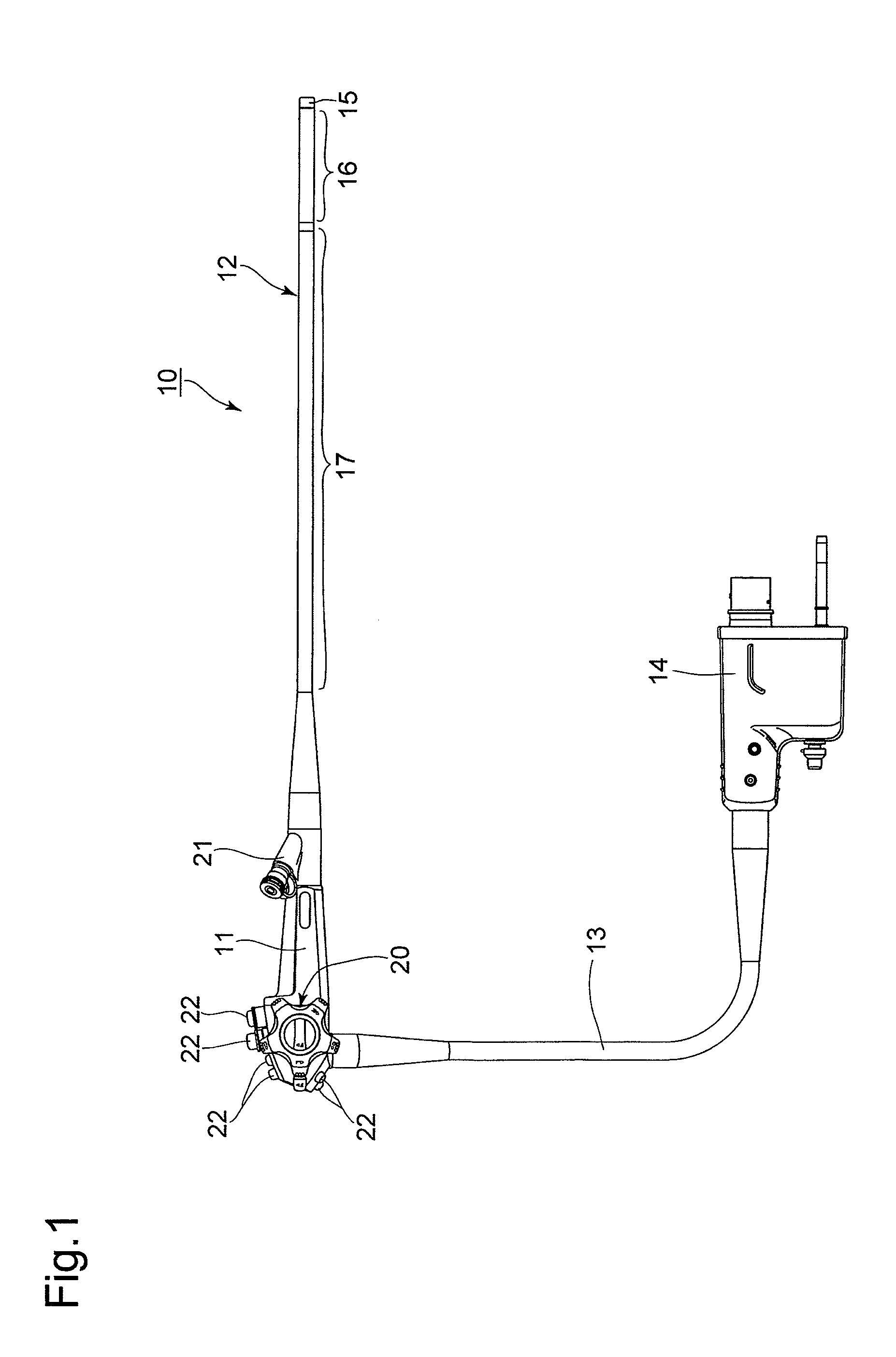
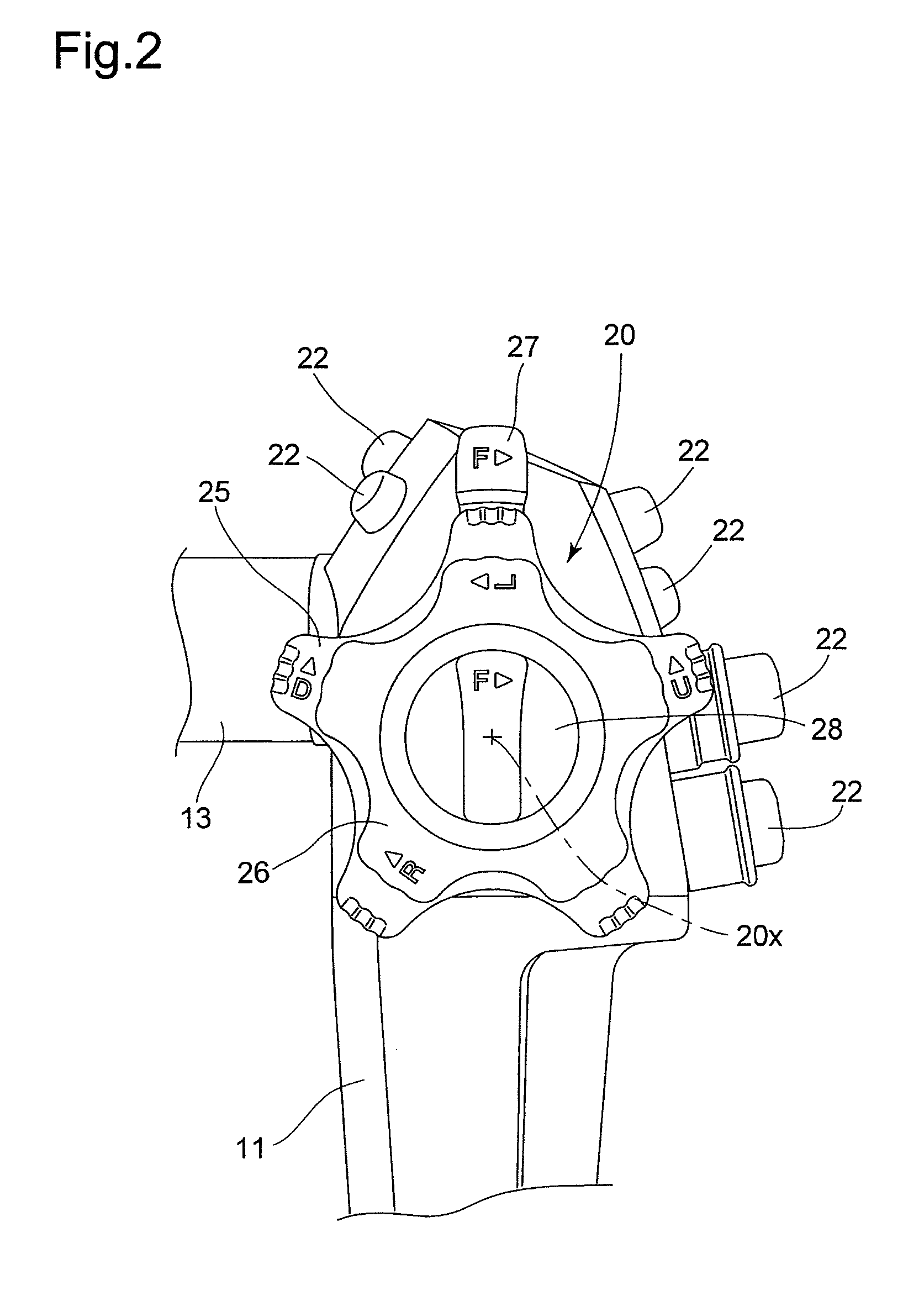
[0026]An endoscope 10 shown in FIG. 1 is provided with a control body 11, a small-diameter insertion section 12 which extends from the distal end of the control body 11, a universal cable 13 which extends from one side of the control body 11, and a connector 14 which is provided on an end of the universal cable 13. The connector 14 is connected to a processor, which is not shown in the drawings. The processor is provided with an in-built image processor and an in-built light-source lamp, for illumination purposes. The insertion section 12 is provided with a distal-end rigid section 15, a bendable section 16 which bends by being remotely controlled (operated) by the control body 11, and a flexible tube 17, in that order from the distal end of the insertion section 12. The control body 11 is provided with a bending controller 20 for controlling the bending of the bendable section 16, a treatment-tool insertion opening 21 via which a treatment tool such as a pair of forceps, etc., are ...