Equalization method for a parsimonious communication channel and device implementing the method
- Summary
- Abstract
- Description
- Claims
- Application Information
AI Technical Summary
Benefits of technology
Problems solved by technology
Method used
Image



Examples
first embodiment
[0048]FIG. 1 shows an overview of an equalizer according to the invention.
[0049]The invention is based on the hypothesis that the transmission channel between the sender and the receiver can be modelled by two remote high-power paths of a duration that is equivalent to a number L of modulated symbols. The other paths are considered to have a low power in relation to the two dominant paths.
[0050]This model is particularly, but not solely, suited to the representation of an aeronautical propagation channel connecting a satellite to an aircraft. In this scenario, the path of highest power corresponds to the direct path between the satellite and the aircraft while the second path, of power that is high but lower than that of the main path, corresponds to the reflection of the signal on the surface of the earth.
[0051]FIG. 2 shows, in a timing diagram, an example of the appearance of the impulse response of a transmission channel with two main paths. The two paths are spaced apart by a ti...
second embodiment
[0096]FIG. 5 diagrammatically illustrates an equalization device 501 according to the invention.
[0097]In this second embodiment, an additional step of removing interference 530 is introduced between the “forward” step of the equalization and the “backward” step.
[0098]The device 501l comprises a first demultiplexer 510 that is identical to the demultiplexer 110 of the device of FIG. 1, which produces, at the output, L parallel routes comprising the same symbols divided into L sub-sampled sub-blocks.
[0099]On each demultiplexing route, a first equalizer F1, F2, . . . FL−1 of MAP equalizer type is applied, but implementing solely the step of traversing the trellis in the forward direction, or the “forward” step.
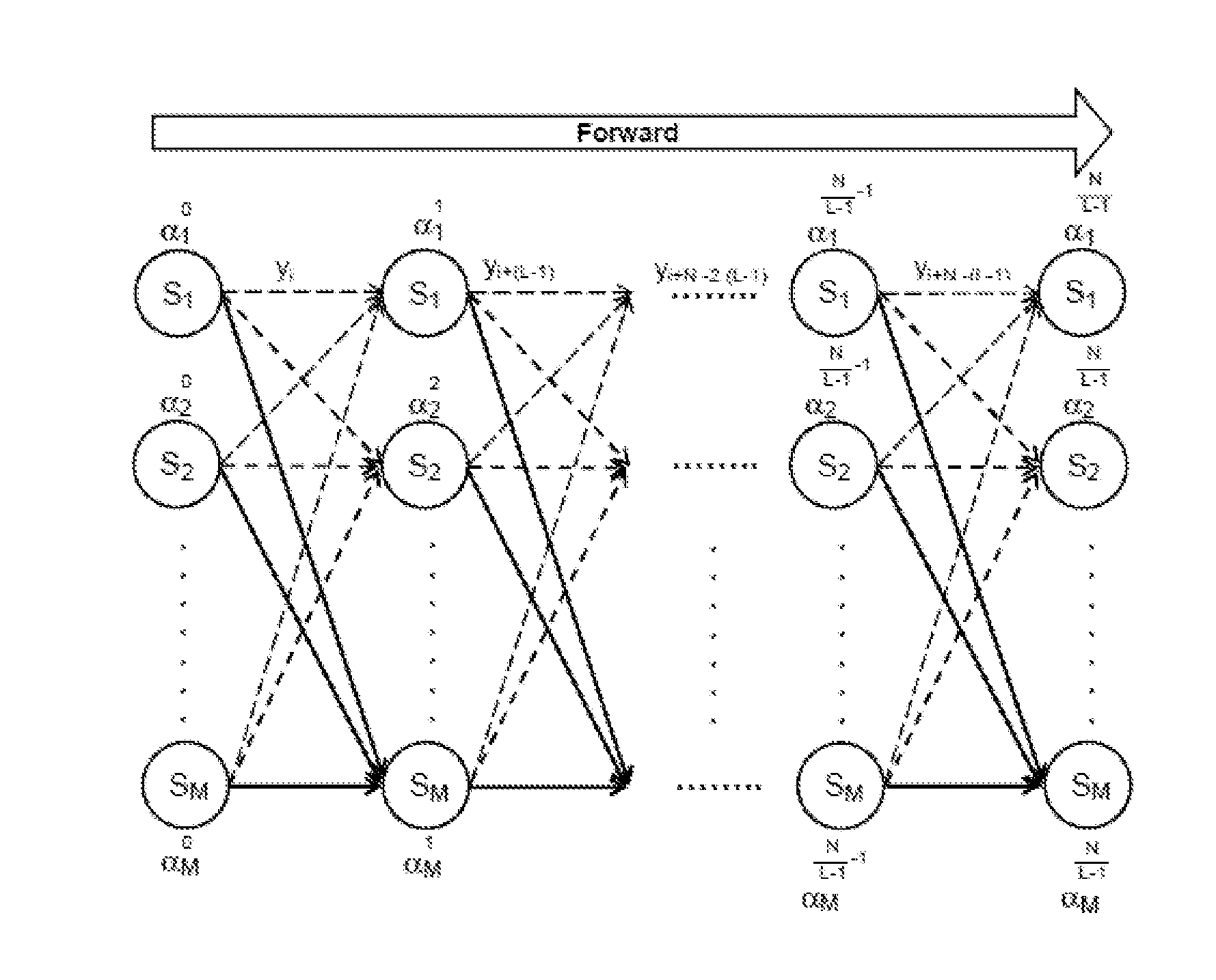
[0100]A first multiplexer 520 that is identical to the multiplexer 130 of FIG. 1 reconstructs a block of N equalized symbols from the outputs of the L first equalizers F1, F2, . . . FL−1. The equalized symbols can be soft-value or LLR (log likelihood ratio) symbols or decided val...
PUM
 Login to View More
 Abstract
Description
Claims
Application Information
 Login to View More