Unlock instant, AI-driven research and patent intelligence for your innovation.

Process for the conversion of methane to c2+ hydrocarbons

a technology of c2+ hydrocarbons and methane, which is applied in the direction of hydrocarbon by hydrocarbon condensation, catalyst regeneration/reactivation, catalysts, etc., can solve the problems of low selectivity of c2+/sub> hydrocarbons, short supply of current feedstocks for ethylene production, and easy combustion of ethylene in the presence of oxygen

Inactive Publication Date: 2016-09-15
SAUDI BASIC IND CORP SA
View PDF5 Cites 0 Cited by
  • Summary
  • Abstract
  • Description
  • Claims
  • Application Information

AI Technical Summary

Benefits of technology

The patent describes a method for making ethane using a metal oxide catalyst. The method involves introducing a chlorine stream and a methane stream to a first reaction zone, where the metal oxide converts to metal chloride and reacts with methane to form a product stream comprising ethane and carbon dioxide. Oxygen is then introduced to a second reaction zone, where it converts the metal chloride back to metal oxide and chlorine gas. This process produces ethane and chlorine gas. In another embodiment, the method includes separately converting the metal chloride back to metal oxide with oxygen from an oxygen source. Overall, the described method provides a means for efficiently producing ethane and chlorine gas.

Problems solved by technology

Olefins, such as ethylene and propylene are major feedstocks in the organic chemical and petrochemical industries and current feedstocks for the production of ethylene are in relatively short supply.
While this method produces ethylene, the produced ethylene in the presence of the oxygen is easily combusted to produce carbon dioxide and water.
Accordingly, this process resulted in a low selectivity for C2+ hydrocarbons (i.e. those comprising two or more carbon atoms) of less than 70%.

Method used

the structure of the environmentally friendly knitted fabric provided by the present invention; figure 2 Flow chart of the yarn wrapping machine for environmentally friendly knitted fabrics and storage devices; image 3 Is the parameter map of the yarn covering machine
View more

Image

Smart Image Click on the blue labels to locate them in the text.
Viewing Examples
Smart Image
  • Process for the conversion of methane to c2+ hydrocarbons

Examples

Experimental program
Comparison scheme
Effect test

embodiment 1

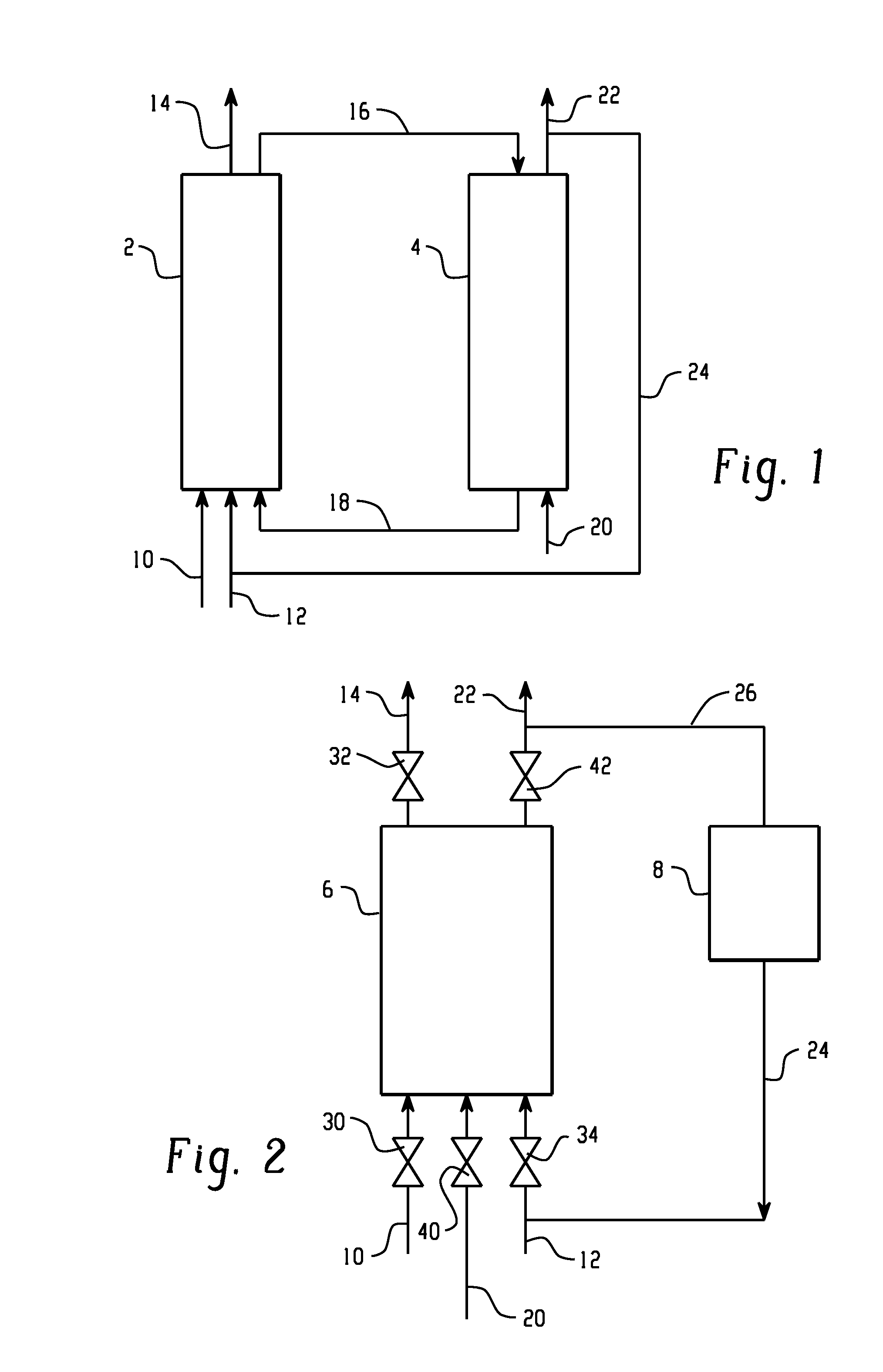
[0032] a method of making ethane, comprising: introducing a chlorine stream and a methane stream to a first reaction zone comprising a metal oxide catalyst; converting the metal oxide to metal chloride and reacting the methane to form a product stream comprising the C2+ hydrocarbon and CO2, wherein the C2+ hydrocarbon comprises at least one of ethane and ethene; introducing the metal chloride to a second reaction zone; introducing oxygen to the second reaction zone to convert the metal chloride to metal oxide and chlorine gas; and directing the metal oxide back to the first reaction zone.

embodiment 2

[0033] a method of making ethane, comprising: introducing only a chlorine stream and a methane stream to a metal oxide catalyst to form the ethane and carbon dioxide, wherein the chlorine stream and the methane stream each comprise less than 1 vol % oxygen, and wherein metal oxide converts to metal chloride; and separately converting the metal chloride back to metal oxide with oxygen from an oxygen source, wherein chlorine gas is produced.

[0034]Embodiment 3: the method of any of Embodiments 1-2, wherein the chlorine stream and the methane streams are introduced to the metal oxide catalyst as a mixed stream.

embodiment 4

[0035] the method of any of Embodiments 1-3, wherein the oxygen source is air.

[0036]Embodiment 5: the method of Embodiment 4, further comprising separating nitrogen from the chloride.

the structure of the environmentally friendly knitted fabric provided by the present invention; figure 2 Flow chart of the yarn wrapping machine for environmentally friendly knitted fabrics and storage devices; image 3 Is the parameter map of the yarn covering machine
Login to View More

PUM

PropertyMeasurementUnit
Fractionaaaaaaaaaa
Volumeaaaaaaaaaa
Login to View More

Abstract

A method of making ethane can comprise: introducing a chlorine stream and a methane stream to a first reaction zone comprising a metal oxide catalyst; converting the metal oxide to metal chloride and reacting the methane to form a product stream comprising the C2H4; introducing the metal chloride to a second reaction zone and introducing oxygen to convert the metal chloride to metal oxide and chlorine gas; and directing the metal oxide back to the first reaction zone. Also, a method of making ethane, comprising: introducing only a chlorine stream and a methane stream to a metal oxide catalyst to form the ethane and carbon dioxide, wherein the chlorine stream and the methane stream each comprise less than 1 vol % oxygen, and wherein metal oxide converts to metal chloride; and separately converting the metal chloride back to metal oxide with oxygen from an oxygen source, wherein chlorine gas is produced.

Description

BACKGROUND[0001]Olefins, such as ethylene and propylene are major feedstocks in the organic chemical and petrochemical industries and current feedstocks for the production of ethylene are in relatively short supply. Due to the high demands for ethylene and due to the abundance of natural gas, methods to convert methane to ethylene have been developed.[0002]Currently, there are several methods of converting methane to C2+ hydrocarbons. One such conversion reaction occurs by pyrolyzing the methane at high temperatures, for example, greater than 1000 degrees Celsius (° C.), with oxygen to produce ethylene and water. While this method produces ethylene, the produced ethylene in the presence of the oxygen is easily combusted to produce carbon dioxide and water. Catalyzed pyrolysis methods were developed, where a catalyst was used to facilitate the methane conversion reaction. In this method an oxygen feed is required to regenerate said catalyst and high combustion is still observed.[0003...

Claims

the structure of the environmentally friendly knitted fabric provided by the present invention; figure 2 Flow chart of the yarn wrapping machine for environmentally friendly knitted fabrics and storage devices; image 3 Is the parameter map of the yarn covering machine
Login to View More

Application Information

Patent Timeline
no application Login to View More
IPC IPC(8): C07C17/10C07C2/76
CPCC07C17/10C07C2/76C07C2523/34C07C2523/14C07C2523/04C07C2523/745C07C2523/26C07C2523/08C07C2523/18C07C2523/72C07C2/78C07C2523/02B01J38/12Y02P20/584C07C9/06C07C11/04C07C21/06
Inventor MAMMADOV, AGHADDIN KH.WEST, DAVID
Owner SAUDI BASIC IND CORP SA