Unlock instant, AI-driven research and patent intelligence for your innovation.

Information recording and reproducing apparatus and information recording and reproducing method

a technology of information recording and reproducing apparatus and information recording and reproducing method, which is applied in the direction of recording strategies, recording signal processing, instruments, etc., can solve the problems of increasing the influence of thermal interference, affecting the formation of recording marks, and reducing so as to reduce the error rate of recording information and achieve stable recording and reproducing system. , the effect of high density

Active Publication Date: 2016-09-22
PANASONIC INTELLECTUAL PROPERTY MANAGEMENT CO LTD
View PDF1 Cites 1 Cited by
  • Summary
  • Abstract
  • Description
  • Claims
  • Application Information

AI Technical Summary

Benefits of technology

This patent aims to provide an apparatus and method for recording and reproducing information in high-density using a laser. The goal is to reduce errors in the recorded information caused by interference between recording marks and improve the accuracy of edge shifts. By using recording compensation, the apparatus and method can create a more stable recording and reproducing system with lower errors and improved accuracy.

Problems solved by technology

In the recording density in which the length of a space between recording marks is short, heat generated when a recording mark is formed is not sufficiently reduced at a space section, and affects a temperature rise at a leading edge of a succeeding recording mark.
Further, since a length of a space from a preceding recording mark decreases, an influence of thermal interference increases.
However, when the recording density is further densified, for example, about 40 GB or 50 GB in the case of a BD, it is not possible to accurately perform conventional edge shift detection.
However, it is not possible to perform waveform equalization to a reproduced signal having no signal amplitude.
As a result, it is not possible to reduce intersymbol interference by performing waveform equalization to a reproduced signal based on the PRML method as in the conventional manner.
Accordingly, it is very difficult to reduce two edge shifts at the same time by recording compensation.
In high density recording, a number of patterns that is most susceptible to an error depending on a length of a bit stream further increases, since a range of intersymbol interference increases.
Accordingly, more than one edge shift is detected for one edge, and it is not possible to determine a correct edge shift, and therefore recording compensation may not be performed.
As described above, in a recording density beyond optical resolution, and with further densified recording density, it is not possible to correctly detect an edge shift based on the conventional method of detecting an edge shift from a reproduced signal near an edge portion.

Method used

the structure of the environmentally friendly knitted fabric provided by the present invention; figure 2 Flow chart of the yarn wrapping machine for environmentally friendly knitted fabrics and storage devices; image 3 Is the parameter map of the yarn covering machine
View more

Image

Smart Image Click on the blue labels to locate them in the text.
Viewing Examples
Smart Image
  • Information recording and reproducing apparatus and information recording and reproducing method
  • Information recording and reproducing apparatus and information recording and reproducing method
  • Information recording and reproducing apparatus and information recording and reproducing method

Examples

Experimental program
Comparison scheme
Effect test

first exemplary embodiment

[0074]Next, recording compensation to an edge shift according to a first exemplary embodiment will be described. In the first exemplary embodiment, recording compensation of each of the recording marks is first performed using recording data between preceding and succeeding spaces that are sufficiently long.

[0075]The lengths of the spaces are set to a length that is not affected by intersymbol interference of preceding and succeeding recording marks. For example, a space length is calculated by defining N times (N is a positive real number) of space length λ / (4×NA), which is a condition that amplitude of a reproduced signal becomes zero, as space length (λ / (4×NA))×N, and by setting N to a large value such as N=10, for example. The space length is a length in which there is no intersymbol interference with other recording marks, and therefore set to be longer than the longest run length in the modulation code. Further, if intersymbol interference can be removed by signal processing s...

second exemplary embodiment

[0174]Hereinafter, detection of an edge shift according to a second exemplary embodiment will be described. In the first exemplary embodiment, the description has been given of recording compensation to the edge shift of the recording mark after interference, such as intersymbol interference, optical interference, and thermal interference, is removed. The recording condition to which recording compensation is performed is converged to an optimal recording condition taking interference as a whole into consideration.

[0175]In the second exemplary embodiment, an edge shift is detected with which the optimal recording condition is directly obtained after symbol interference is removed.

[0176]In order to detect the edge shift, a binary signal as the recording data, a reproduced signal when the binary signal is recorded and reproduced, and an expectation signal are required. Here, similarly to the first exemplary embodiment, the expectation signal is obtained by convolution of the binary si...

the structure of the environmentally friendly knitted fabric provided by the present invention; figure 2 Flow chart of the yarn wrapping machine for environmentally friendly knitted fabrics and storage devices; image 3 Is the parameter map of the yarn covering machine
Login to View More

PUM

No PUM Login to View More

Abstract

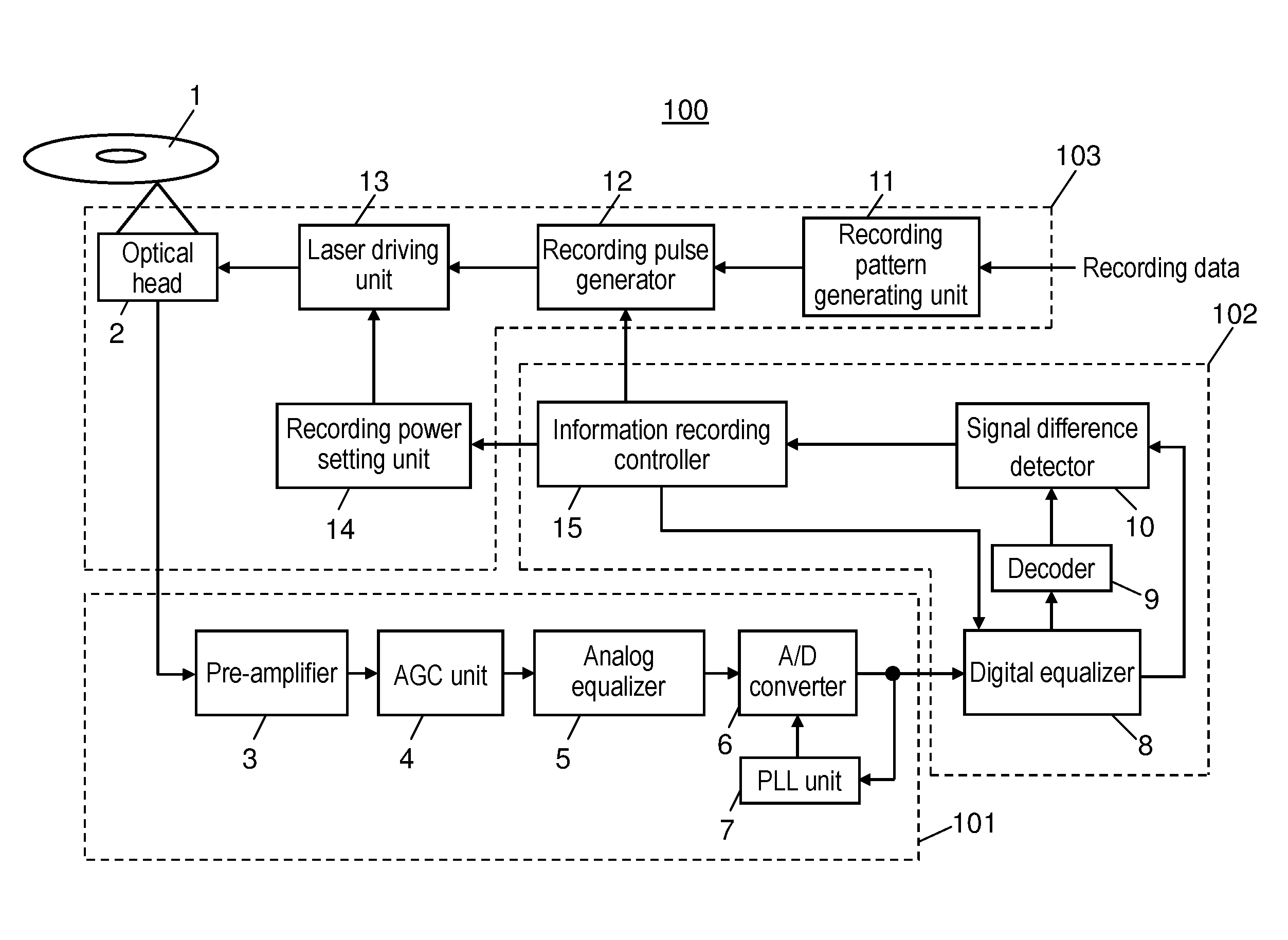
An information recording and reproducing apparatus including: a reproducing unit which generates a digital signal from an analog signal; a recording compensation unit which generates an expectation signal from the digital signal, detects a signal difference between the digital signal and the expectation signal, and adjusts a recording condition for recording the information; and a recording unit configured to record the information based on the recording condition. First recording compensation is performed for adjusting the recording condition using first recording where lengths of a preceding space and a succeeding space of a first recording mark and lengths of a preceding space and a succeeding space of a second recording mark are not in intersymbol interference; and second recording compensation is performed for adjusting the recording condition for the first recording mark using second recording data for changing a length of the second recording mark.

Description

BACKGROUND[0001]1. Technical Field[0002]The present disclosure relates to an information recording and reproducing apparatus and an information recording and reproducing method, both capable of performing recording compensation more accurately to an information recording medium having an information recording surface to which information is optically recordable, the recording compensation being performed for realizing high density recording more stably.[0003]2. Description of Related Art[0004]Conventionally, information recording media such as DVDs (Digital Versatile Discs) and BDs (Blu-ray (registered trademark) Discs) are used as recording media aimed at general users for storing video or data. In recent years, BDs have come to be used in data archivers for storing important data for an extended period of time with a highly reliable system. Data archivers are a product that is mainly available for business use, and are required to have higher density in order to allow more data to...

Claims

the structure of the environmentally friendly knitted fabric provided by the present invention; figure 2 Flow chart of the yarn wrapping machine for environmentally friendly knitted fabrics and storage devices; image 3 Is the parameter map of the yarn covering machine
Login to View More

Application Information

Patent Timeline
no application Login to View More
IPC IPC(8): G11B7/0045G11B20/10
CPCG11B20/10037G11B7/00456G11B20/10009G11B20/10194G11B7/0045G11B7/1263G11B7/1267G11B7/0062
Inventor KOBAYASHI, ISAONAKATA, KOHEIHINO, YASUMORI
Owner PANASONIC INTELLECTUAL PROPERTY MANAGEMENT CO LTD