
Azaindole acetic acid derivatives and their use as prostaglandin d2 receptor modulators
a technology of azaindole and acetic acid, which is applied in the field of azaindole acetic acid derivatives, can solve the problems of limited efficacy of anti-histamines and leukotriene antagonists, and the association of long-term use of corticosteroids with unwanted side effects
- Summary
- Abstract
- Description
- Claims
- Application Information
AI Technical Summary
Benefits of technology
Problems solved by technology
Method used
Image

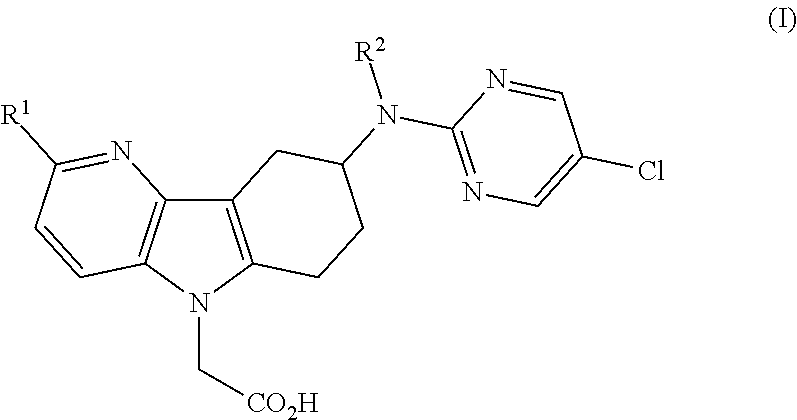
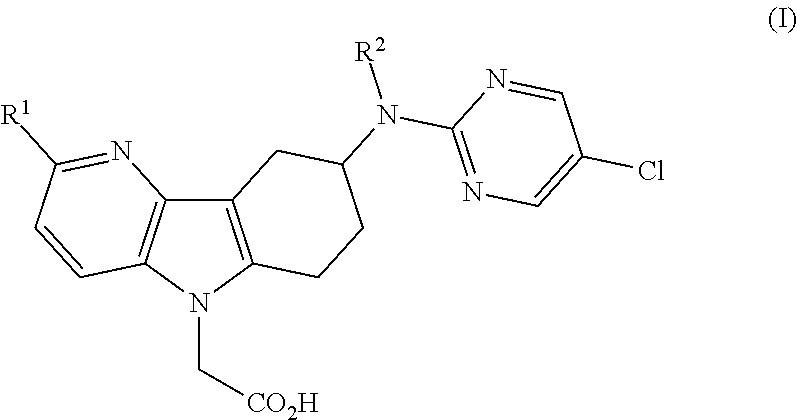
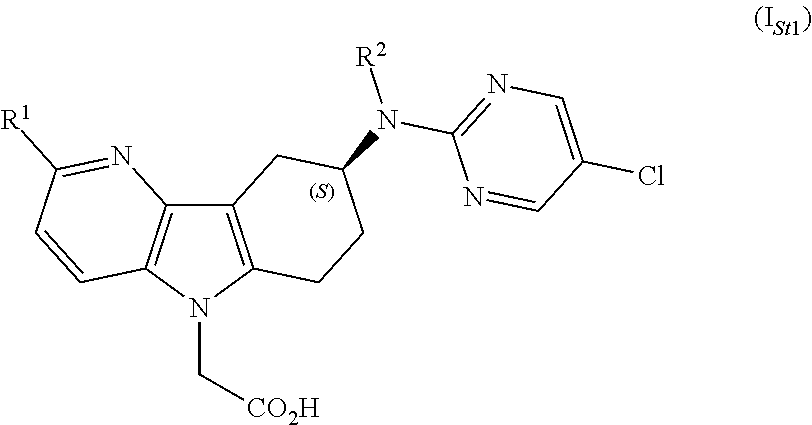
Examples
example 6
[0183]
[0184]To (S)-ethyl 2-(8-((tert-butoxycarbonyl)(methyl)amino)-6,7,8,9-tetrahydro-5H-pyrido[3,2-b]indol-5-yl)acetate (100 mg, 0.258 mmol) was added 4N HCl in dioxane (0.895 mL). The reaction mixture was stirred at RT for 1 h and concentrated to give the desired product as a hydrochloride salt which was used in the next step without further purification.
[0185]LC-MS: tR: 0.38 min. / [M+H]+: 288.25.
[0186]To a solution of this intermediate (93 mg, 0.26 mmol) in DMA (1.8 mL) were added 2,5-dichloropyrimidine (38.5 mg, 0.26 mmol) and K2CO3 (143 mg, 1.03 mmol). The reaction mixture was stirred at 80° C. for 20 h. After cooling to RT, water (0.26 mL) and 30% aq NaOH (0.26 mL) were added and the reaction mixture was stirred at 50° C. for 2 h. Then 37% aq HCl (0.26 mL) was added, and the resulting precipitate was filtered off and purified by prep-HPLC (basic conditions) to give the titled compound as a white solid.
[0187]LC-MS: tR: 0.61 min. / [M+H]+: 372.18.
[0188]HPLC (chiral HPLC-2): tR: 7.8...
example 7
[0197]
[0198]To a solution of (S)-ethyl 2-(8-((5-chloropyrimidin-2-yl)(methyl)amino)-2-fluoro-6,7,8,9-tetrahydro-5H-pyrido[3,2-b]indol-5-yl)acetate (271 mg, 0.649 mmol, 1 eq) in THF (10 mL) was added NaOH 1N (10 mL, 10 mmol, 15.42 eq) at RT. The reaction mixture was stirred at RT for 1 h. The reaction mixture was concentrated in vacuo to remove only THF. It was then acidified with HCl conc. to pH-5-6 and stirred at RT. The suspension was extracted with EtOAc (4×). The combined organic layers were dried over MgSO4, filtered and concentrated in vacuo to give the title compound as a beige solid (255 mg, 100%).
[0199]LC-MS: tR: 0.82 min. / [M+H]+: 390.12
[0200]HPLC (chiral HPLC-2): tR: 4.96 min.
A.5 Synthesis of (S)-2-(8-((5-chloropyrimidin-2-yl)amino)-2-fluoro-6,7,8,9-tetrahydro-5H-pyrido[3,2-b]indol-5-yl)acetic acid
A.5.1 Synthesis of benzyl (2-fluoro-6,7,8,9-tetrahydro-5H-pyrido[3,2-b]indol-8-yl)carbamate
[0201]
[0202]A solution of 2-fluoro-5-hydrazinylpyridine hydrochloride (200 mg, 1 eq), b...
example 8
[0215]
[0216]To a solution of (S)-ethyl-2-(8-amino-2-fluoro-6,7,8,9-tetrahydro-5H-pyrido[3,2-b]indol-5-yl)acetate (hydrobromide salt) (48 mg, leg) in DMA (1 mL) were added successively 2,5-dichloropyrimidine (15.6 mg, 1.4 eq) and anhydrous K2CO3 (41.5 mg, 4 eq). The reaction mixture was stirred at 80° C. for 16 h. After cooling to RT, the reaction was poured into water and extracted with EA. The combined organic extracts were dried over MgSO4, filtered and concentrated in vacuo. The residue was purified by prep-HPLC (acidic conditions) to give the intermediate ethyl ester (9 mg, 30%).
[0217]LC-MS: tR: 0.88 min. / [M+H]+: 404.05
[0218]To a solution of the ethyl ester intermediate (9 mg, 1 eq) in THF (0.5 mL) was added 1N NaOH (0.5 mL). The reaction mixture was stirred at RT for 1 h, acidified until pH 1-2 with 1N HCl and extracted with EA. The combined organic extracts were dried over MgSO4, filtered and concentrated in vacuo to give the title compound as a beige solid (6 mg, 24%).
[0219]L...
PUM
| Property | Measurement | Unit |
|---|---|---|
| Absolute configuration | aaaaa | aaaaa |
Abstract
Description
Claims
Application Information
 Login to View More