Magnesium battery having an electrolyte containing cations of magnesium and sodium
a technology of magnesium and sodium ions, applied in the direction of batteries, sustainable manufacturing/processing, cell components, etc., can solve the problems of sodium ion batteries suffering many of the same problems, lithium ion batteries based on lithium metal anodes are subject to safety concerns, and most advanced lib technology is not considered to be viable as a power source capabl
- Summary
- Abstract
- Description
- Claims
- Application Information
AI Technical Summary
Benefits of technology
Problems solved by technology
Method used
Image

Examples
example 1
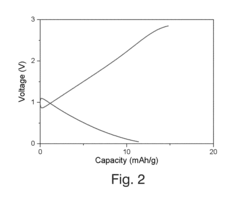
[0061]A Mg—Na dual ion battery was constructed with a magnesium metal negative electrode and a positive electrode of Na2Ti6O13. The electrolyte was prepared of 0.5 M Na(CB11H12) and 0.25 M Mg(CB11H12)2 dissolved in tetraglyme. The cell delivered 11 mAh / g capacity in the discharge and was charged to a capacity of 15 mAh / g.
[0062]FIG. 2 shows a Voltage profile of the battery using a test current of 10 μA.
[0063]FIG. 3(A) shows the cyclic voltage profile of the Mg—Na dual ion battery and FIG. 3(B) shows the discharge capacity as a function of cycle number using a test current of 10 μA.
example 3
[0065]A battery was constructed with a magnesium metal negative electrode and a positive electrode of NaCrO2. An electrolyte of 0.5 M Na(CB11H12) / tetraglyme and 0.4 M PhMgCl—AlCl3 / THF was used. The cell delivered a discharge capacity about 80 mAh / g (FIG. 4 (curve A) was used. This capacity was much higher than the capacity of the battery in Comparative Example 2 and indicated that the addition of a Mg2+ source to the electrolyte could significantly improve the battery performance.
example 4
[0066]A battery was constructed with a magnesium metal negative electrode and a positive electrode of NaCrO2. An electrolyte of 0.5 M Na(CB11H12) / tetraglyme and 0.4 M PhMgCl—AlCl3 / THF was used. A study was then conducted to determine the effect of the relative amounts of the two electrolytes. The 2nd discharge capacity of Mg—Na dual ion battery using different relative amounts of Na(CB11H12) and APC electrolyte was determined as shown in FIG. 5. At first, the capacity increased with mol % amount of APC added, because the existence of Mg2+ source in the electrolyte improved both charge and discharge capacity. The reversible capacity reached a maximum of 83 mAh / g at an optimal APC ratio of 20-40 mol % and then decreased as more APC was added. It is believed that the decrease of the capacity with increasing APC beyond 40% is related to the reduction of Na+ source in the electrolyte mixture.
PUM
 Login to View More
 Abstract
Description
Claims
Application Information
 Login to View More