Unlock instant, AI-driven research and patent intelligence for your innovation.

Reduction of greenhouse gas emission

a technology of greenhouse gas and emission reduction, which is applied in the field can solve the problems of less able to replace the current energy infrastructure in the transportation sector, less commercially available technologies, and -to-liquid problems, and achieve the effect of reducing greenhouse gas emission

Active Publication Date: 2018-01-04
RES USA LLC
View PDF4 Cites 0 Cited by
  • Summary
  • Abstract
  • Description
  • Claims
  • Application Information

AI Technical Summary

Benefits of technology

The patent describes a method for reducing greenhouse gas emissions by using a reformer to generate synthesis gas, and converting this gas to dimethyl ether. The reformer can be a fluidized bed dry reforming reactor, and it may include a hydrogen membrane that removes hydrogen from the synthesis gas and shifts the reforming reactions towards completion. The method also involves using a regenerator to regenerate the spent catalyst, and a renewable fuel can be used in this regenerator, which can help reduce CO2 emissions. The method does not require any process water or oxygen, and it produces low levels of CO2 and greenhouse gas emissions.

Problems solved by technology

These more commercially available technologies are less able to replace the current energy infrastructure in the transportation sector, namely for heavy vehicle and long haul aircraft.
Unfortunately, conventional gas-to-liquid (GTL) technologies, by and large, do not achieve significant GHG emission reductions versus conventional oil refining; and in some cases result in higher overall wheel-to-wheel GHG emissions.
They also typically require very large net water usages and often import dirty power.
Hence, conventional GTL technologies don't appear to address the specific commitments made at COP 21.

Method used

the structure of the environmentally friendly knitted fabric provided by the present invention; figure 2 Flow chart of the yarn wrapping machine for environmentally friendly knitted fabrics and storage devices; image 3 Is the parameter map of the yarn covering machine
View more

Image

Smart Image Click on the blue labels to locate them in the text.
Viewing Examples
Smart Image
  • Reduction of greenhouse gas emission
  • Reduction of greenhouse gas emission
  • Reduction of greenhouse gas emission

Examples

Experimental program
Comparison scheme
Effect test

Embodiment Construction

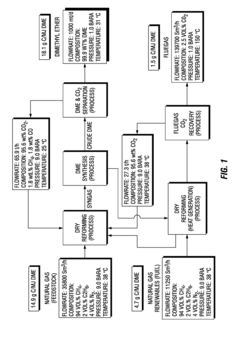
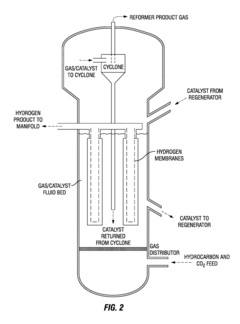
[0021]Herein disclosed is a method of reducing greenhouse gas (GHG) emission comprising introducing one or more feed streams into a reformer to generate synthesis gas; and converting synthesis gas to dimethyl ether (DME). In an embodiment, the reformer is a fluidized bed dry reforming reactor. In an embodiment, the reformer comprises a hydrogen membrane. In an embodiment, the membrane is coated with an erosion resistant layer. In an embodiment, the hydrogen membrane removes hydrogen contained in the synthesis gas and shifts reforming reactions toward completion.

[0022]In an embodiment, reformed gas exits the top of the reformer and is separated from spent catalyst. In an embodiment, spent catalyst is routed to a regenerator in which the catalyst is regenerated.

[0023]In an embodiment, a renewable fuel is used in the regenerator. In an embodiment, the renewable fuel comprises landfill gas, bio-digester gas, pyrolysis oils and liquid fuels, spent glycerol, biomass derived syngas. In an ...

the structure of the environmentally friendly knitted fabric provided by the present invention; figure 2 Flow chart of the yarn wrapping machine for environmentally friendly knitted fabrics and storage devices; image 3 Is the parameter map of the yarn covering machine
Login to View More

PUM

PropertyMeasurementUnit
Weightaaaaaaaaaa
Volumeaaaaaaaaaa
Greenhouse gas emissionaaaaaaaaaa
Login to View More

Abstract

Herein disclosed is a method of reducing greenhouse gas (GHG) emission comprising introducing one or more feed streams into a reformer to generate synthesis gas; and converting synthesis gas to dimethyl ether (DME). In some cases, the reformer is a fluidized bed dry reforming reactor. In some cases, the reformer comprises a hydrogen membrane. In some cases, the hydrogen membrane removes hydrogen contained in the synthesis gas and shifts reforming reactions toward completion.

Description

CROSS-REFERENCE TO RELATED APPLICATIONS[0001]This application claims the benefit under 35 U.S.C. §119(e) of U.S. Provisional Patent Applications No. 62 / 357,521 filed Jul. 1, 2016, the disclosure of which is hereby incorporated herein by reference in its entirety.STATEMENT REGARDING FEDERALLY SPONSORED RESEARCH OR DEVELOPMENT[0002]Not applicable.BACKGROUNDField of the Invention[0003]This disclosure relates generally to the reduction of greenhouse gas (GHG) emission. More particularly, this disclosure relates to the reduction of greenhouse gas (GHG) emission via dry reforming of natural gas.Background of Invention[0004]The recent UN Climate Conference (COP 21) achieved commitments from most countries on specific GHG emission reductions, to limit global temperature rise at or below 2 degrees Celsius, by the end of this century. There is general consensus among the scientific community that this will require a reduction in GHG emissions in the order of 50% from current levels by 2050, w...

Claims

the structure of the environmentally friendly knitted fabric provided by the present invention; figure 2 Flow chart of the yarn wrapping machine for environmentally friendly knitted fabrics and storage devices; image 3 Is the parameter map of the yarn covering machine
Login to View More

Application Information

Patent Timeline
no application Login to View More
IPC IPC(8): C07C41/01B01J23/755C01B3/38C01B3/50B01J23/94B01J38/02
CPCC07C41/01C01B3/38C01B3/503B01J23/755B01J23/94C01B2203/1241C01B2203/0238C01B2203/041C01B2203/06C01B2203/1058B01J38/02Y02P20/584Y02P20/129C01B3/44Y02P20/52C07C43/043
Inventor WRIGHT, HAROLD A.ROBERTSON, MARK K.JIANG, WEIBIN
Owner RES USA LLC