Method for producing a toner

a technology of toner and polymerization method, which is applied in the field of toner, can solve the problems of deterioration of the flowability of the toner, unreacted polymerizable monomer remains, and difficulty in completely polymerizing the polymerizable monomer, and achieve excellent printing durability and improved environmental charge stability

a technology of toner and polymerization method, which is applied in the field of toner, can solve the problems of deterioration of the flowability of the toner, unreacted polymerizable monomer remains, and difficulty in completely polymerizing the polymerizable monomer, and achieve excellent printing durability and improved environmental charge stability

US20180307149A1Active Publication Date: 2018-10-25ZEON CORP

Image

Smart Image Click on the blue labels to locate them in the text.
Viewing Examples
Smart Image
  • Method for producing a toner
  • Method for producing a toner
  • Method for producing a toner

Examples

Experimental program
Comparison scheme
Effect test

synthesis example 1

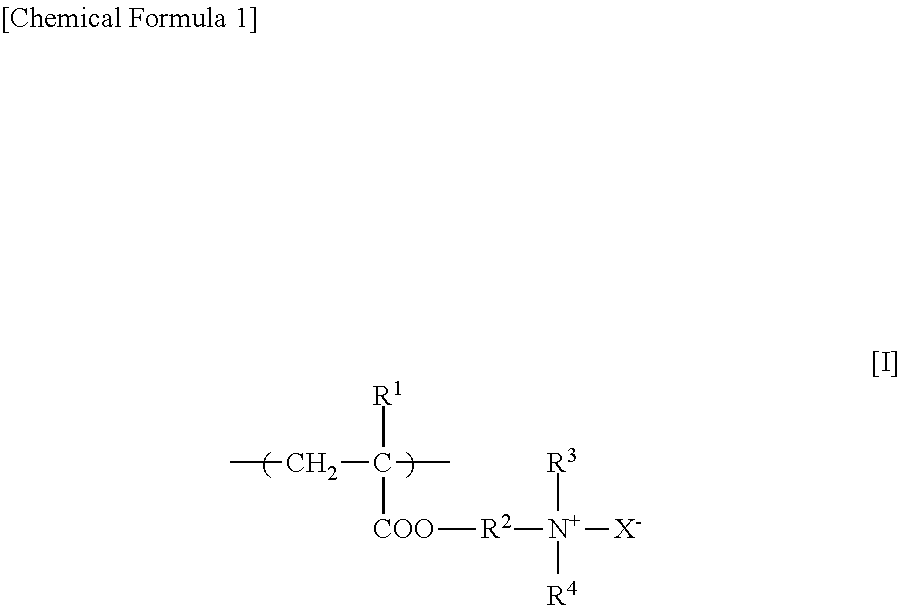
[0189]A polymerizable monomer of 100 parts containing 88% of styrene, 10% of butyl acrylate, and 2% of an N,N-diethyl-N-methyl-N-(2-methacryloylethyl)ammonium p-toluenesulfonic acid unit was put into a mixed solvent containing 500 parts of toluene and 400 parts of methanol and reacted at 80° C. in the presence of 4 parts of 2,2′-azobisdimethylvaleronitrile for 8 hours. After the completion of the reaction, the solvent was distilled away to obtain a quaternary ammonium salt group-containing copolymer (hereinafter, referred to as a positively-chargeable charge control resin 1). The obtained positively-chargeable charge control resin 1 had a weight-average molecular weight of 1.2×10⁴, a glass transition temperature of 76° C., and a base number of 0.3 mgHCl / g.

synthesis example 2

[0190]A polymerizable monomer of 100 parts containing 85% of styrene, 11% of butyl acrylate, and 4% of an N,N-diethyl-N-methyl-N-(2-methacryloylethyl)ammonium p-toluenesulfonic acid unit was put into a mixed solvent containing 500 parts of toluene and 400 parts of methanol and reacted at 80° C. in the presence of 4 parts of 2,2′-azobisdimethylvaleronitrile for 8 hours. After the completion of the reaction, the solvent was distilled away to obtain a quaternary ammonium salt group-containing copolymer (hereinafter, referred to as a positively-chargeable charge control resin 2). The obtained positively-chargeable charge control resin 2 had a weight-average molecular weight of 1.2×10⁴, a glass transition temperature of 73° C., and a base number of 0.4 mgHCl / g.

production example 1

[0191]The positively-chargeable charge control resin 1 synthesized in Synthesis Example 1 was spread on a tray and vacuum-dried for 10 hours under conditions of a temperature of 55° C. and a pressure of 1.3 kpa to obtain a charge control resin A. The properties of the obtained charge control resin A are shown in Table 1.

the structure of the environmentally friendly knitted fabric provided by the present invention; figure 2 Flow chart of the yarn wrapping machine for environmentally friendly knitted fabrics and storage devices; image 3 Is the parameter map of the yarn covering machine
Login to View More

PUM

PropertyMeasurementUnit
Temperatureaaaaaaaaaa
Fractionaaaaaaaaaa
Fractionaaaaaaaaaa
Login to View More

Abstract

Disclosed is a method for producing a toner comprising combining a binder resin, a wax, a negatively-chargeable charge control resin and a colorant to form the toner, prior to said combining, the negatively-chargeable charge control resin is obtained by drying treatment conducted for 2 to 24 hours under conditions of a drying temperature of 45 to 80° C. and a pressure of 0.5 to 20 kPa, wherein the negatively-chargeable charge control resin comprises a monomer unit having a functional group that imparts a negative charging property, a vinyl aromatic hydrocarbon monomer unit, and a (meth)acrylate monomer unit.

Description

CROSS-REFERENCE TO RELATED APPLICATIONS[0001]This application is a Continuation in Part of U.S. application Ser. No. 15 / 584,384 filed on May 2, 2017, and patented as U.S. patent Ser. No. 10 / 012,917, which is a Divisional of copending U.S. patent application Ser. No. 14 / 779,436, filed on Sep. 23, 2015, which is now abandoned, and wherein U.S. patent application Ser. No. 14 / 779,436, is a National Stage application filed under 35 U.S.C. § 371 of International Application No. PCT / JP2014 / 058639, filed on Mar. 26, 2014, and which is based upon and claims the benefit of priority under 35 U.S.C. § 119(a) of Japanese Patent Application No. 2013-067257, filed on Mar. 27, 2013, the entire contents of which are incorporated herein by reference.TECHNICAL FIELD[0002]The present invention relates to a toner that can be used for development in an image forming device using electrophotography, such as a copying machine, a facsimile, or a printer.BACKGROUND ART[0003]In an image forming device of an e...

Claims

the structure of the environmentally friendly knitted fabric provided by the present invention; figure 2 Flow chart of the yarn wrapping machine for environmentally friendly knitted fabrics and storage devices; image 3 Is the parameter map of the yarn covering machine
Login to View More

Application Information

Patent Timeline
25 Oct 2018
Publication
US20180307149A1
IPC
G03G9/08; G03G9/097; G03G9/093; G03G9/09; C08J3/00; G03G9/087; G03G9/083
CPC
G03G9/0904; C08L2205/00; G03G9/087; G03G9/09775; G03G9/09314; C08J3/005; G03G9/08711; G03G9/0839
Inventors
CHIBA, TAKERU; NAKATANI, HIROSHI