Some workloads may serve applications that are availability-sensitive, wherein the vast majority of requests are to be successfully completed, and wherein an inability to satisfy a request is significantly problematic.
Some workloads may serve applications that are consistency-sensitive, wherein data updates that are occurring in an inadequately synchronized manner may cause parts of the
data set of the
workload to diverge, and may cause different servers to
handle an identical request in different ways due to discrepancies in the data set of the application that is stored by each
server.
In some cases, the simultaneous updates may cause one update to be lost; in other cases, a conflict may be detected, but the servers may be unable to resolve it.
In other instances, the concurrent fulfillment of two performance guarantees may not be reasonably achievable, or in some cases may be physically impossible with some data service architectures.
A particular example of a
performance requirement tradeoff that may be difficult to fulfill is a
workload that requires both low latency and a strict consistency level.
However, such propagation may involve an unavoidable network
transport delay, based upon technical constraints (e.g., the maximum achievable responsiveness of
server and
networking hardware) and / or physical constraints (e.g., maximum transmission speeds limited by the
speed of light).
It may therefore be difficult or even impossible to guarantee that all updates are to be committed to the data set of the
workload by a single-master server architecture within a latency bound, such as ten milliseconds.
For example, if updates are to be received throughout the world, and the maximum round-trip
delay between any selectable server location and the furthest anticipated source of update requests may exceed the maximum desired latency, then fulfilling the strict
consistency model within the specified latency bound may not be possible with any single-master configuration of the server set.
Due to such constraints, distributed data services based on single-master configurations may risk violating some performance guarantees, and / or may be unable to offer certain types of service level agreements with performance guarantees that may be violated in some circumstances.
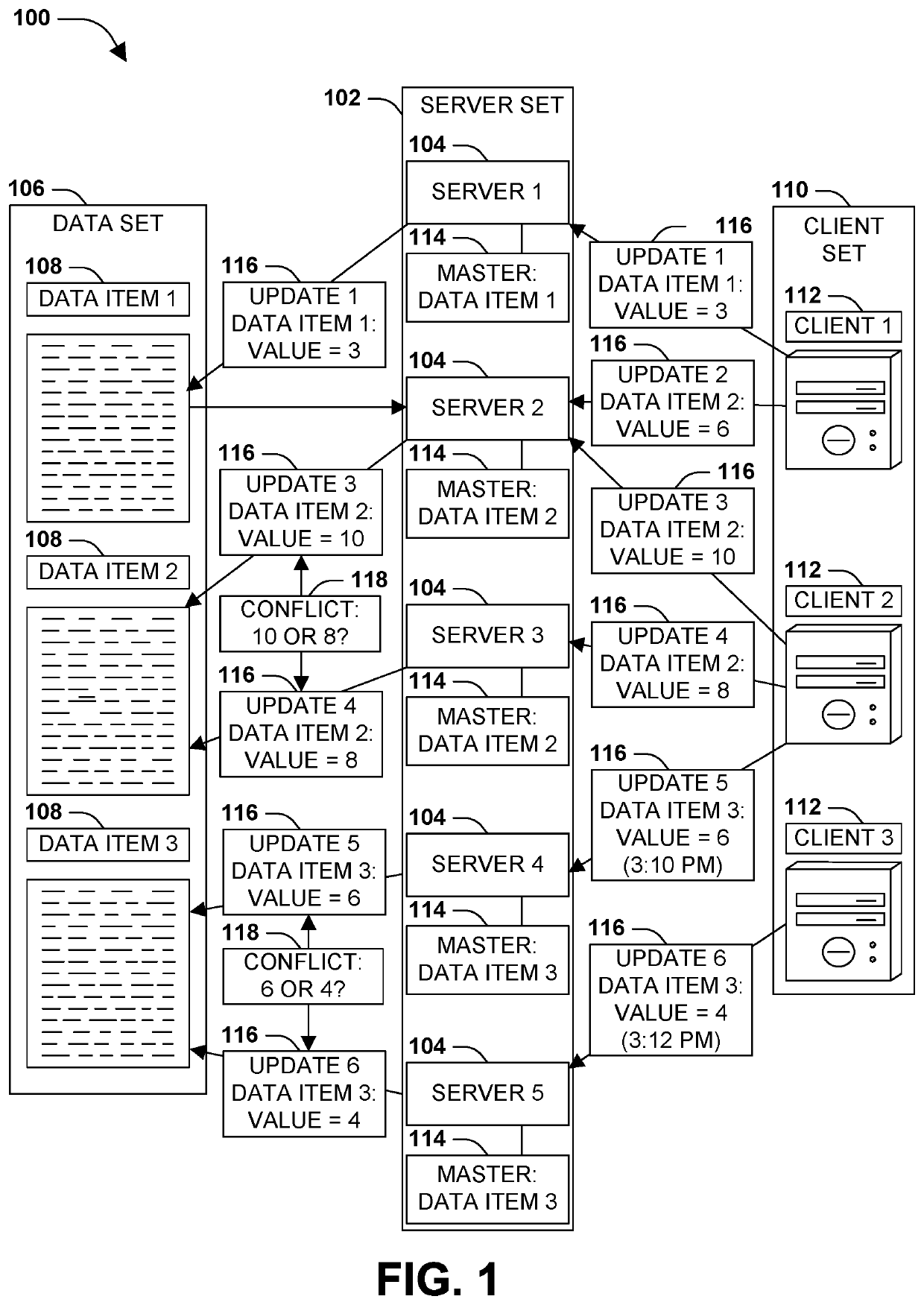
However, in other scenarios, such architectures may present a risk of data version conflicts, where a data item is concurrently updated in contradictory ways by different master servers.
However, single-master server sets 102 may exhibit significant disadvantages, such as limitations on achievable performance factors.
Due to the designation of the first server 104 as the sole master 114 for the first data item 108, all updates 116 to the data item 108 are processed by the first server 104, thus creating a performance
bottleneck, which limits latency reduction and
scalability, and creates a
single point of failure, which limits availability (both the likelihood and consequences of hardware failure and the complexity of fault
recovery).
Moreover, a further complexity may arise if the
semantics of updating the third data item 108 differ from those in the second data item 108.
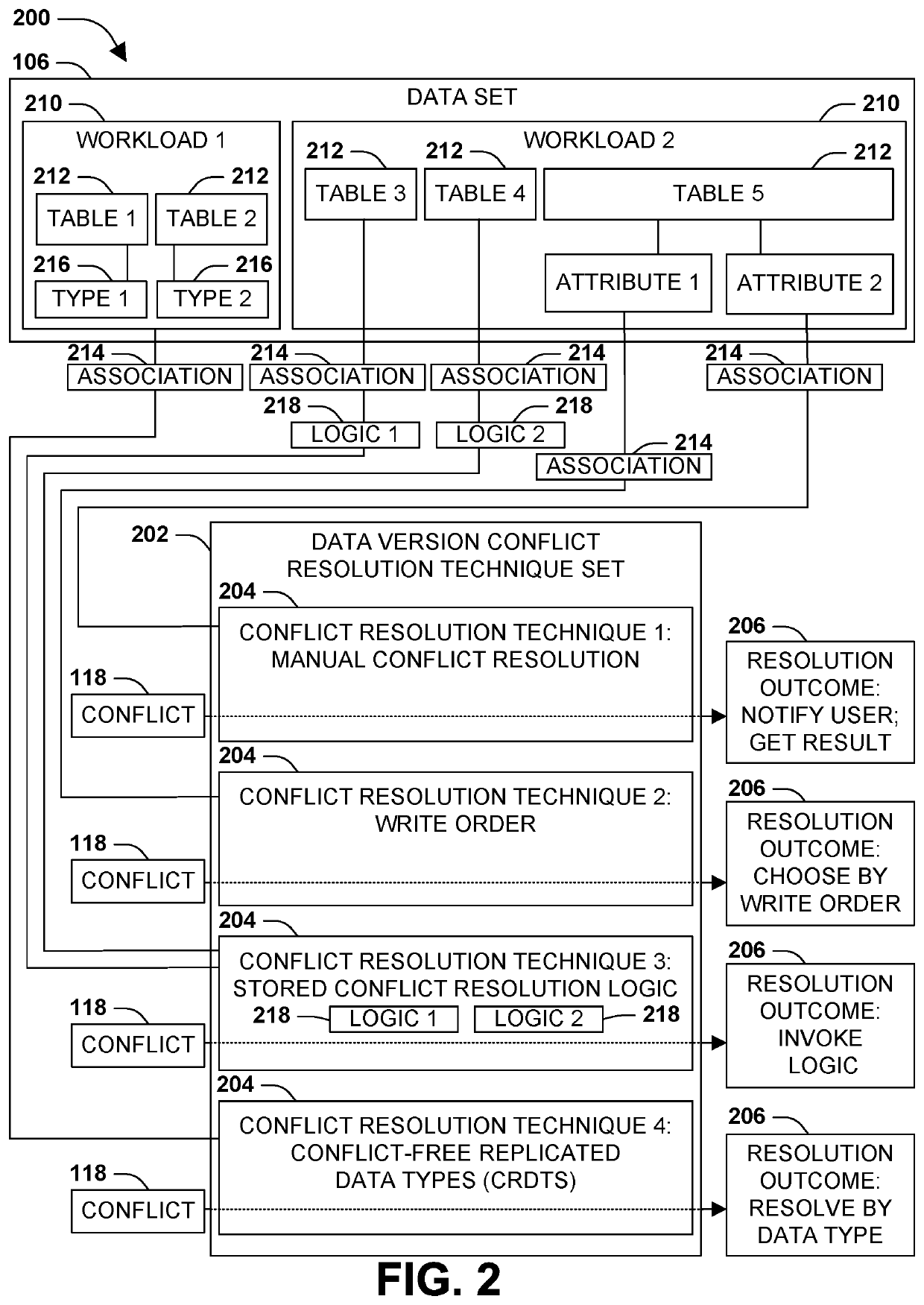
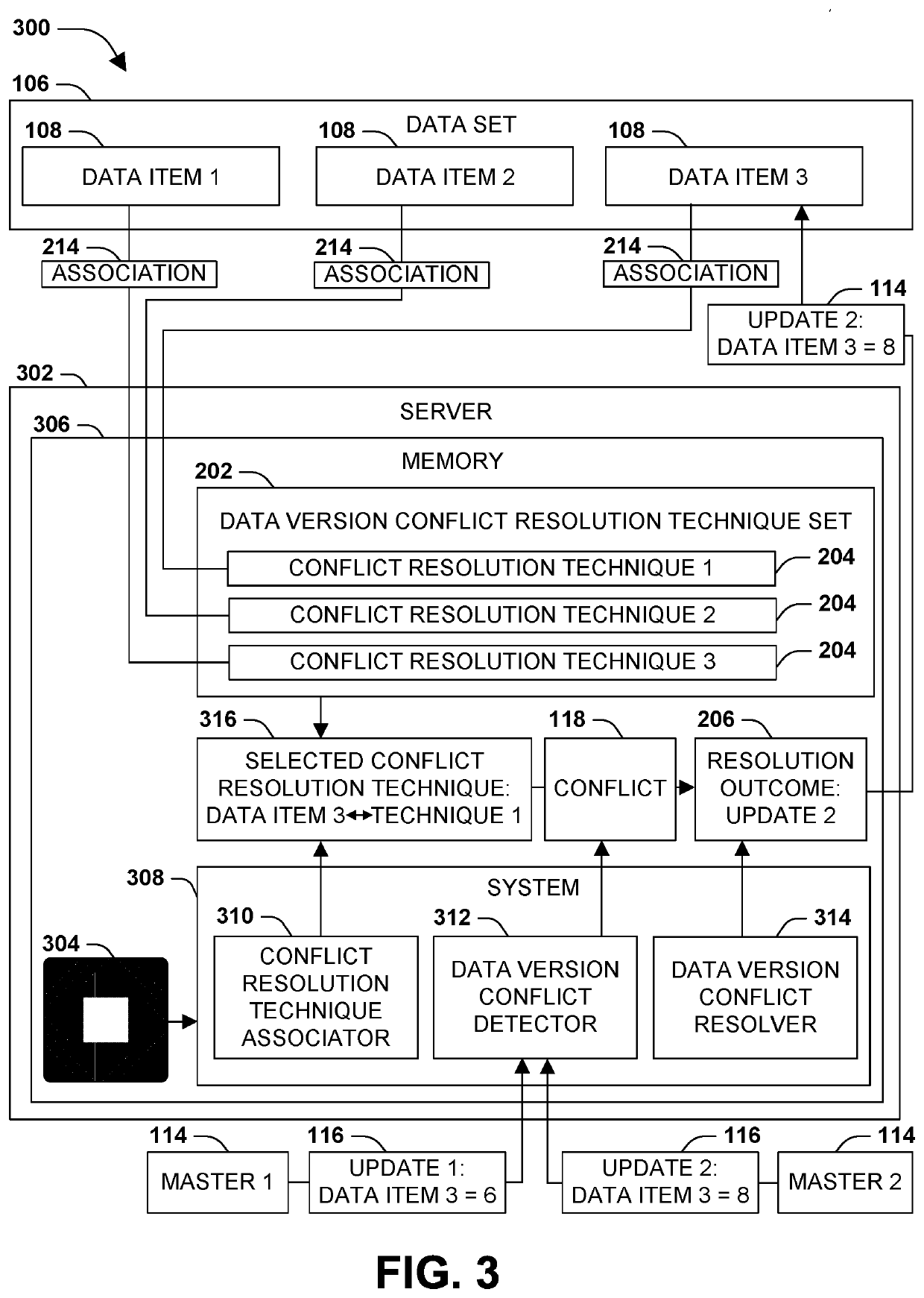
Even if a data version conflict 118 is identified, it may be difficult for a particular master 114 to determine the conflict resolution logic.
These and other problems may arise from the designation of multiple masters 114 of a data set 106.



 Login to View More
  Login to View More