Methods of manufacture for polyetherimide
a technology of polyetherimide and manufacturing method, which is applied in the field of manufacturing methods of polyetherimide, can solve the problems that byproducts can have detrimental effects on the properties of resultant polymers, and achieve the effect of improving the properties of the resultant polymer
- Summary
- Abstract
- Description
- Claims
- Application Information
AI Technical Summary
Benefits of technology
Problems solved by technology
Method used
Image



Examples
examples
[0054]Materials used in the Examples are listed Table 1. Amounts listed in the Examples are in weight percent (wt. %), based on the total weight of the composition. Table 1
TABLE 1MaterialChemical DescriptionSourcemPDMeta-phenylene diamineDuPont4-ClPA4-chlorophthalic anhydrideSABIC3-ClPA3-chlorophthalic anhydrideSABICNa2BPADisodium bisphenol ASABICoDCBOrtho-dichlorobenzeneFisher ScientificHEGClHexaethylguanidiniumSABICchlorideH3PO4Phosphoric acidFisher Scientific
Gel Permeation Chromatograph (GPC) Testing Procedure
[0055]The GPC samples were prepared by dissolving 5-10 milligrams (mg) of a sample in 10 mL of dichloromethane. Three to five drops of the polymer solution was added to a 10 milliliters (mL) dichloromethane solution with acetic acid (1-2 drops). The sample solution was then filtered and the analysis was performed by referencing the polymer peak to the oDCB peak. The instrument was a Waters 2695 separations module, which was calibrated with polystyrene standards from Aldrich ...
embodiment 1
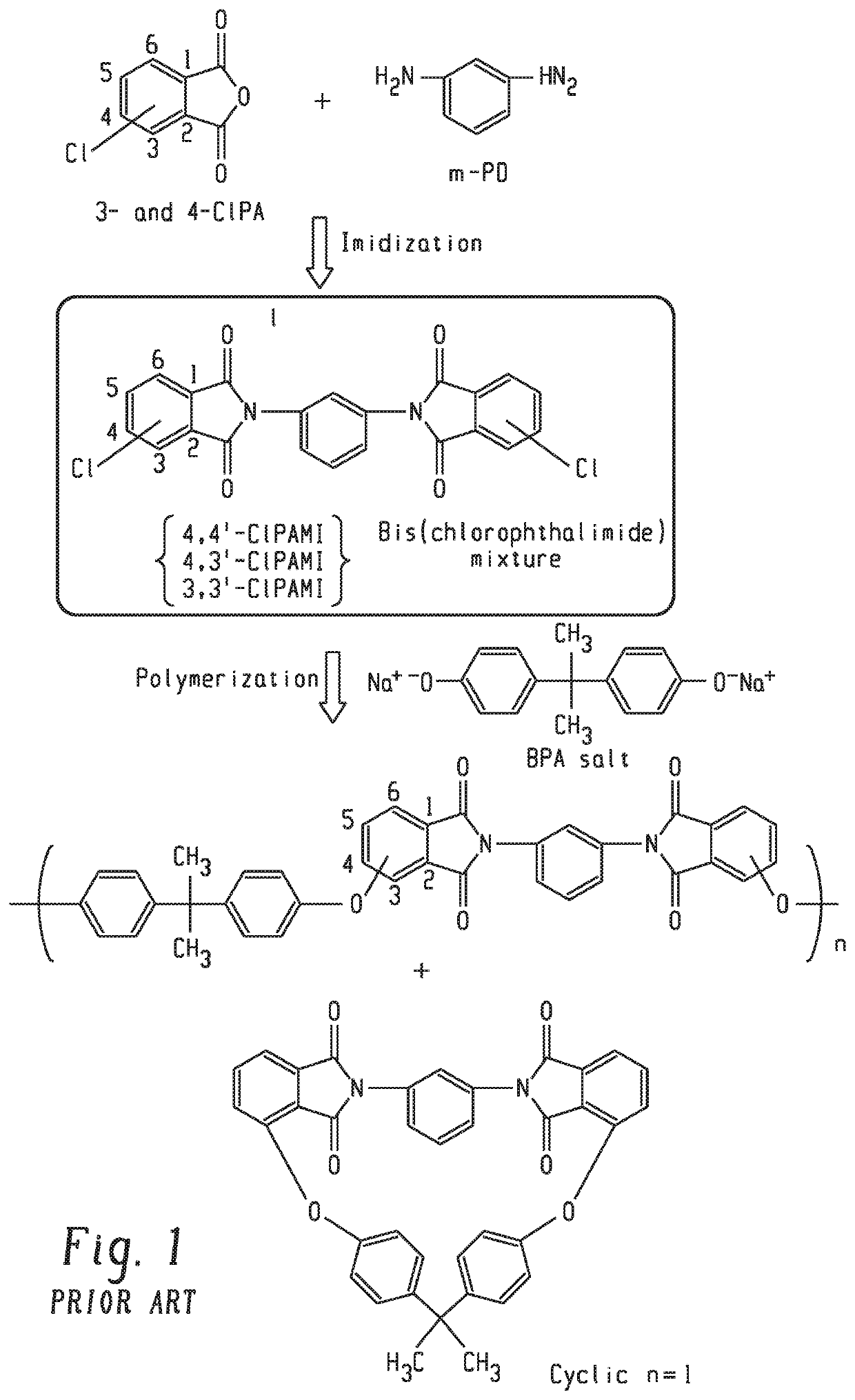
[0062]A method of making polyetherimide comprising: reacting a diamine having four bonds between the amine groups, 4-halophthalic anhydride and 3-halophthalic anhydride at an imidization reaction temperature and pressure in the presence of a solvent and a polymer additive to produce a mixture comprising 3,3′-bis(halophthalimide), 3,4′-bis(halophthalimide), 4,4′-bis(halophthalimide), solvent, and the polymer additive wherein the molar ratio of 3-halophthalic anhydride to 4-halophthalic anhydride is 95:05 to 60:40; reacting the mixture with alkali metal salt of a dihydroxy aromatic compound to produce a polyetherimide having a cyclics content less than or equal to 6 weight percent based on the total weight of the polyetherimide, a glass transition temperature greater than or equal to 220° C., and a weight average molecular weight greater than or equal to 25,000 Daltons; wherein the polymer additive dissolves in the solvent at a temperature less than or equal to the imidization reactio...
embodiment 2
[0063]A method of making polyetherimide comprising: reacting an aromatic diamine having amine groups located on the aromatic ring in a meta relationship, 4-halophthalic anhydride and 3-halophthalic anhydride at an imidization reaction temperature and pressure in the presence of a solvent and a polymer additive to produce a mixture comprising 3,3′-bis(halophthalimide), 3,4′-bis(halophthalimide), 4,4′-bis(halophthalimide), solvent and the polymer additive wherein the molar ratio of 3-halophthalic anhydride to 4-halophthalic anhydride is 95:05 to 60:40; reacting the mixture with alkali metal salt of a dihydroxy aromatic compound to produce a polyetherimide having a cyclics content less than or equal to 6 weight percent based on the total weight of the polyetherimide, a glass transition temperature greater than or equal to 220° C., and a weight average molecular weight greater than or equal to 25,000 Daltons; wherein the polymer additive dissolves in the solvent at the imidization react...
PUM
| Property | Measurement | Unit |
|---|---|---|
| molar ratio | aaaaa | aaaaa |
| weight average molecular weight | aaaaa | aaaaa |
| glass transition temperature | aaaaa | aaaaa |
Abstract
Description
Claims
Application Information
 Login to View More
 - R&D
- Intellectual Property
- Life Sciences
- Materials
- Tech Scout
- Unparalleled Data Quality
- Higher Quality Content
- 60% Fewer Hallucinations
Browse by: Latest US Patents, China's latest patents, Technical Efficacy Thesaurus, Application Domain, Technology Topic, Popular Technical Reports.
© 2025 PatSnap. All rights reserved.Legal|Privacy policy|Modern Slavery Act Transparency Statement|Sitemap|About US| Contact US: help@patsnap.com