
Composition, fiber treatment agent, fiber treatment method, and treated fiber
a technology of fiber treatment agent and treatment method, applied in the field of fiber treatment agent, fiber treatment method, and treatment fiber, can solve the problems of reducing the water absorption effect, reducing the softness and smoothness of polyoxyalkylene groups, and reducing the softness and smoothness of the skin. , to achieve the effect of good softness, high water absorption and maintaining water absorption
- Summary
- Abstract
- Description
- Claims
- Application Information
AI Technical Summary
Benefits of technology
Problems solved by technology
Method used
Image

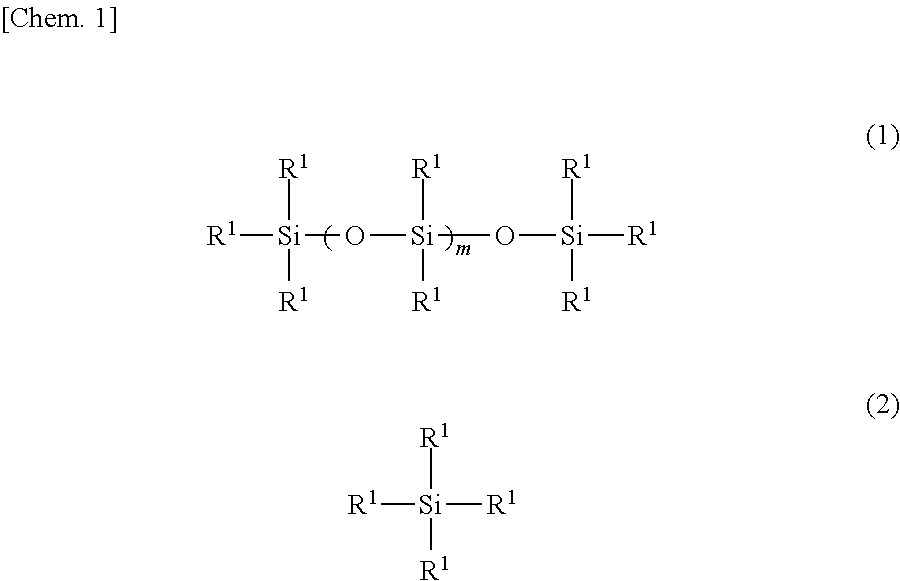
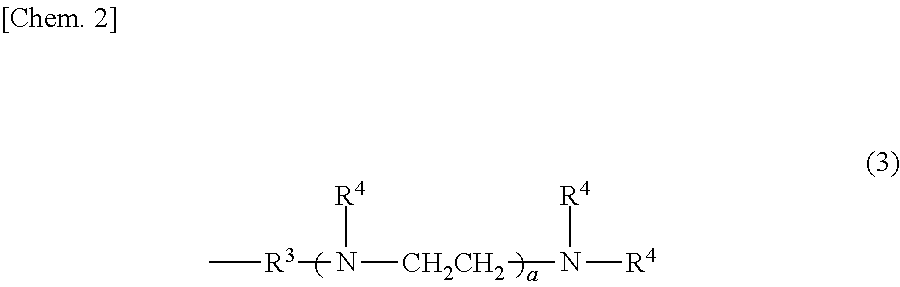
Examples
examples
[0041]Examples and Comparative Examples are given below by way of illustration and not by way of limitation. In these Examples, unless noted otherwise, all references to percent (%) and proportions in the formulations are by weight.
production example 1
alkyl Group-Containing Polysiloxane
[0042]The interior of a four-neck flask equipped with a stirrer, a thermometer, a reflux condenser with attached Dean-Stark tube and a nitrogen inlet was placed under a nitrogen atmosphere, charged with 122.3 g of the organopolysiloxane of formula (a) below, 33.2 g of the organosilane of formula (b) below and 44.5 g of the organosilane of formula (c) below and, by holding the temperature within the reaction vessel at 130° C. while blowing in nitrogen and stirring, a dealcoholation reaction was effected while removing the alcohol that formed as a by-product. The system was cooled to 40° C., following which 174.8 g of the polyethylene glycol monobutyl monoglycidyl ether of formula (d) below (an amount such that the ratio of the number of glycidyl groups on the polyethylene glycol monobutyl monoglycidyl ether to the total number of nitrogen-bonded hydrogen atoms (—NH) on the aminoalkyl group-containing organopolysiloxane becomes 0.95) and 20.0 g of is...
production example 2
alkyl Group-Containing Polysiloxane
[0043]Using an apparatus like that in Production Example 1, the interior of the four-neck flask was placed under a nitrogen atmosphere and charged with 151.3 g of the organopolysiloxane of formula (f) below, 20.8 g of the organosilane of formula (b) above and 27.9 g of the organosilane of formula (c) above and, by holding the temperature within the reaction vessel at 130° C. while blowing in nitrogen and stirring, a dealcoholation reaction was effected while removing the alcohol that formed as a by-product. The system was cooled to 40° C., following which 109.5 g of the polyethylene glycol monobutyl monoglycidyl ether of formula (d) above (an amount such that the ratio of the number of glycidyl groups on the polyethylene glycol monobutyl monoglycidyl ether to the total number of nitrogen-bonded hydrogen atoms (—NH) on the aminoalkyl group-containing organopolysiloxane becomes 0.95) and 16.3 g of isopropyl alcohol were added and, by holding the temp...
PUM
| Property | Measurement | Unit |
|---|---|---|
| Temperature | aaaaa | aaaaa |
| Temperature | aaaaa | aaaaa |
| Fraction | aaaaa | aaaaa |
Abstract
Description
Claims
Application Information
 Login to View More