

Nanoscale drug carrier capable of passing through blood-brain barrier
a drug carrier and nanoscale technology, applied in the field of nanoscale drug delivery system, can solve the problem of extreme limits on the efficacy of drugs for brain diseases
- Summary
- Abstract
- Description
- Claims
- Application Information
AI Technical Summary
Benefits of technology
Problems solved by technology
Method used
Image

Examples
example 1
Human H-Ferritin Specifically Binds To Human Brain Endothelial Cells Via The Receptor TfR1
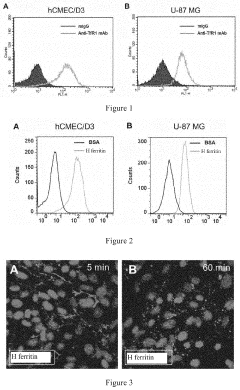
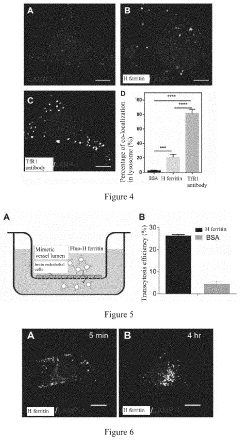
[0071]To study whether human H-ferritin specifically binds to human brain endothelial cells, human brain endothelial hCMEC / D3 cells (EMD Millipore Corporation: SCC066) are selected for this study. Firstly, the invention proves in vitro that the receptor TfR1 of H-ferritin is highly expressed on human BBB brain endothelial hCMEC / D3 cells. Then human BBB brain endothelial hCMEC / D3 cells are incubated with human H-ferritin labeled with fluorescent molecules, and the binding between human H-ferritin and tumor cells is tested by flow-cytometry and laser confocal microscopy.
[0072]Experimental methods are as follows:
[0073]a) Expression of TfR1 on human brain endothelial cells.
[0074]Human BBB brain endothelial hCMEC / D3 cells were cultured to about 1×10⁵ (100×20 mm culture dish, Corning, USA). Culture conditions: the cells were cultured in EBM-2 medium (Gibco Life Technologies Inc., UK) containing growt...
example 2
Subcellular Localization Of Human H-Ferritin After Entering Human Brain Endothelial Cells
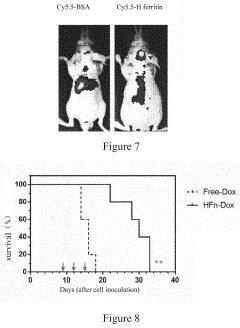
[0077]A classic intracellular path of TfR1: after binding with a ligand, the receptor TfR1 mediates endocytosis to enter the endosome, and then enter the lysosome. To cross BBB, the first question to be answered is whether the ligand enters the lysosome after binding with TfRl. The invention proves for the first time that in human brain endothelial cells, most of H-ferritins exist in the endosome instead of being co-localized with the lysosome, which provides a support for crossing BBB from the aspect of intracellular localization
[0078]Detailed experimental methods are as follows:
[0079]a) Human H-ferritins can be effectively endocytosed by human BBB brain endothelial cells
[0080]Human BBB brain endothelial cells hCMEC / D3 slides (BD Biosciences) were placed in a 6-well plate (with well diameter of 34.8 mm, Corning, USA) for culturing above to a density of about 60%, then the experiment was conduct...
example 3
Human H-Ferritin Can Effectively Cross The Blood Brain Barrier Model
[0083]a) Establishment of a BBB model
[0084]Human BBB brain endothelial cells hCMEC / D3 (2×10⁴ / pore) were inoculated on a Transwell plate (3 μm well diameter, Corning, USA) pretreated with gelatin (10 μg / cm2) (culture conditions are the same as that in Example 1). The cells were cultured at 37° C. under CO2 in an incubator to confluence (2-3d). After the confluence state of hCMEC / D3 was observed by a microscope, medium (EBM-2 medium) was added to an upper chamber of the Transwell plate, resulting a more than 0.5 cm difference of liquid level between the upper and lower chamberst. If an obvious difference between the two chambers can be still observed after 4 h, it was regarded as completely confluent. The wells of Transwell without inoculated cells were used as a blank control. A BBB model was now established successfully (FIG. 5A).
[0085]b) Human H-ferritins cross the blood brain barrier
[0086]Equal amount (50 μg / mL) o...
PUM
| Property | Measurement | Unit |
|---|---|---|
| Fraction | aaaaa | aaaaa |
| Fraction | aaaaa | aaaaa |
| Fraction | aaaaa | aaaaa |
Abstract
Description
Claims
Application Information
 Login to View More