
Sustained-release anesthetic compositions and methods of preparation thereof
- Summary
- Abstract
- Description
- Claims
- Application Information
AI Technical Summary
Benefits of technology
Problems solved by technology
Method used
Image

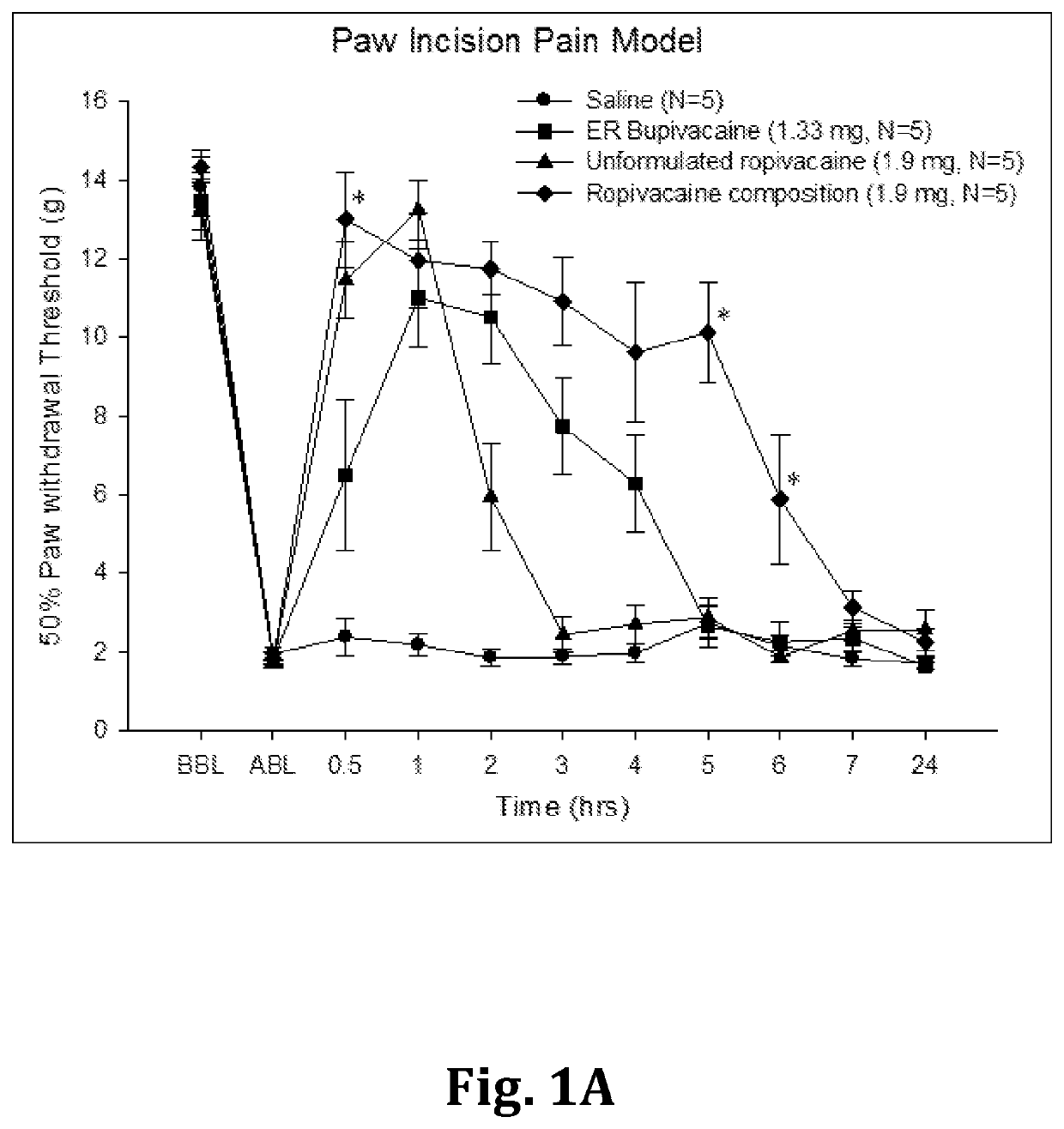
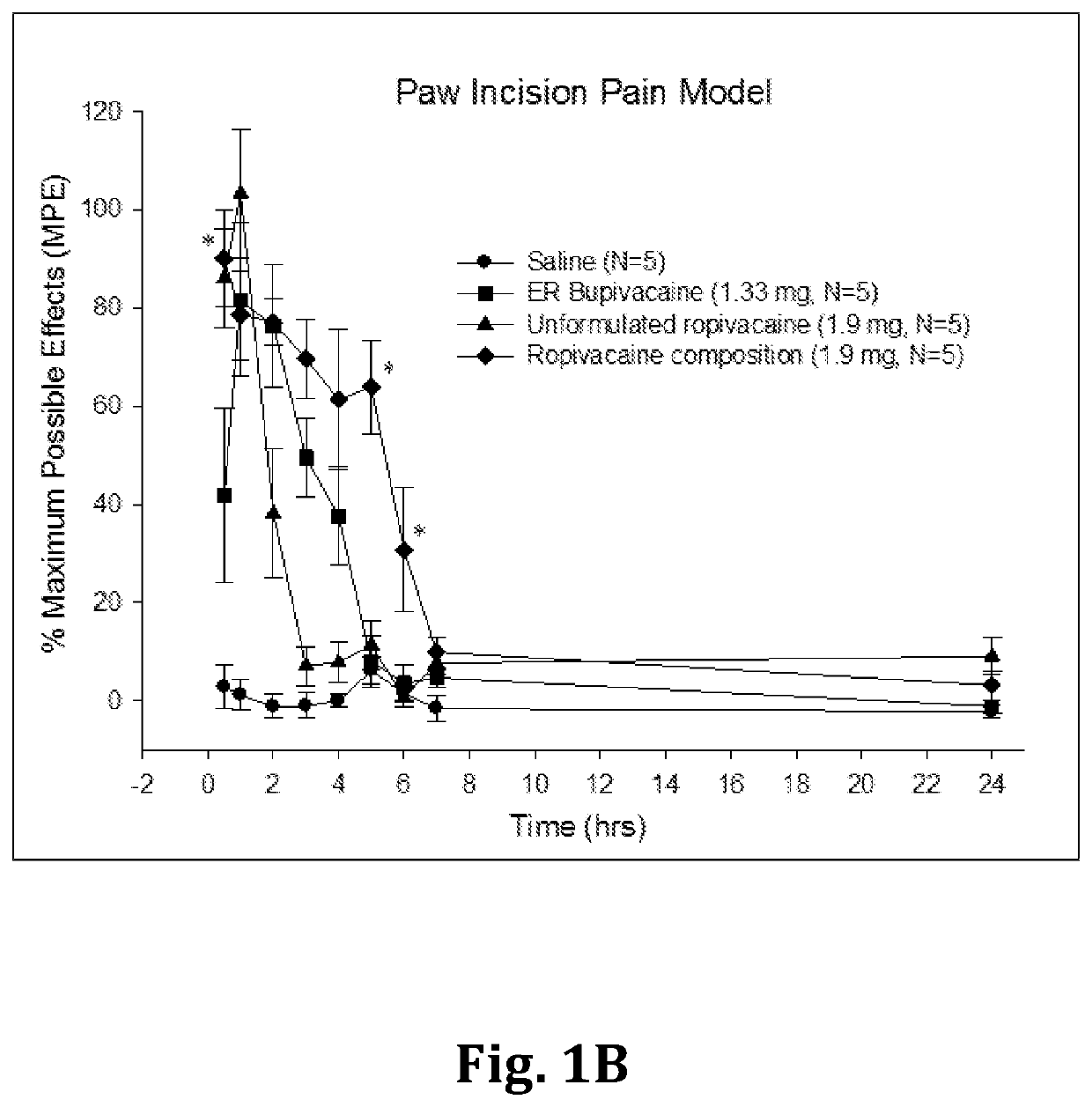
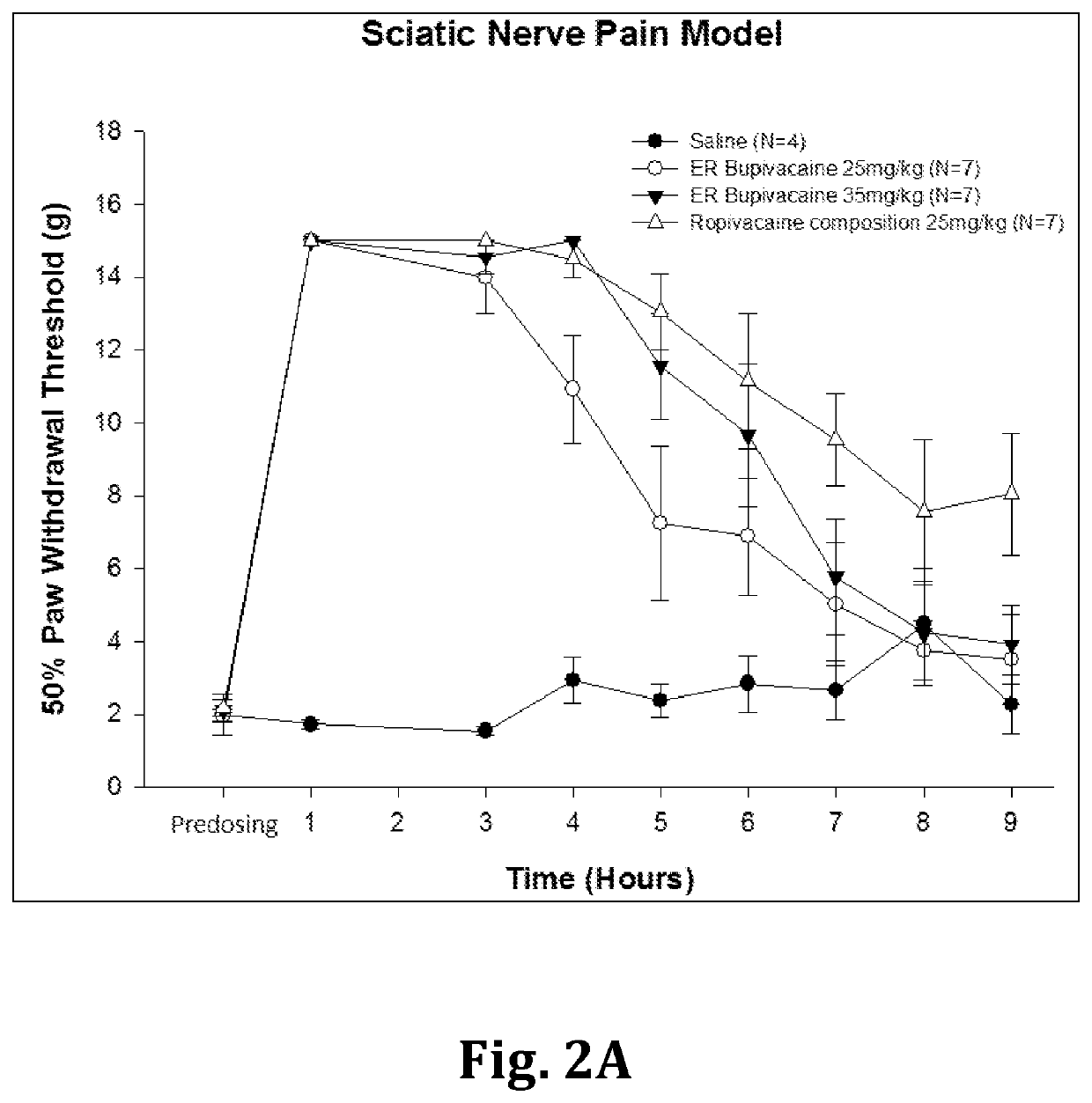
Examples
example 1
[0051]Preparation of Ropivacaine Compositions with Various Phospholipids
[0052]Phospholipids, including DLPC, DMPC, DPPC, DOPG, DOPC, DOPS, DOPA, Egg PC, Egg PE, POPE, cardiolipin, and DMPA were purchased from NOF Corporation (Tokyo, Japan) or Lipoid GmbH (Ludwigshafen, Germany). Cholesterol was purchased from Sigma-Aldrich (Darmstadt, Germany) or Dishman Pharmaceuticals and Chemicals (Gujarat, India), and ropivacaine was purchased from Apollo Scientific (Cheshire, UK) or Dishman Pharmaceuticals and Chemicals. All other chemicals were purchased from Sigma-Aldrich.
[0053]To prepare lipid cakes, ropivacaine was combined with different lipid mixtures as indicated in Table 1 at a drug-to-phospholipid ratio (D:PL) of 1.458 μmol / μmol, i.e, phospholipid:cholesterol:ropivacaine=2:1:2.9. The lipids and ropivacaine were mixed and then dissolved in tert-butanol or a tert-butanol / water cosolvent system (1 / 1, vol / vol) to form the liquid structures. Each liquid structure sample was frozen for 30 to...
example 2
Characterization of Ropivacaine Compositions
[0056]The association efficiency (AE) of each of the preparations described in Example 1 was determined as follows. Two hundred microliters of each ropivacaine composition were transferred to a centrifuge and spun for 5 min at 3000×g at 4° C. After decanting the supernatant, the separated lipid based complex was obtained and re-suspended to a final volume of 200 μL. A reference absorbance standard was established for each drug substance (e.g., ropivacaine) based on solutions of the test drug substance of known concentration. The amounts of drug substance of both the original ropivacaine composition and the separated lipid based complex were measured using an ultraviolet / visible (UV / Vis) spectrophotometer. The AE represents the ratio of the amount of drug substance in the separated lipid based complex to the amount of drug substance in the original ropivacaine composition. The D:PL of the separated lipid based complex was calculated by mult...
example 3
[0059]Preparation of Ropivacaine Compositions with Various Phospholipid Combinations
[0060]Sources of phospholipids, cholesterol, ropivacaine, and all other chemicals were described in Example 1.
[0061]To prepare lipid cakes, ropivacaine was combined with different lipid mixtures at the molar ratio of phospholipids:cholesterol:ropivacaine=2:1:2.9, where the phospholipids were a combination of DMPC and one of the other phospholipids described in Table 2 with molar ratio of DMPC:the other phospholipid=1.8:0.2. The lipids and ropivacaine were mixed and then dissolved in tert-butanol to form the liquid structures. Each liquid structure sample was frozen for 30 to 60 minutes and then was lyophilized overnight to obtain a lipid cake.
[0062]The lipid cakes were hydrated with 50 mM histidine buffers at pH 6.5 at ambient temperature to form ropivacaine compositions, followed by characterization of association efficiency and particle size distribution.
[0063]The resultant lipid based complex cont...
PUM
| Property | Measurement | Unit |
|---|---|---|
| Length | aaaaa | aaaaa |
| Length | aaaaa | aaaaa |
| Length | aaaaa | aaaaa |
Abstract
Description
Claims
Application Information
 Login to View More