
Permeable membranes having high temperature capabilities
a technology of permeable membranes and high temperature, applied in the direction of containers preventing decay, rigid containers, synthetic resin layered products, etc., can solve the problems of membranes that cannot maintain release products over long periods, and still exist in the field of permeable membranes
Inactive Publication Date: 2003-10-28
PECHINEY EMBALLAGE FLEXIBLE EURO
View PDF14 Cites 13 Cited by
- Summary
- Abstract
- Description
- Claims
- Application Information
AI Technical Summary
Benefits of technology
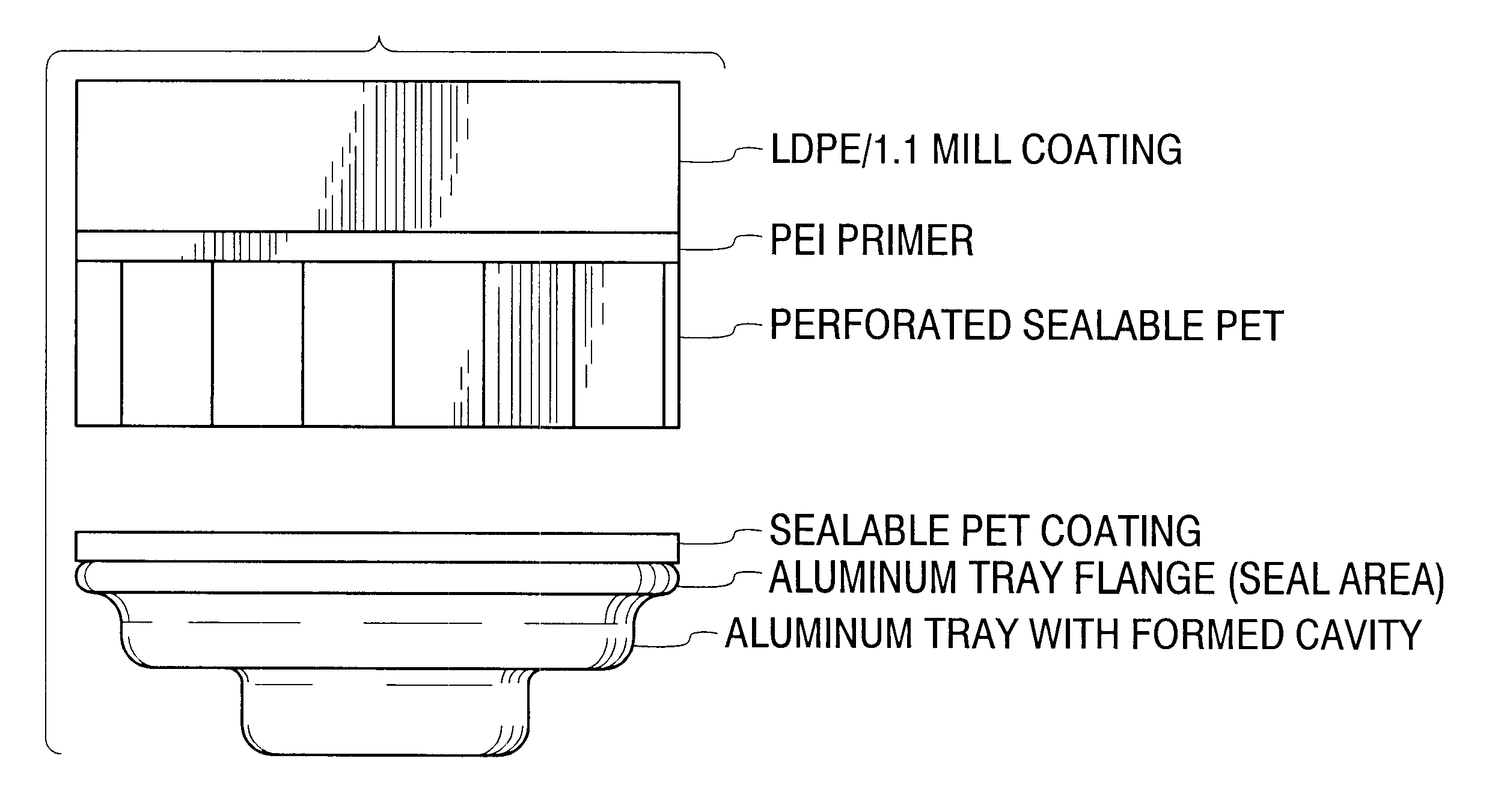
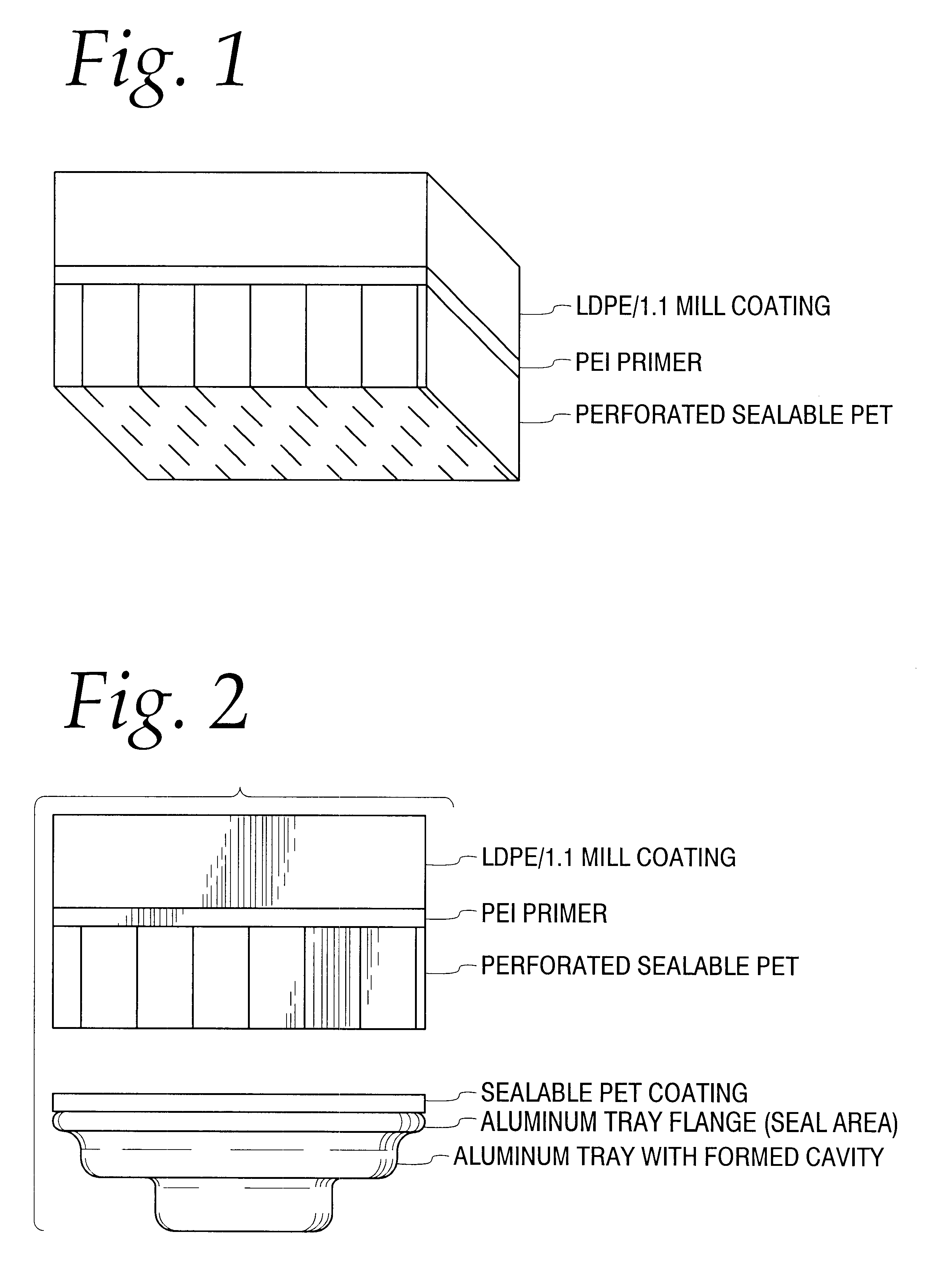
In one embodiment of the present invention, the invention is a multilayer structure comprising a permeable membrane. The membrane comprises a first permeable perforated sealable layer, a second primer layer and a third outer layer. The first perforated sealable layer is heat sealed to the formed tray containing the volatile product. The second primer layer is sandwiched between the first permeable, perforated sealable layer and the outer third layer and bonds the first and third layer together. The bond strength of layer two is sufficient to prevent delamination of the first and third layer during exposure to temperatures over 125.degree. F. The outer third layer comprises a polymer which allows for permeation of the product but at the same time prevents undesired spillage of the product. Permeation of the third layer is determined by the polymer and / or thickness of the layer. The thickness of the outer third layer can range from 0.5 mls to 5 mls, preferable 1.0 mls to 3 mls.
The package of this invention has the desirable feature of being relatively light in weight while having no breakable parts that might be hazardous. The package is inexpensive to manufacture and is suitable for dispensing small quantities of material. The package can be heated to temperature between about 125.degree. F. to about 300.degree. F. without failure of the permeable membrane. Once the package has been placed in a heater, the volatile vapors diffuse through the permeable membrane at a controlled rate. Because this transfer of the vapors through the permeable layer is a diffusion process rather than direct evaporation, the rate of release of the product is relatively uniform over the expected life of the package. The package also provides a controlled release rate of about 7 to about 30 days.
Problems solved by technology
Despite the considerable art which is known, problems associated with permeable membranes still exist.
One of these problems is the membrane's inability to maintain release product over long periods of time when subjected to temperatures above about 125.degree. F.
Method used
the structure of the environmentally friendly knitted fabric provided by the present invention; figure 2 Flow chart of the yarn wrapping machine for environmentally friendly knitted fabrics and storage devices; image 3 Is the parameter map of the yarn covering machine
View moreImage
Smart Image Click on the blue labels to locate them in the text.
Smart ImageViewing Examples

Examples
Experimental program
Comparison scheme
Effect test
Embodiment Construction
A multilayer structure according to the invention was produced as follows: a first heat sealable, perforated film layer having a perforation percentage of 330 holes per square inch with a per hole diameter of 0.7 mm was coated with polyethylenimine. Low density polyethylene was extruded onto this film structure. The resultant permeable membrane was then heat sealed to a formed aluminum foil tray. In Example 1, the perforated film layer was 60 Ga Perforated PET / seal copolymer polyester, wherein the polymer is Dupont / ICI 851 and the final perforation film is Mica-A-131-X from Mica Corporation. The LDPE is Equistar NA-204 from Equistar Chemicals.
the structure of the environmentally friendly knitted fabric provided by the present invention; figure 2 Flow chart of the yarn wrapping machine for environmentally friendly knitted fabrics and storage devices; image 3 Is the parameter map of the yarn covering machine
Login to View More PUM
| Property | Measurement | Unit |
|---|---|---|
| temperatures | aaaaa | aaaaa |
| temperatures | aaaaa | aaaaa |
| temperatures | aaaaa | aaaaa |
Login to View More
Abstract
A multilayer permeable film structure having high temperature capabilities comprising a first, perforated sealable layer; a second primer layer and a third outer layer is disclosed. The multilayer permeable film structure can be heat sealed to a formed tray containing a volatile material.
Description
The invention pertains generally to the field of permeable membranes and packaging for volatile materials such as insecticides and other organic products. It pertains more particularly to permeable multilayer membranes having high temperature capabilities and also to packages incorporating such membranes, which allow for the controlled release of volatile materials over a period of time. The packages contain the volatile materials and prevent any substantial release of the volatile materials until heat has been applied to the packages.The controlled time release of more volatile substances, such as fragrances and other aromatic products, present a number of packaging problems. Room "air fresheners" or fragrances have usually been packaged in glass bottles or vials. The fragrance is released into the atmosphere by transmission through an absorbent wick, which is capped until the time of use. However, glass bottles are bulky and breakable. It is generally not economical to package fra...
Claims
the structure of the environmentally friendly knitted fabric provided by the present invention; figure 2 Flow chart of the yarn wrapping machine for environmentally friendly knitted fabrics and storage devices; image 3 Is the parameter map of the yarn covering machine
Login to View More Application Information
Patent Timeline
 Login to View More
 Patent Type & AuthorityPatents(United States)
IPC IPC(8): A01M1/20A61L9/015A61L9/03B32B3/24B32B27/32A45D34/02A61L9/12B65D65/40B65D81/28B65D83/00
CPCA01M1/2061A61L9/03B32B3/266B32B27/32Y10T428/2843Y10T428/2848Y10T428/1352Y10T428/31786Y10T428/31746Y10T428/31757Y10T428/31797Y10T428/249985Y10T428/31725
InventorBOWEN, WILLIAM E.STECKER, MICHAEL
OwnerPECHINEY EMBALLAGE FLEXIBLE EURO