Rubidium titanyl arsenate-silver gallium selenide tandem optical parametric oscillator

a technology of tandem optical parametric oscillator and rubidium titanyl arsenate, which is applied in the direction of laser details, instruments, light demodulation, etc., can solve the problems of tunable laser output, no current solid-state laser source is capable of emitting pulses, and limited wavelengths which can be generated by lasers

US6833945B2Inactive Publication Date: 2004-12-21RAYTHEON CO
10 Cites 4 Cited by

Patent Information

Authority / Receiving Office
US · United States
Patent Type
Patents(United States)
Current Assignee / Owner
Publication Date
2004-12-21
Estimated Expiration
Not applicable · inactive patent

Smart Images

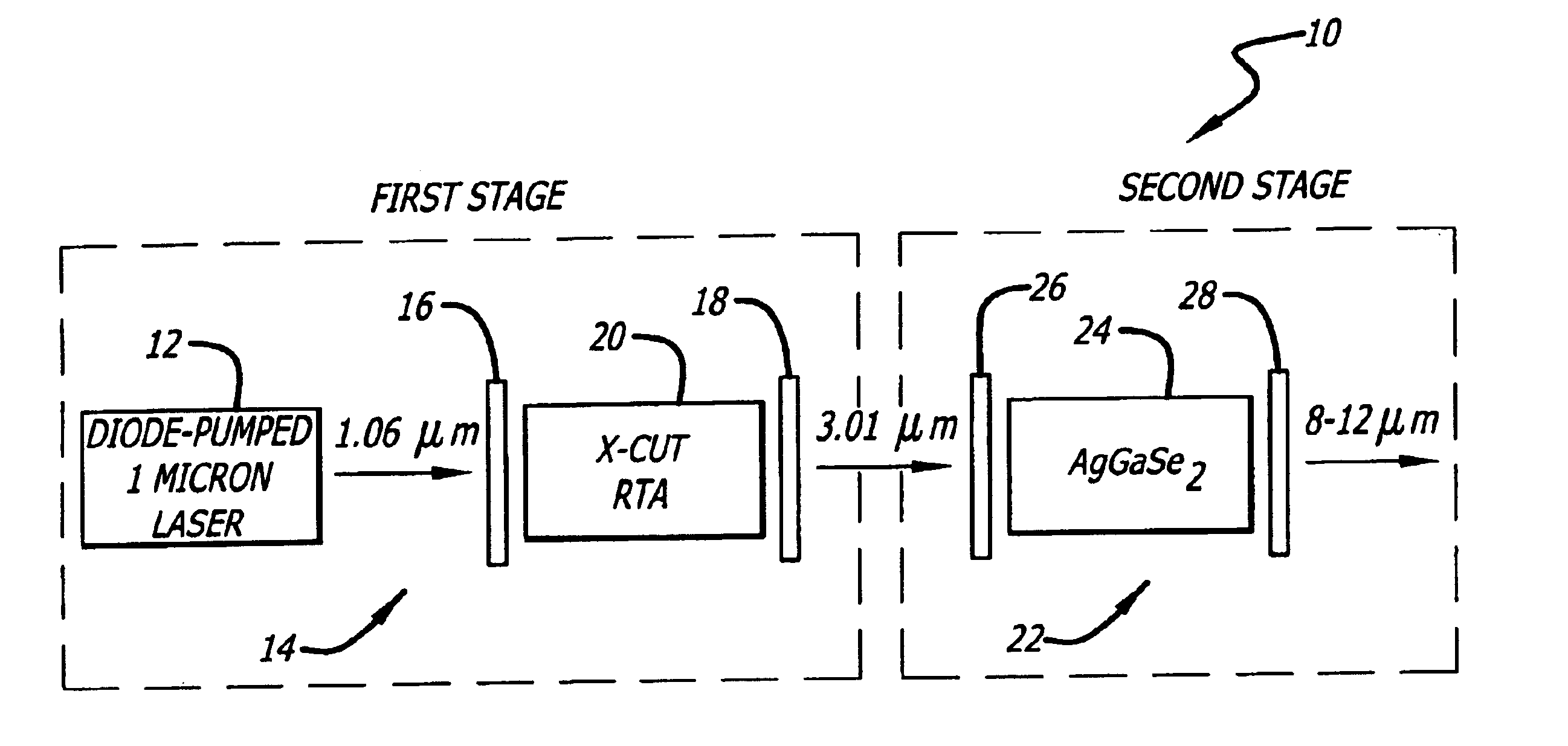
  • Figure 1
    Figure 1
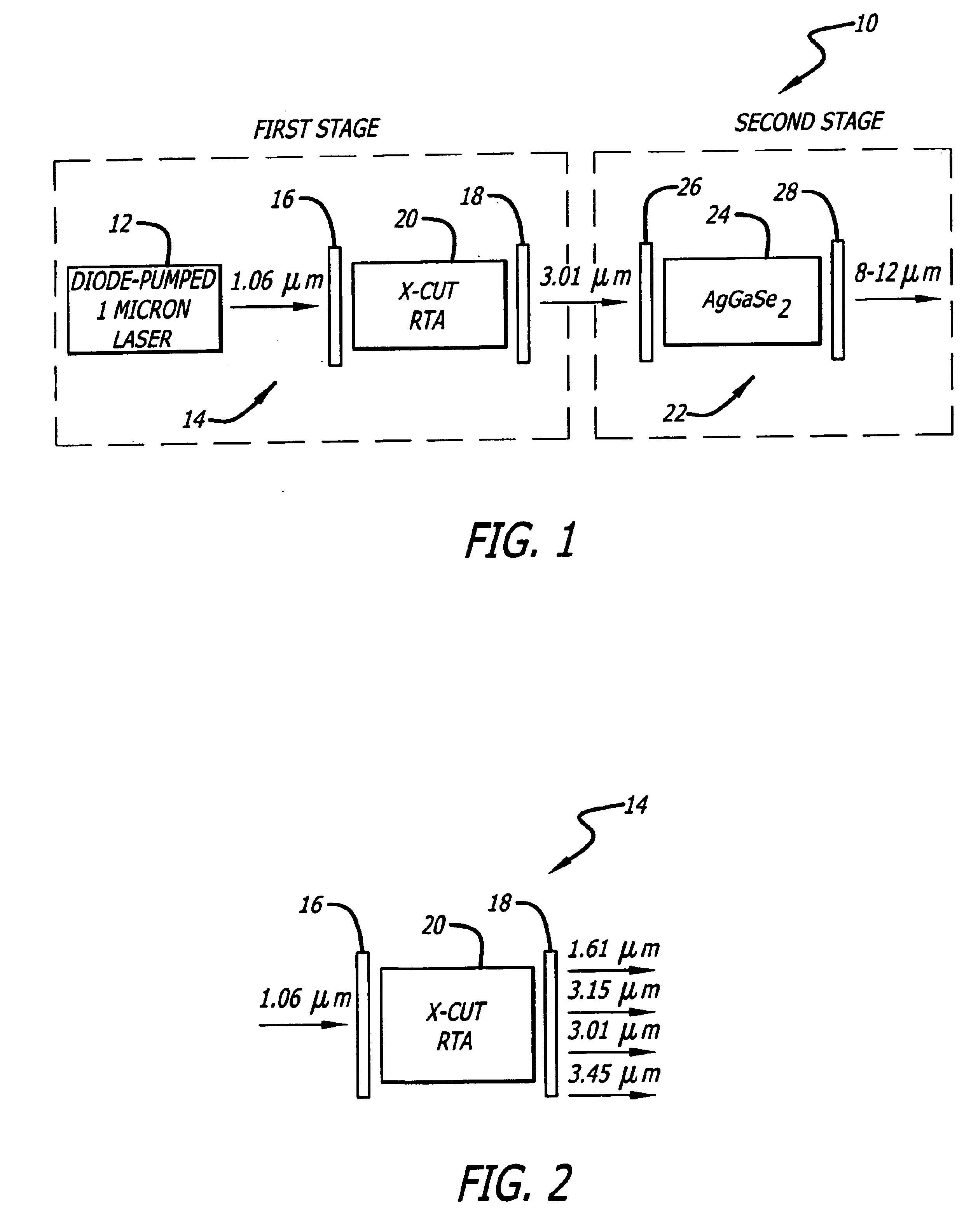
  • Figure 2
    Figure 2
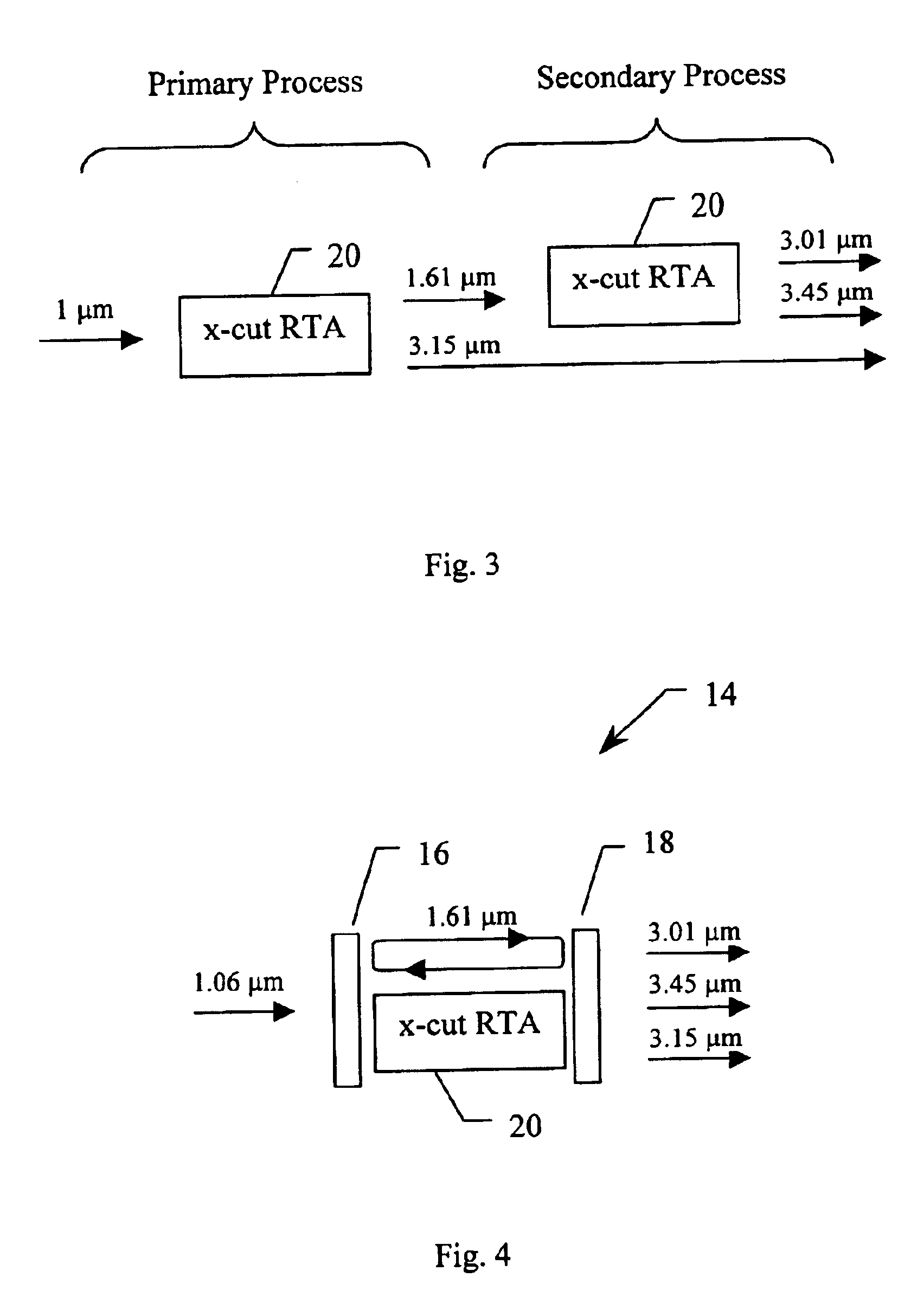
  • Figure 3
    Figure 3
Patent Text Reader

Abstract

An arrangement (10) for efficiently generating tunable pulsed laser output at 8-12 microns. The arrangement (10) includes a laser (12), a first optical parametric oscillator (14) of unique design, and a second optical parametric oscillator (22). The first oscillator (14) is constructed with an energy shifting crystal (20) and first and second reflective elements (16) and (18) disposed on either side thereof. Energy from the laser (12) at a first wavelength is shifted by the crystal and output at a second wavelength. The second wavelength results from a secondary process induced by a primary emission of energy at a third wavelength, the third wavelength resulting from a primary process generated from the first wavelength in the crystal. Mirror coatings are applied on the reflective elements (16 and / or 18) for containing the primary emission and enhancing the secondary process. The second optical parametric oscillator (22) then shifts the energy output by the first OPO (14) at the second wavelength to the desired fourth wavelength.
Need to check novelty before this filing date? Find Prior Art

Description

1. Field of the InventionThe present invention relates to solid state lasers and frequency shifting of laser output. More specifically, the present invention relates to frequency shifted solid state laser output operative in the 8-12 micron range.2. Description of the Related ArtLasers are currently widely used for communication, research and development, manufacturing, directed energy and numerous other applications. For many applications, the energy efficiency, power and light weight of solid state lasers make these devices particularly useful. Because only a few crystals lase and each crystal lases at a unique fundamental frequency, the wavelengths which can be generated by a laser are limited.Solid state lasers currently lase in the range of one to three microns. For certain applications, there is a need to reach longer laser operating wavelengths. In particular, there is interest in the 8-12 micron (.mu.m) region. A system which can generate pulsed, tunable radiation at these w...

Examples

Embodiment Construction

Illustrative embodiments and exemplary applications will now be described with reference to the accompanying drawings to disclose the advantageous teachings of the present invention.

While the present invention is described herein with reference to illustrative embodiments for particular applications, it should be understood that the invention is not limited thereto. Those having ordinary skill in the art and access to the teachings provided herein will recognize additional modifications, applications, and embodiments within the scope thereof and additional fields in which the present invention would be of significant utility.

The present invention provides a novel system and method for generating tunable pulsed laser output at 8-12 microns by converting the output of a standard 1 micron laser using a serial optical parametric oscillator (OPO) conversion scheme which uses the non-linear crystals rubidium titanyl arsenate (RTA) and silver gallium selenide (AgGaSe.sub.2). This system ca...