Rotary machine having bypath magnetic path blocking magnetic barrier

a rotary machine and magnetic barrier technology, applied in the direction of synchronous motors, magnetic circuit rotating parts, magnetic circuit shape/form/construction, etc., can solve the problems of insufficient reduction, insufficient increase of xd/xq, insufficient increase of produced torque, etc., to achieve the effect of prolonging the travel distance of one charging of an electrical vehicl

a rotary machine and magnetic barrier technology, applied in the direction of synchronous motors, magnetic circuit rotating parts, magnetic circuit shape/form/construction, etc., can solve the problems of insufficient reduction, insufficient increase of xd/xq, insufficient increase of produced torque, etc., to achieve the effect of prolonging the travel distance of one charging of an electrical vehicl

US6849983B2Inactive Publication Date: 2005-02-01HITACHI LTD +1

Image

Smart Image Click on the blue labels to locate them in the text.
Viewing Examples
Smart Image
  • Rotary machine having bypath magnetic path blocking magnetic barrier
  • Rotary machine having bypath magnetic path blocking magnetic barrier
  • Rotary machine having bypath magnetic path blocking magnetic barrier

Examples

Experimental program
Comparison scheme
Effect test

second embodiment

Next, the constitution and operation of the rotary machine of the present invention will be explained with reference to FIGS. 8 and 9.

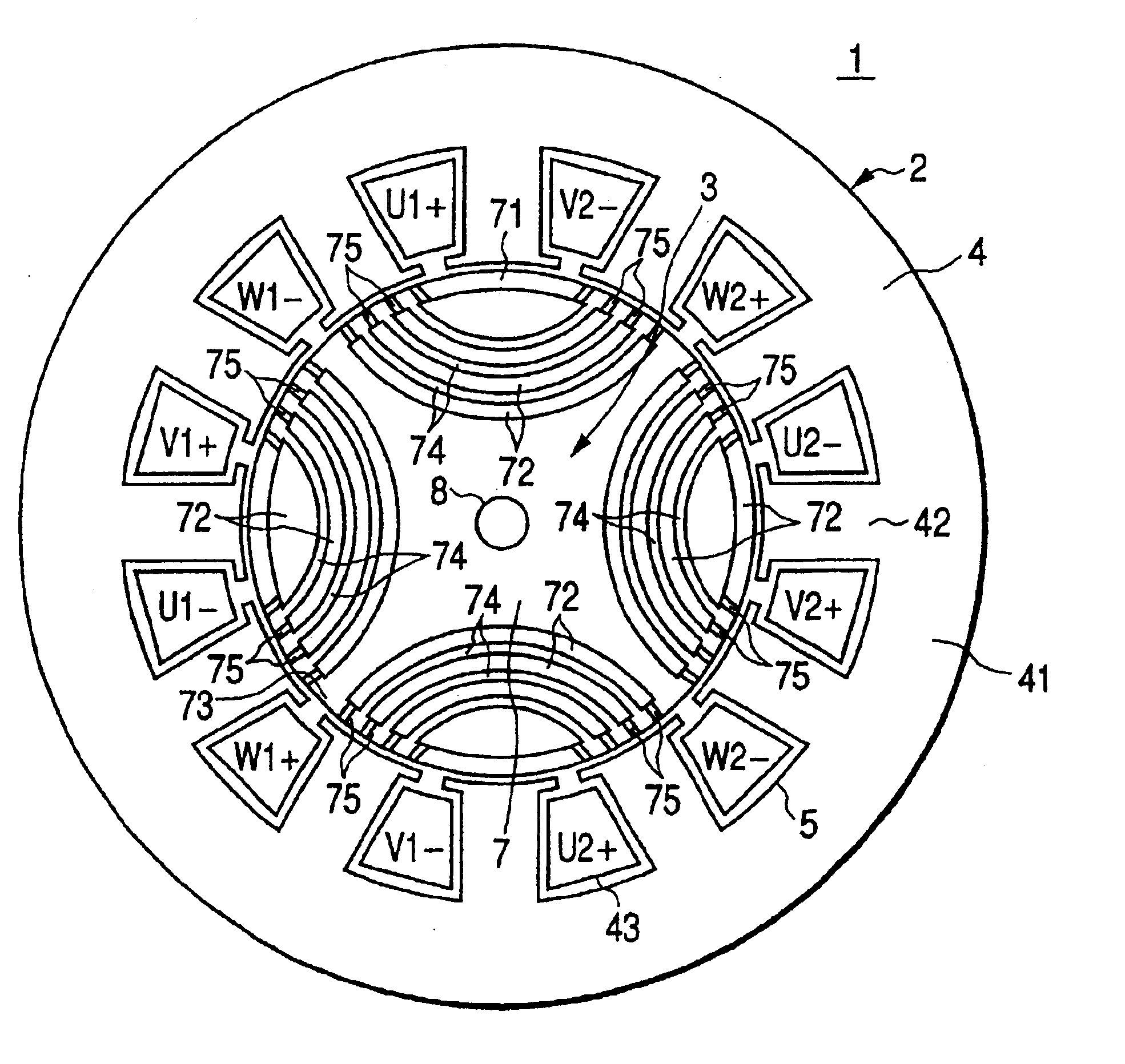
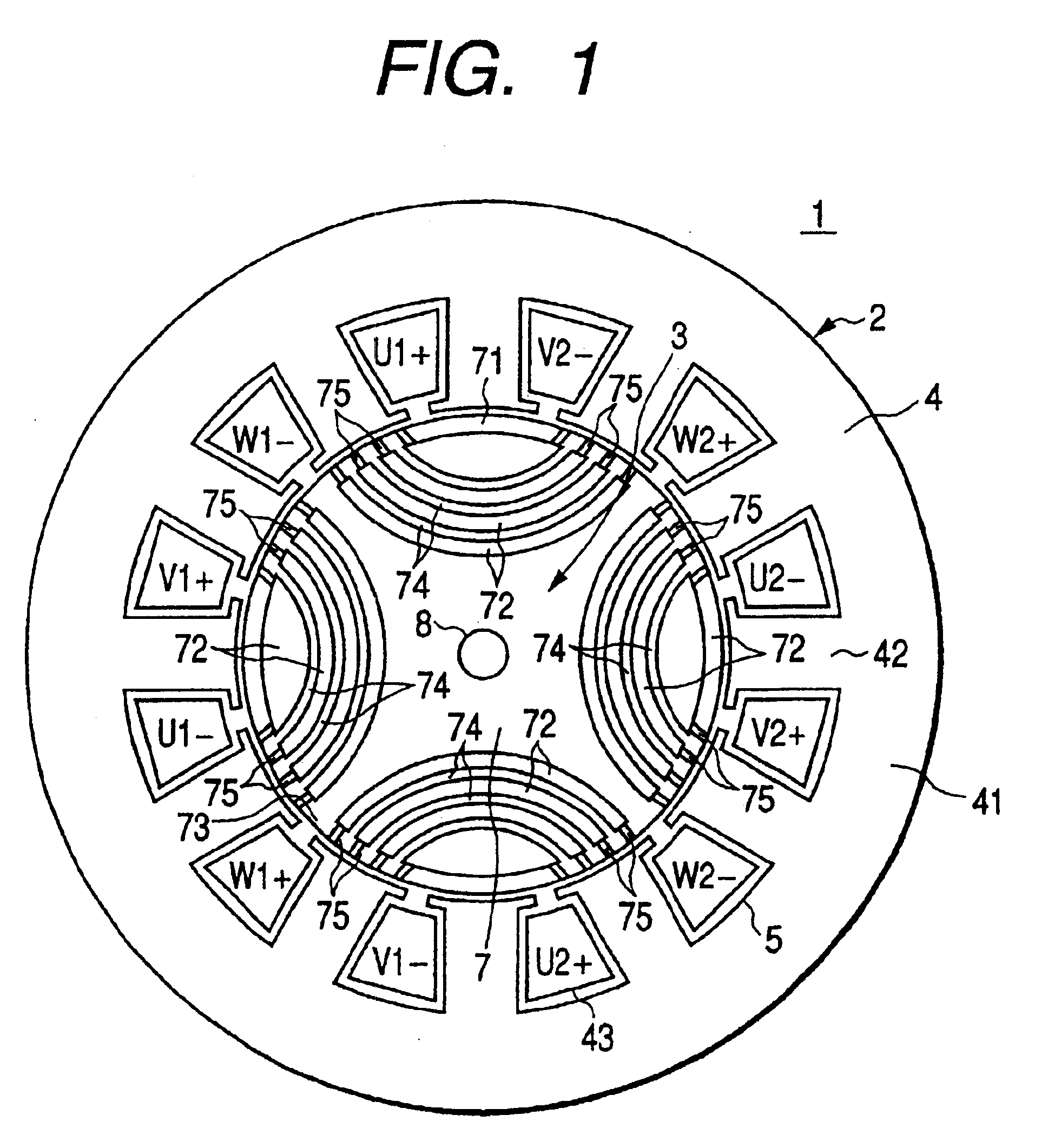
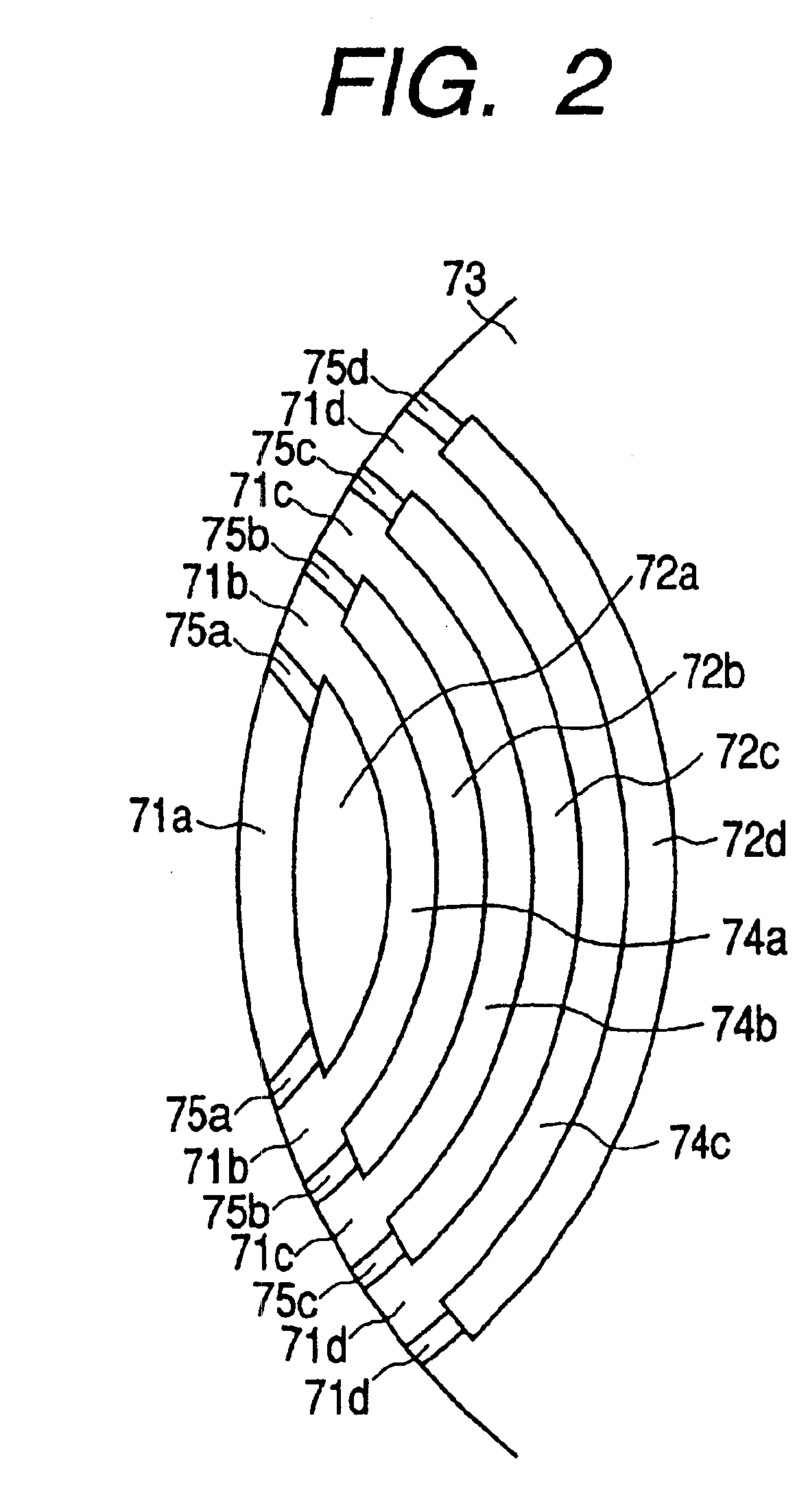
FIG. 8 is a cross sectional view showing the constitution of the rotary machine of the second embodiment of the present invention and FIG. 9 is an enlarged view of the essential section shown in FIG. 8. The same numerals as those shown in FIGS. 1 and 2 indicate the same parts.

The characteristic of the reluctance motor of this embodiment is that non-magnetic part concavities 76 are installed in the peripheral part of the non-magnetic parts 75 positioned in the outer periphery of the reluctance type rotary machine. According to this embodiment, for example, the part to be non-magnetized of a material having a ferromagnetic tissue is heated at the austenite critical temperature or higher and then cooled or heated and fused at the melting point or higher and then cooled and solidified, thereby a rotor iron core that the ferromagnetic part and non-magnetic...

third embodiment

Next, the constitution and operation of the rotary machine of the present invention will be explained with reference to FIGS. 10 and 11.

FIG. 10 is a cross sectional view showing the constitution of the rotary machine of the third embodiment of the present invention and FIG. 11 is a process diagram showing the manufacturing process of a rotor of this embodiment. The same numerals as those shown in FIGS. 1 and 2 indicate the same parts.

The characteristic of the reluctance motor of this embodiment is that permanent magnets 6 are arranged in a part of the rotor. By doing this, the defects of the reluctance type rotary machine against a permanent magnet rotary machine, for example, small torque and a low power factor can be improved.

In FIG. 10, windows for housing the permanent magnets 6 are press-cut in the rotary iron core 7 having a material that the magnetic part and non-magnetic part coexist and the permanent magnets 6 are housed in the windows. The length of each permanent magnet 6...

the structure of the environmentally friendly knitted fabric provided by the present invention; figure 2 Flow chart of the yarn wrapping machine for environmentally friendly knitted fabrics and storage devices; image 3 Is the parameter map of the yarn covering machine
Login to View More

PUM

No PUM Login to View More

Abstract

The rotary machine is composed of the rotor having magnetic poles and the stator having the stator yoke portion constituting the iron core tooth portion wound by the stator winding and the flux flow path of the magnetic poles. The rotor is composed of a metallic material having ferromagnetic parts and non-magnetic parts as a member and has a magnetic barrier area composed of the slit portion for blocking the bypath magnetic path in the periphery of the rotor and the non-magnetic parts. The rotary machine that produced torque can be increased sufficiently and the mechanical strength during high-speed running is improved and an electrical vehicle using it.

Description

BACKGROUND OF THE INVENTION1. Field of the InventionThe present invention relates to a rotary machine and an electrical vehicle using it and more particularly to a reluctance type rotary machine suitable for an electrical vehicle and an electrical vehicle using it.2. Prior ArtRecently, a motor used for an electrical vehicle such as an electric car or a battery fork is required to be small-sized, light in weight, and highly efficient. Therefore, as a driving motor of an electrical vehicle, a brushless motor (reluctance motor) using 1) a permanent magnet or 2) reluctance is most suitable. Particularly, as compared with a permanent magnet type motor using a highly efficient permanent magnet, although a reluctance motor is slightly low in efficiency and torque, it is almost equal to a permanent magnet type motor using a ferrite magnet and has an advantage that there are no problems imposed such as dependence on temperature of the characteristics and demagnetization of the magnet.A first...

Claims

the structure of the environmentally friendly knitted fabric provided by the present invention; figure 2 Flow chart of the yarn wrapping machine for environmentally friendly knitted fabrics and storage devices; image 3 Is the parameter map of the yarn covering machine
Login to View More

Application Information

Patent Timeline
01 Feb 2005
Publication
US6849983B2
IPC
H02K1/27; H02K19/02; H02K19/10; H02K1/22; B60L15/20; H02K21/14
CPC
H02K1/246; H02K1/276; Y02T10/7258; Y02T10/641; H02K15/022; H02K15/12; Y02T10/64; Y02T10/72
Inventors
TAJIMA, FUMIO; MATSUNOBU, YUTAKA