Eight-stroke internal combustion engine utilizing a slave cylinder

a technology of internal combustion engine and slave cylinder, which is applied in the direction of reciprocating combination engine, non-fuel substance addition to fuel, output power, etc., can solve the problems of limited compression volume ratio and premature ignition of mixture, and achieve the effect of increasing fuel efficiency

US6918358B2Inactive Publication Date: 2005-07-19HU LUNG TAN
11 Cites 33 Cited by

Patent Information

Authority / Receiving Office
US · United States
Patent Type
Patents(United States)
Current Assignee / Owner
Publication Date
2005-07-19
Estimated Expiration
Not applicable · inactive patent

Smart Images

  • Figure 1
    Figure 1
  • Figure 2
    Figure 2
  • Figure 3
    Figure 3
Patent Text Reader

Abstract

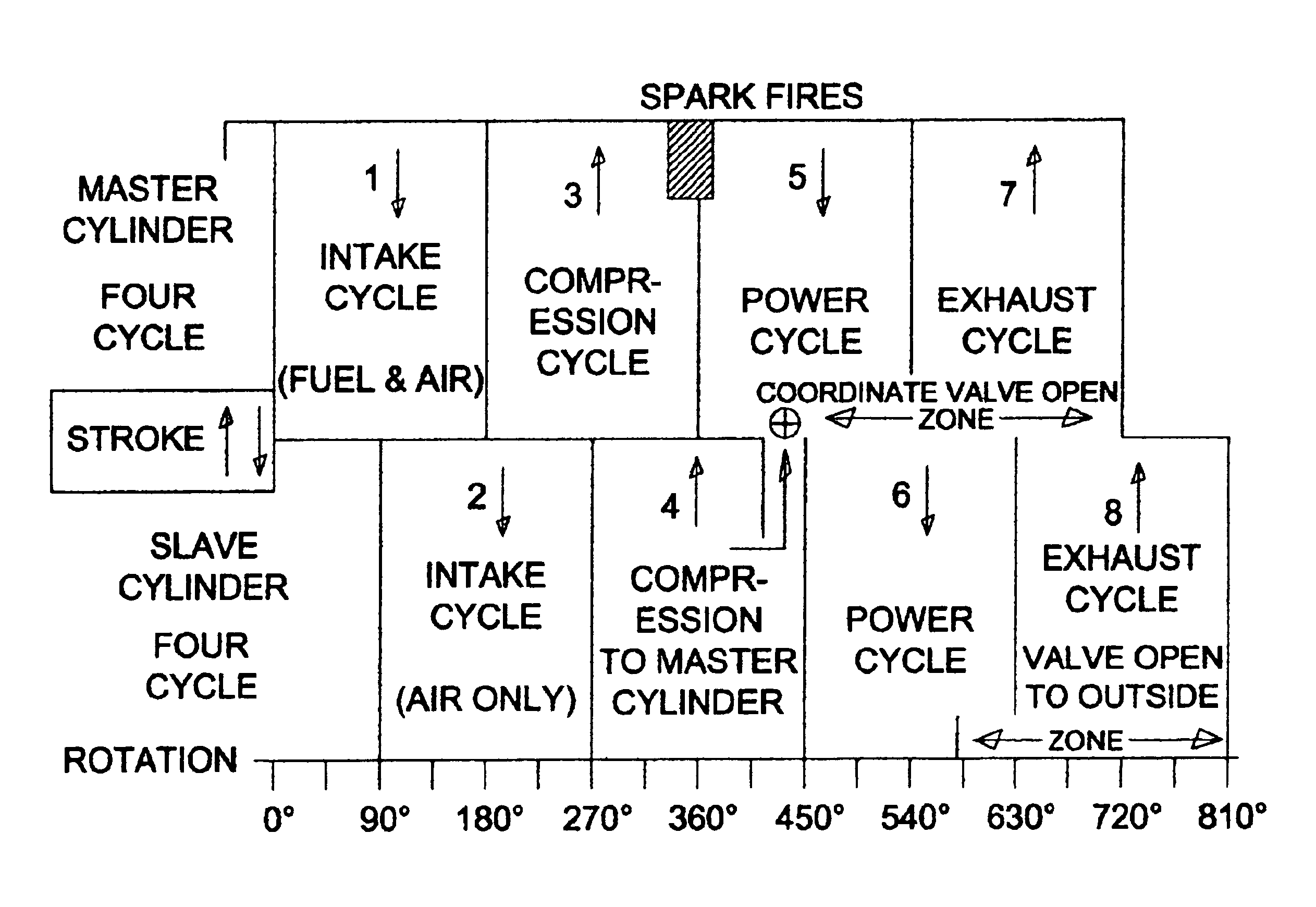
By the utilizing of a slave cylinder working in coordination with a master cylinder, the slave cylinder both receives cool atmospheric air and receives hot, partially un-burnt exhaust gases from the master cylinder to create a second power-stroke in the slave cylinder. With the two coordinating cylinders, the entire working process is from 0 to 810 degrees of revolution crankshaft. The master cylinder cycles work from 0 to 720 degrees of revolution and slave cylinder cycles work from 90 to 810 degrees of revolution. The master cylinder begins to intake air and fuel at 0 degree of revolution and slave cylinder begins to intake air at 90 degrees of revolution. There is an angle of 60-120 degrees differences between master and slave cylinder, where the slave cylinder is trailing the master.
Need to check novelty before this filing date? Find Prior Art

Description

FIELD

[0001] The present invention is related to an eight-stroke internal combustion engine, which may be used in most any application of present uses of internal combustion engines, such as a transportation vehicle. More-specifically this invention relates to an eight-stroke reciprocating piston driven internal combustion engine utilizing a slave cylinder working in cooperation with a master cylinder.BACKGROUND OF THE INVENTION

[0002] There are two main types of piston driven reciprocal internal combustion engines, they are the spark ignition engines, and the auto-ignition engines, also called diesel engines.

[0003] These piston driven reciprocal engines, for the most part, use either a two-stroke cycle or more commonly, a four-stroke cycle. The main parts of these engines are; a cylinder containing a piston with a reciprocal movement which is converted into a rotational movement by means of a connecting rod and a crankshaft, and a cylinder head consisting of at least two valves, one exh...

Examples

Embodiment Construction

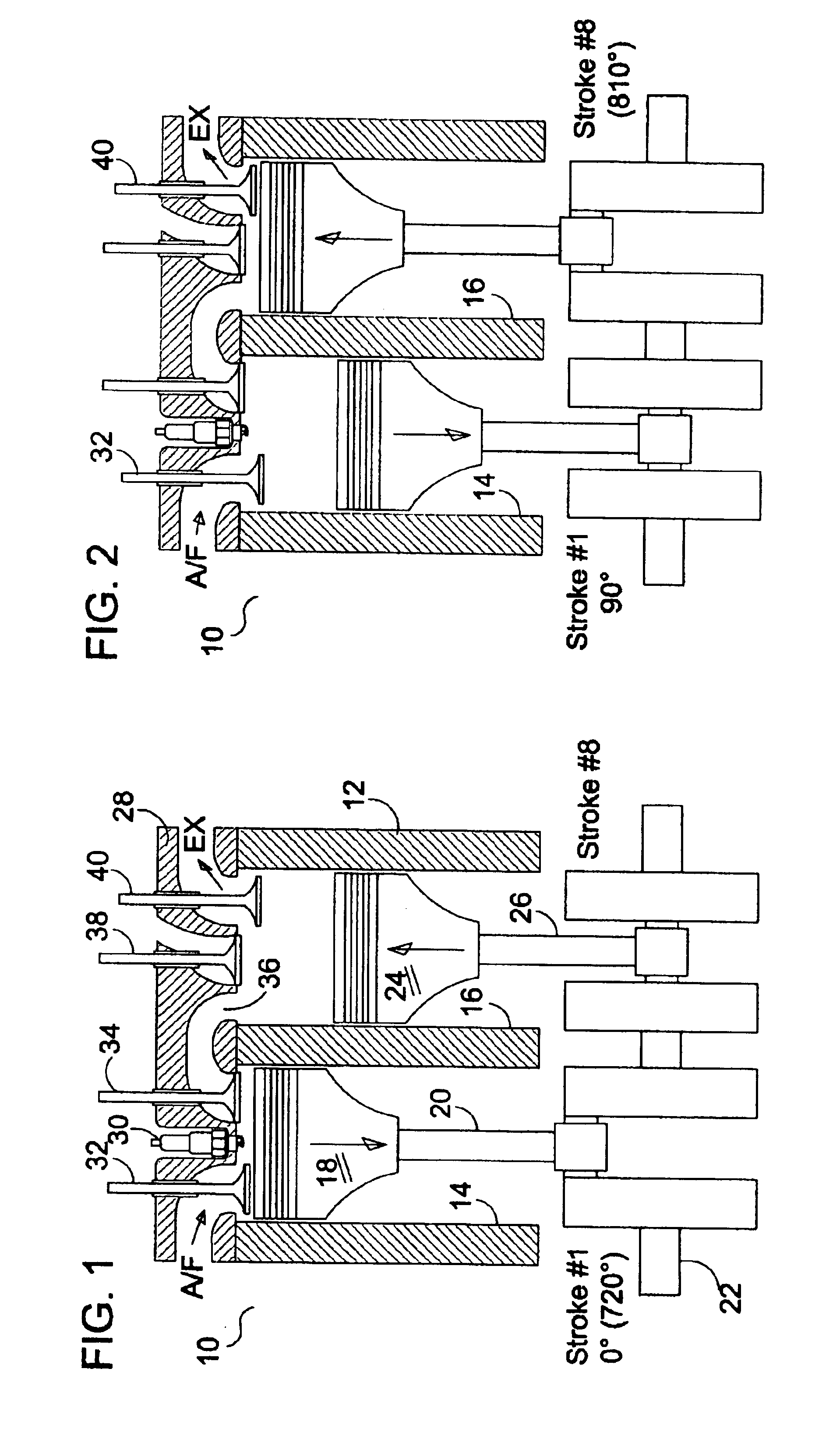
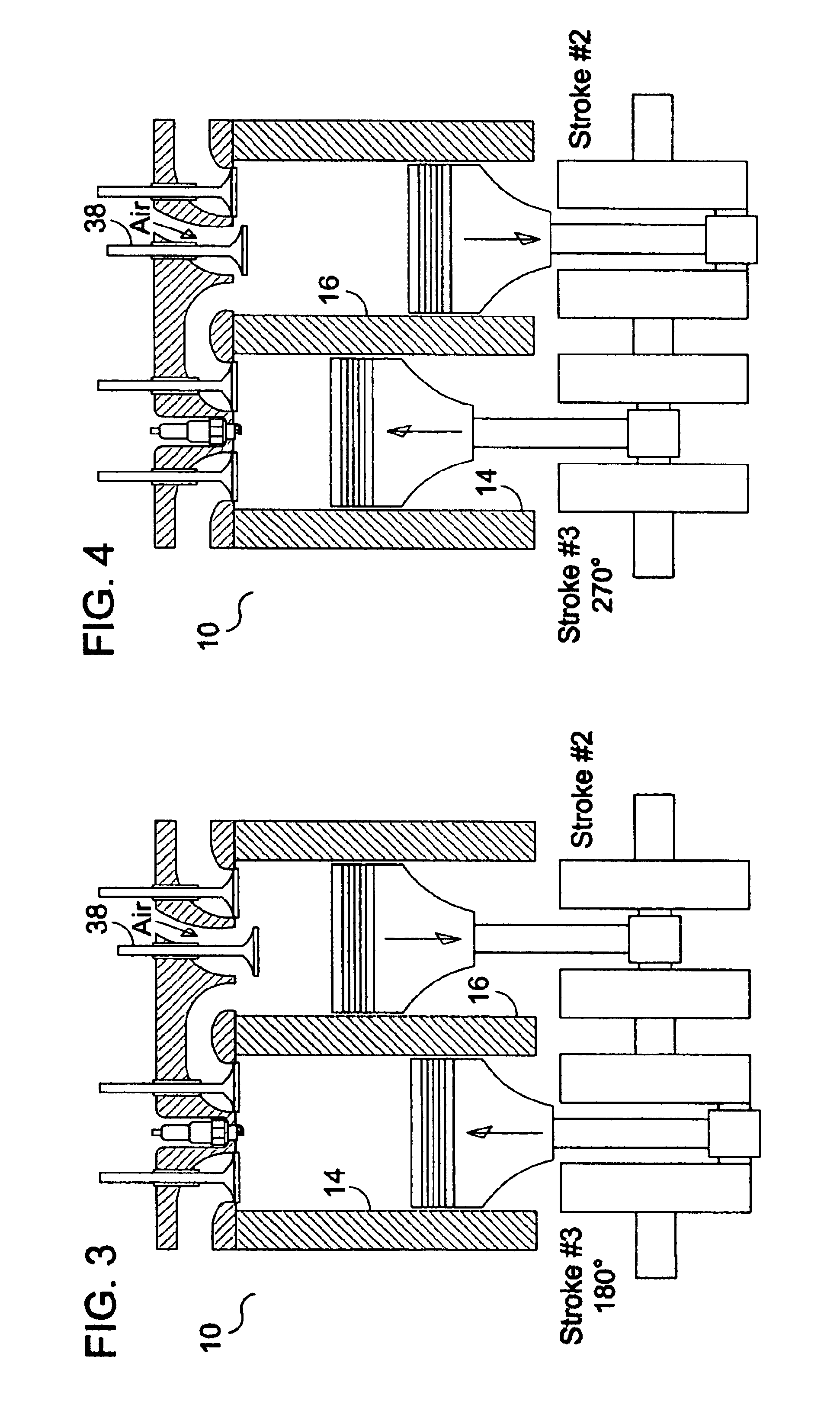
[0028]The eight-stroke internal combustion engine is generally referred to as 10, it is shown in a cutaway sectional elevation view, where engine 10 comprises a cylinder block 12, and within block 12, there is a master cylinder bore 14 and a slave cylinder bore 16.

[0029]The master cylinder 14 contains a piston 18 which is slidable movable by connecting rod assembly 20, rod 20 is rotationally supported by crankshaft 22, where crankshaft 22 is rotationally supported by cylinder block 12. Slave cylinder bore 16 contains a piston 24 which is slidable movable by connecting rod assembly 26, rod 26 is also rotationally supported by crankshaft 22.

[0030]Fixed atop cylinder block 12 is a cylinder head 28. Above master cylinder 14, cylinder head 28 includes a spark plug 30, an intake valve 32 and a coordinate valve 34. Above slave cylinder 16, cylinder head 22 includes an open port 36 to coordinate valve 34, an intake valve 38 and an exhaust valve 40.

[0031]As seen in FIG. 1, intake stroke, str...