Also, where relatively high conversion rates are desired, a digital-based QM or QD frequently requires the addition of a frequency up-converter or a frequency down-converter, respectively, thereby adding expense to the QM or QD.
Further, image-rejection filters that accompany the up-converter add additional cost to a digital-based QM.
Disadvantageously, conventional analog-based QM or QD circuits exhibit less accuracy in the modulation or
multiplexing process than digital-based QM or QD circuits.
Further, related components such as digital-to-analog
converters and reconstruction filters can also contribute to quadrature impairment.
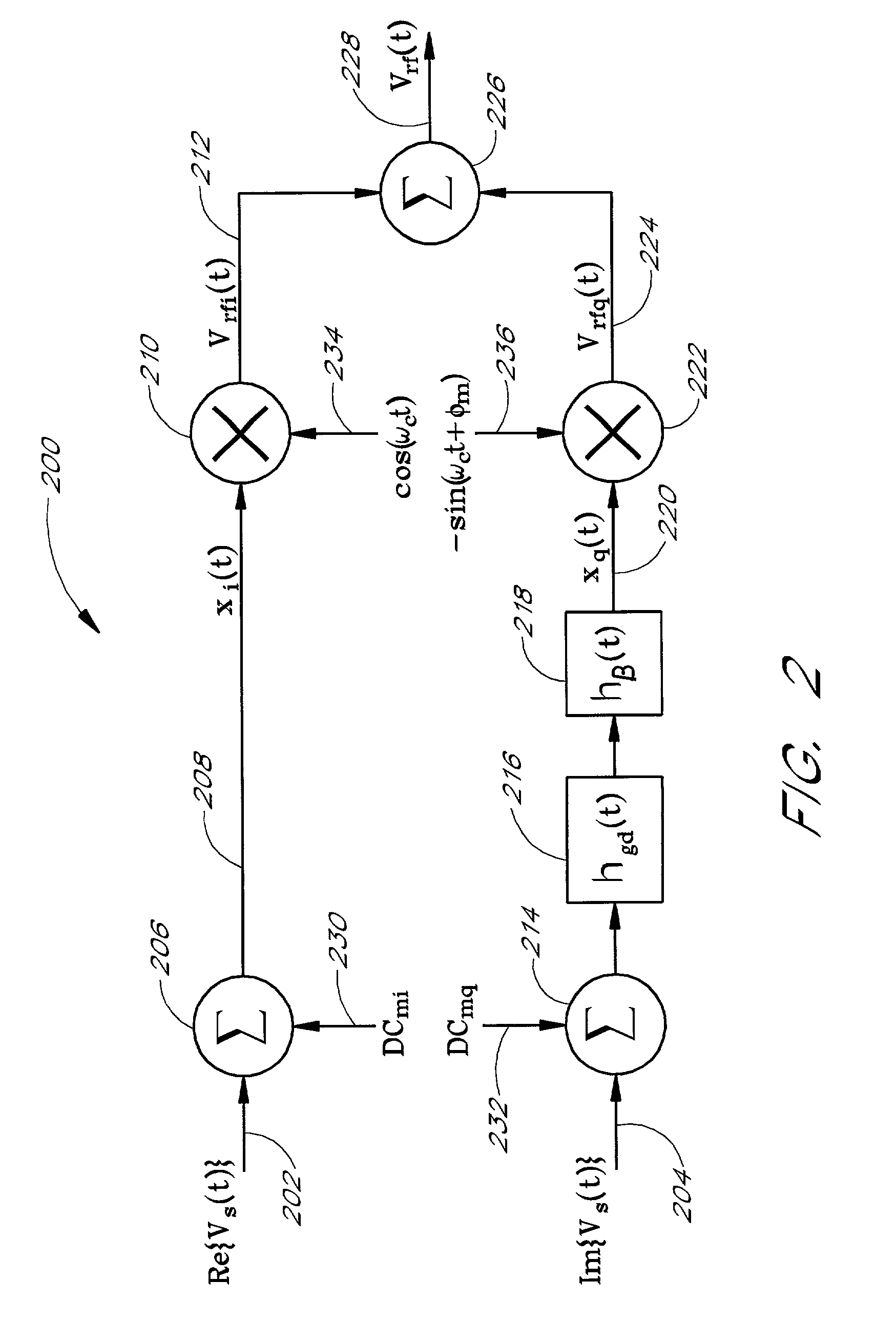
Gain imbalance occurs where the two sinusoids have unequal power, when the two baseband signals (input signals to the quadrature modulator, or output signals from the quadrature demodulator) are amplified / attenuated by different amounts by the
quadrature modulation or
demodulation device or by supporting hardware, e.g., filters and the like.
LO feed-through occurs when power at the frequency of the LO used to generate the two sinusoids of the QM process is undesirably present in the output of the quadrature modulator.
The power present at the LO frequency disadvantageously wastes valuable output power.
Similarly, undesired
coupling of the LO into a quadrature demodulator results in an undesirable DC offset in the recovered baseband signals.
Conventional compensation techniques for quadrature impairment are inadequate.
However, conventional techniques suffer from several drawbacks, such as relatively low performance and relatively high cost.
Conventional compensation techniques are limited in compensation bandwidth and do not adequately compensate for quadrature impairment across an entire band.
Some conventional techniques employ computationally intensive
Fourier transform computations to extend the bandwidth of computation, but are still relatively limited in bandwidth.
Such use of injected test signals is not feasible in all applications because of the interruption to the transmission of the baseband signals that occurs while the test signals are injected.
Circuits and switches to inject test signals also add cost to the compensation
system.
Diode detectors add to the cost of a
system and are also sensitive to temperature, aging, and other environmental effects, and often require periodic recalibration.
Further, a
detector diode typically does not provide an ideal response, such as a predictable linear or logarithmic response, to an RF signal, which thereby limits the amount of compensation attainable with such
diode detectors.
In addition,
detector diodes can vary over frequency, thereby further limiting the compensation capability of such systems.
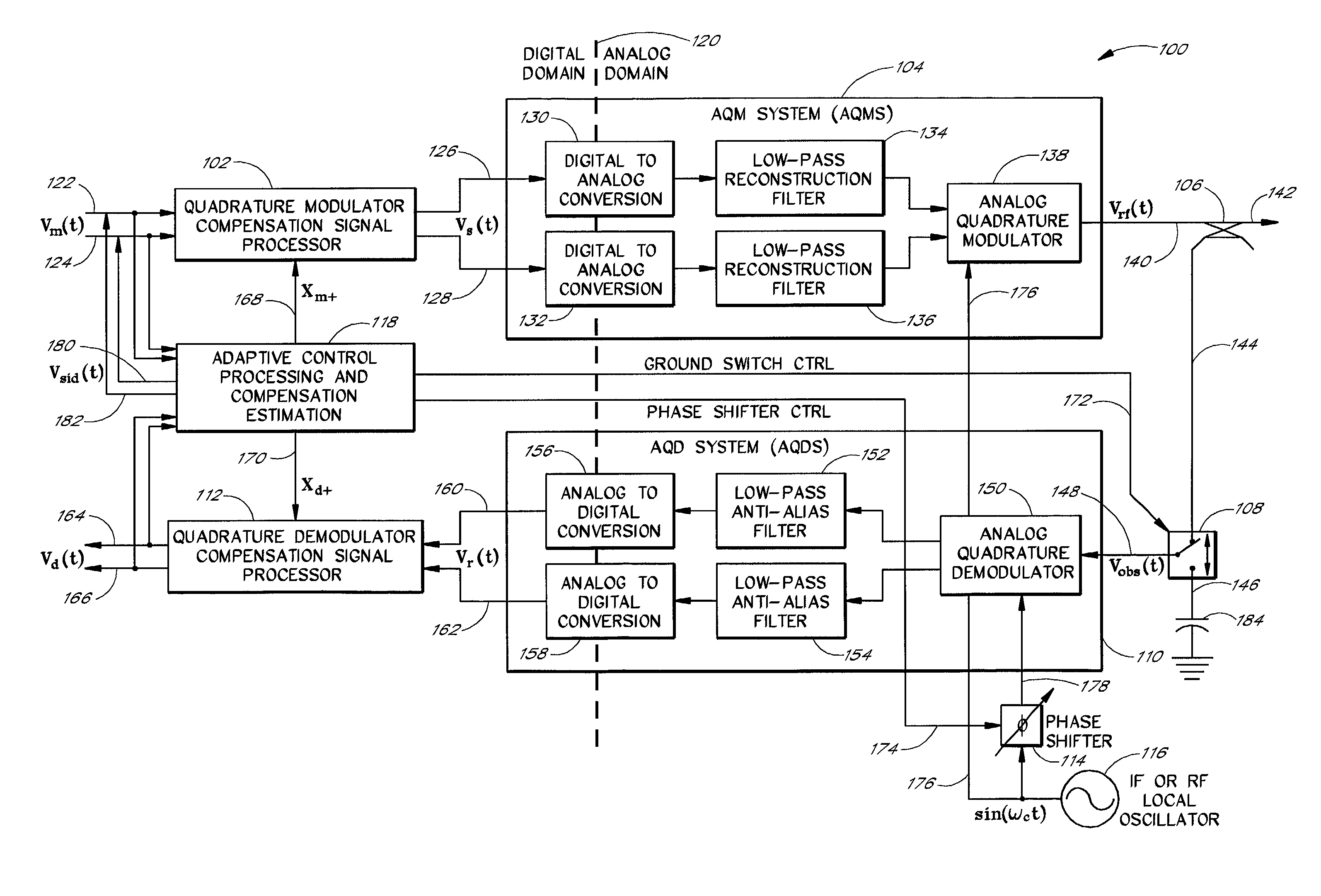
Where a modulator includes both QM and QD, conventional compensation techniques fail to distinguish between the quadrature impairment caused by the quadrature modulator and the quadrature impairment caused by the quadrature demodulator.


 Login to View More
  Login to View More