
Position information input apparatus and method
a position information and input apparatus technology, applied in static indicating devices, instruments, optics, etc., can solve the problems of increasing the difficulty of achieving the effect of the apparatus using a psd having a high tolerance to ambient light, and the increase of the cost and size of the apparatus
- Summary
- Abstract
- Description
- Claims
- Application Information
AI Technical Summary
Benefits of technology
Problems solved by technology
Method used
Image

Examples
third embodiment
The Third Embodiment
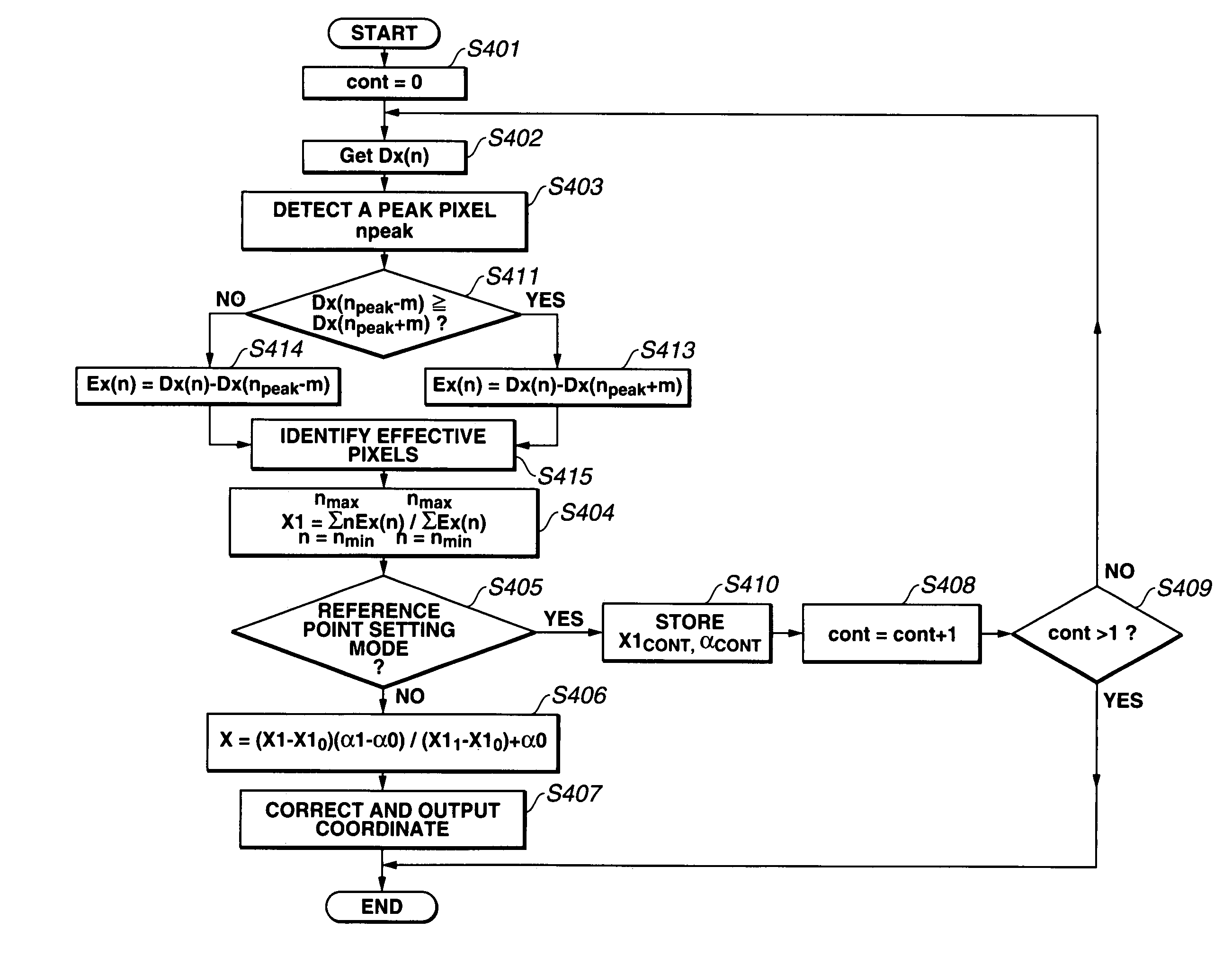
[0136]FIG. 17 is a flowchart showing a coordinate calculation processing according to the third embodiment. After the processing has started in FIG. 17, a variable cont is set to 0 for initializing in step S401, and difference data Dx(n) corresponding to a difference signal at each coordinate input device is read out and stored in the buffer in step S402. Next, a pixel npeak where output signal becomes maximum is detected in step S403, m-th pixels in each direction forward and backward from the pixel npeak are selected, and the signal levels of both selected pixels Dx(npeak−m) and Dx(npeak+m) are compared in step S411. The smaller of the signal levels is set as a threshold value based on the comparison, and the output signals of each of the pixels are compared with the threshold value in step S413 or step S414. The smaller one is set as the threshold value in this embodiment, and FIG. 14(A) shows a case where m=3. In the figure, it is clear that the threshold val...
fourth embodiment
The Fourth Embodiment
[0142]In this embodiment, a determination is made as to whether or not the set threshold value is effective for identifying the receiving light, which is the light emitted from the light source arranged in the designating device. The determination provides higher accuracy and reliability in coordinate detection. If the products using the sensor are manufactured in quantity, the differences between products and their parts should be considered. Especially, the output voltage when no light reaches the sensor, namely output voltage in a dark condition, is a problem. The output voltage in a dark condition usually varies by plus and minus dozens of percent from the nominal value, due to manufacturing tolerances. The distribution is from about 0.7 V to about 1.3 V depending on the difference between each product if the electric source voltage is 5 V and it is assumed that the nominal output voltage in a dark condition is 1 V. Therefore, the threshold level must be set...
PUM
 Login to View More
 Abstract
Description
Claims
Application Information
 Login to View More