Check patentability & draft patents in minutes with Patsnap Eureka AI!

Optimized cache structure for multi-texturing

Active Publication Date: 2006-06-27
ORACLE INT CORP
View PDF5 Cites 2 Cited by
  • Summary
  • Abstract
  • Description
  • Claims
  • Application Information

AI Technical Summary

Benefits of technology

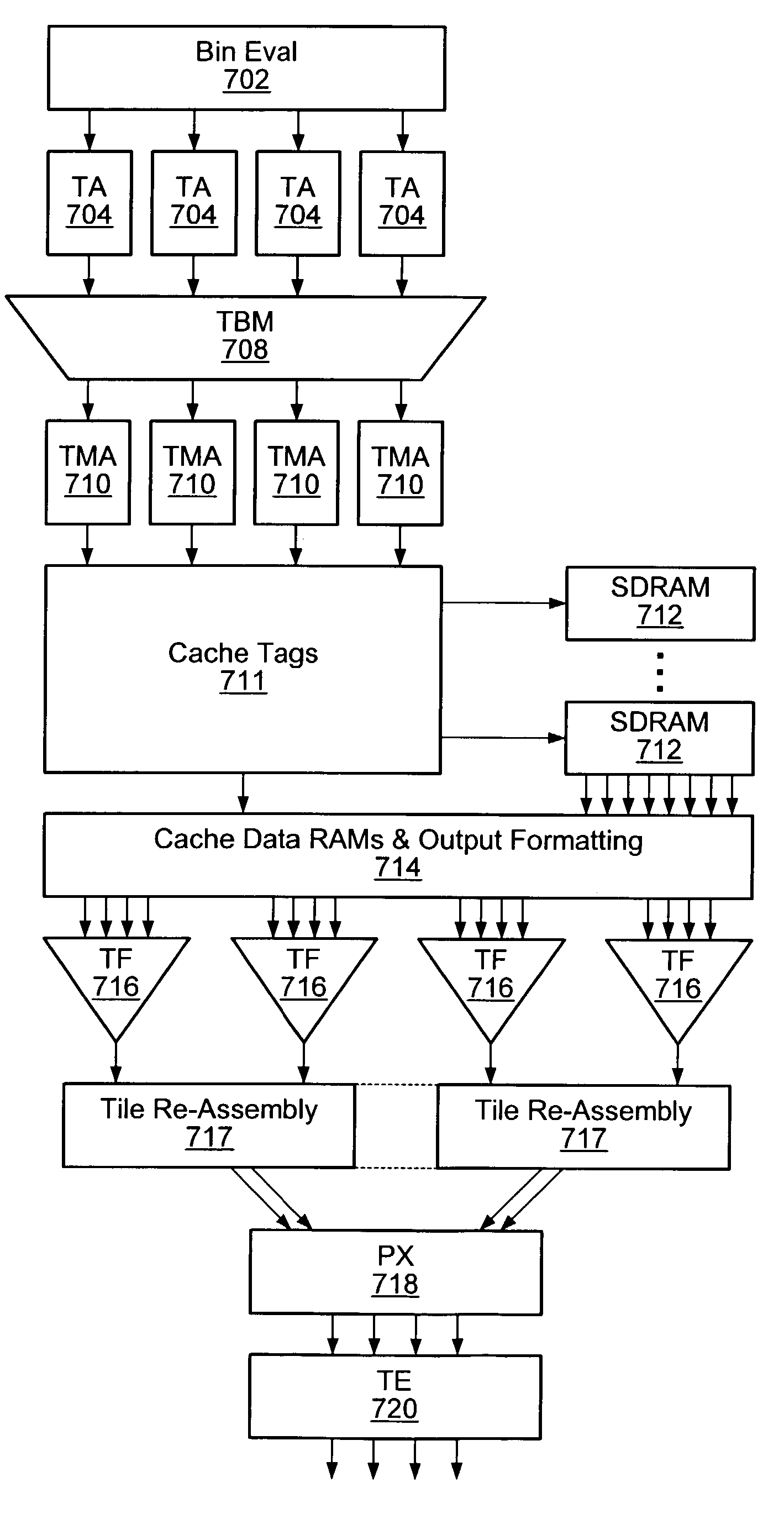
[0013]By operating the texture cache as described above, a need for a fully associative texture cache to avoid thrashing may be averted. Instead, thrashing may be minimized through isolating the texture maps from each other by allocating a single texture cache partition to a single texture map. In other words, a single texture cache partition may operate as a direct-mapped cache corresponding to a si

Problems solved by technology

Modern graphics systems, however, incorporate graphics processors with a great deal of processing power.
This change is due to the recent increase in both the complexity and amount of data being sent to the display device.
Similarly, the images displayed are now more complex and may involve advanced techniques such as anti-aliasing and texture mapping.
This consistent increase in data and data rates places additional burden on the memory systems that form an integral part of the graphics system.
Thus, poor performance of the texture buffer is capable of affecting a cascading degradation through the graphics system, stalling the render pipeline, and increasing the render or refresh times of displayed images.
The resulting stream of widely varying addresses may cause the texture memory cache to thrash, unless it is a fully associative cache, which is generally very expensive to implement.
Every time the two texture maps are accessed in succession, one after the other, the cache line will have to be flushed and reloaded, which is very inefficient and degrades the overall performance of the graphics system.
Another possible solution in addition of a fully associative cache, which as mentioned above is generally very expensive to implement, is to permanently divide the cache into a set number of partitions.
This would however be impractical, as it would degrade performance of the cache during non-multitexturing operations.

Method used

the structure of the environmentally friendly knitted fabric provided by the present invention; figure 2 Flow chart of the yarn wrapping machine for environmentally friendly knitted fabrics and storage devices; image 3 Is the parameter map of the yarn covering machine
View more

Image

Smart Image Click on the blue labels to locate them in the text.
Viewing Examples
Smart Image
  • Optimized cache structure for multi-texturing
  • Optimized cache structure for multi-texturing
  • Optimized cache structure for multi-texturing

Examples

Experimental program
Comparison scheme
Effect test

Embodiment Construction

[0038]As used herein, “burst length” is used to refer to a number that indicates how many consecutive data bus transfers may be performed in response to a single bus transfer request sent by a host system. For example, if a burst length is four and a memory read operation is performed, there may be four consecutive sets of data transferred on the data bus in response to a single read signal pulse sent by a host system. The size of a set of data for a single transfer over a data bus is typically commensurate with the size of the data bus. Common burst lengths for a DDR SDRAM may include the values of two, four or eight.

[0039]According to prior art, a read operation for a DDR SDRAM may be performed as follows. A DDR SDRAM may receive a Read request through a set of control signals from a requester. A predetermined number of clock cycles after having received the Read request, the DDR SDRAM sends a predetermined number of consecutive strobe signal (DQS) pulses back to the host system. ...

the structure of the environmentally friendly knitted fabric provided by the present invention; figure 2 Flow chart of the yarn wrapping machine for environmentally friendly knitted fabrics and storage devices; image 3 Is the parameter map of the yarn covering machine
Login to View More

PUM

No PUM Login to View More

Abstract

A method for optimizing a cache memory used for multitexturing in a graphics system is implemented. The graphics system comprises a texture memory, which stores texture data comprised in texture maps, coupled to a texture cache memory. Active texture maps for an individual primitive, for example a triangle, are identified, and the texture cache memory is divided into partitions. In one embodiment, the number of texture cache memory partitions equals the number of active texture maps. Each texture cache memory partition corresponds to a respective single active texture map, and is operated as a direct mapped cache for its corresponding respective single active texture map. In one embodiment, each texture cache memory partition is further operated as an associative cache for the texture data comprised in the partition's corresponding respective single active texture map. The cache memory is dynamically re-configured for each primitive.

Description

BACKGROUND OF THE INVENTION[0001]1. Field of the Invention[0002]This invention relates generally to the field of memory interface design and, more particularly, to cache design in a graphics system[0003]2. Description of the Related Art[0004]A computer system typically relies upon its graphics system for producing visual output on the computer screen or display device. Early graphics systems were only responsible for taking what the processor produced as output and displaying that output on the screen. In essence, they acted as simple translators or interfaces. Modern graphics systems, however, incorporate graphics processors with a great deal of processing power. They now act more like coprocessors rather than simple translators. This change is due to the recent increase in both the complexity and amount of data being sent to the display device. For example, modern computer displays have many more pixels, greater color depth, and are able to display images that are more complex wit...

Claims

the structure of the environmentally friendly knitted fabric provided by the present invention; figure 2 Flow chart of the yarn wrapping machine for environmentally friendly knitted fabrics and storage devices; image 3 Is the parameter map of the yarn covering machine
Login to View More

Application Information

Patent Timeline
no application Login to View More
IPC IPC(8): G06F12/00G06T1/60
CPCG06T1/60
Inventor EMBERLING, BRIAN D.
Owner ORACLE INT CORP
Features
  • R&D
  • Intellectual Property
  • Life Sciences
  • Materials
  • Tech Scout
Why Patsnap Eureka
  • Unparalleled Data Quality
  • Higher Quality Content
  • 60% Fewer Hallucinations
Social media
Patsnap Eureka Blog
Learn More