Binder for powder metallurgy, mixed powder for powder metallurgy and method for producing same
Active Publication Date: 2006-07-11
KOBE STEEL LTD
View PDF7 Cites 14 Cited by
Summary
Abstract
Description
Claims
Application Information
AI Technical Summary
This helps you quickly interpret patents by identifying the three key elements:
Problems solved by technology
Method used
Benefits of technology
Benefits of technology
[0010]According to a second aspect of the invention, in the binder of the first aspect, it is preferable for the epoxy resin to have a viscosity of 15,000 mPa·s or less at 25° C. This is because setting the viscosity at 15,000 mPa·s or less enables dispersibility of the binder in the raw powder to be enhanced.
[0017]This invention, which does not use a highly flammable solvent having an offensive smell, has few problems in point of safety and workability. Besides, the invention may provide a mixed powder for powder metallurgy capable of preventing the scattering of graphite, etc. effectively and superior in powder characteristics, especially powder characteristics in a warm condition.
Problems solved by technology
However, these solvents are highly flammable and such a danger as fire is involved in the manufacturing process for a mixed powder for powder metallurgy.
Moreover, in view of the recent demand for coping with environmental problems, it is required to decrease the amount of the solvent used.
Poor performance of the binder for powder metallurgy used might not only bring about the foregoing segregation of components or scattering of graphite results, but also badly influence characteristics of the resulting mixed powder.
Method used
the structure of the environmentally friendly knitted fabric provided by the present invention; figure 2 Flow chart of the yarn wrapping machine for environmentally friendly knitted fabrics and storage devices; image 3 Is the parameter map of the yarn covering machine
View more
Image
Smart Image Click on the blue labels to locate them in the text.
Viewing Examples
Smart Image
Click on the blue label to locate the original text in one second.
Reading with bidirectional positioning of images and text.
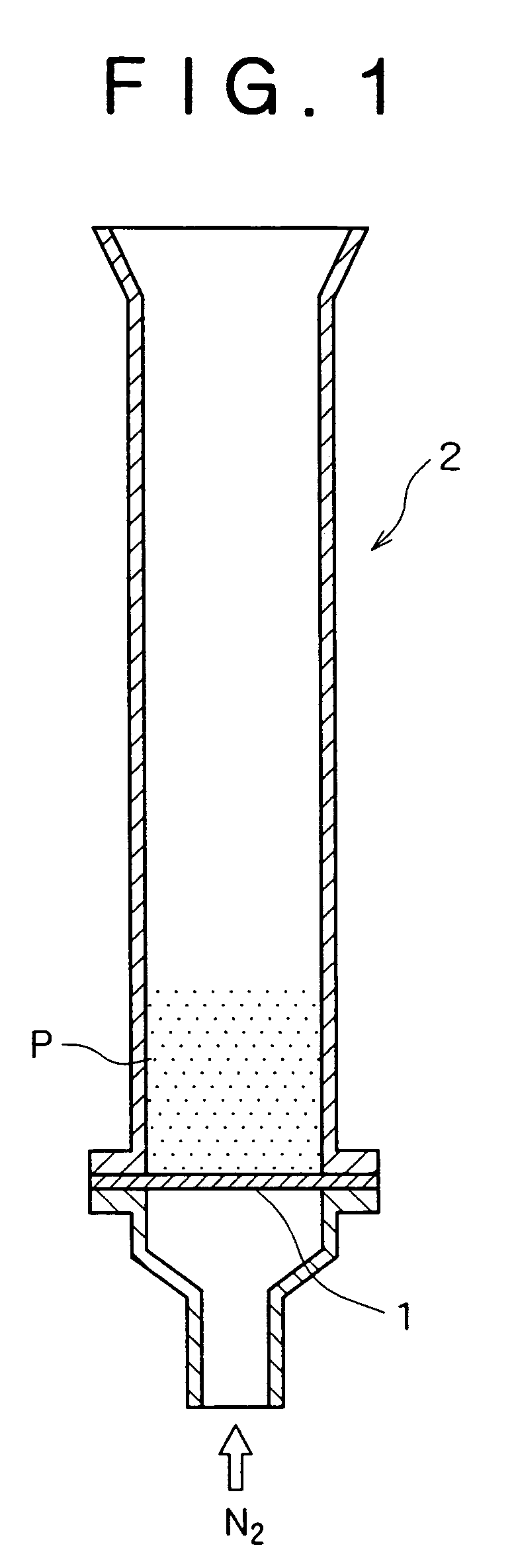
[0043]As shown in FIG. 1, a sample powder P (25 g) is placed in a funnel-like glass tube 2 (inside diameter: 16 mm, height; 106 mm) equipped with a nuclepore filter 1 (12 μm mesh), then N2 gas is allowed to flow from below for 20 minutes at a rate of 0.8 l / min, and a percent graphite scattering (%) is determined in accordance with the following equation:
Percent graphite scattering (%)=[1−(amount of graphite (g) in the sample powder after flowing of N2 gas / amount of graphite (g) in the sample powder before flowing of N2 gas]×100
[0044]The amount of graphite contained in the sample powder is determined by quantitative analysis of carbon contained in the sample powder.
(2) Fluidity (sec / 50 g)
[0045]In accordance with JIS Z 2502 (a metal powder fluidity testing method), the time required for 50 g of a mixed powder to flow out from a 2.63 mm dia. orifice is determined as fluidity (sec / 50 g).
(3) Critical...
example 2
[0062]The following are examples of using different substances as curing agents.
[0063]As to the method for evaluating mixed powders for powder metallurgy, it is the same as in Example 1.
[0064]100 parts by weight of a bisphenol A type epoxy resin (Epikote 828, viscosity 12,000 mPa·s / 25° C., a product of Japan Epoxy Resin Co.) and 60 parts by weight of polymercaptan (EH-317, a product of Asahi Denka Kogyo Co.) were mixed together before use to prepare binder 7.
Binder 8
[0065]100 parts by weight of a bisphenol A type epoxy resin (Epikote 828, viscosity 12,000 mPa·s / 25° C., a product of Japan Epoxy Resin Co.) and 85 parts by weight of methyltetrahydrophthalic anhydride (EH-3326, a product of Asahi Denka Kogyo Co.) were mixed together before use to prepare binder 8.
Binder 9
[0066]100 parts by weight of a bisphenol A type epoxy resin (Epikote 828, viscosity 12,000 mPa·s / 25° C., a product of Japan Epoxy Resin Co.) and 11 parts by weight of die...
the structure of the environmentally friendly knitted fabric provided by the present invention; figure 2 Flow chart of the yarn wrapping machine for environmentally friendly knitted fabrics and storage devices; image 3 Is the parameter map of the yarn covering machine
Login to View More
PUM
Property
Measurement
Unit
Temperature
aaaaa
aaaaa
Fraction
aaaaa
aaaaa
Percent by mass
aaaaa
aaaaa
Login to View More
Abstract
The invention aims to provide a binder for powdermetallurgy, the binder containing an epoxy resin which is liquid at room temperature and a curing agent having at least one functional group selected from the group consisting of amino, mercapto and carboxyl groups. The binder involves few problems in point of workability and safety, suppress the scattering of graphite, and is superior in powder characteristics. The invention also provides a mixed powder for powder metallurgy using the binder and a method for producing the mixed powder.
Description
BACKGROUND OF THE INVENTION[0001]1. Field of the Invention[0002]The present invention relates to a binder for powder metallurgy capable of being suitably incorporated in a raw powder for powder metallurgy, such as iron powder or copper powder, also relates to a mixed powder for powder metallurgy, and further relates to a method for producing the mixed powder for powder metallurgy.[0003]2. Description of the Prior Art[0004]A mixed powder for powder metallurgy is generally produced by mixing an iron powder-based metal powder with an alloying powder such as graphite, nickel, copper, or molybdenum, and then treating the resulting powder mixture with a binder. The binder treatment permits prevention of segregation of components caused by the difference in specific gravity between the metal powder and the alloying powder such as graphite, and suppression of scattering of graphite, etc.[0005]As one example, Japanese Patent No. 1597077 discloses a binder treatment method comprising the step...
Claims
the structure of the environmentally friendly knitted fabric provided by the present invention; figure 2 Flow chart of the yarn wrapping machine for environmentally friendly knitted fabrics and storage devices; image 3 Is the parameter map of the yarn covering machine
Login to View More
Application Information
Patent Timeline
Application Date:The date an application was filed.
Publication Date:The date a patent or application was officially published.
First Publication Date:The earliest publication date of a patent with the same application number.
Issue Date:Publication date of the patent grant document.
PCT Entry Date:The Entry date of PCT National Phase.
Estimated Expiry Date:The statutory expiry date of a patent right according to the Patent Law, and it is the longest term of protection that the patent right can achieve without the termination of the patent right due to other reasons(Term extension factor has been taken into account ).
Invalid Date:Actual expiry date is based on effective date or publication date of legal transaction data of invalid patent.


 Login to View More