Catheter with spiral cut transition member

a transition member and catheter technology, applied in catheters, other medical devices, surgery, etc., can solve the problems of kinking at the joint, affecting the flexibility of the transition, and the hypertubing is often prone to kinking

US7115183B2Inactive Publication Date: 2006-10-03BOSTON SCI SCIMED INC
195 Cites 43 Cited by

Patent Information

Authority / Receiving Office
US · United States
Patent Type
Patents(United States)
Current Assignee / Owner
Publication Date
2006-10-03
Estimated Expiration
Not applicable · inactive patent

Smart Images

  • Figure 1
    Figure 1
  • Figure 2
    Figure 2
  • Figure 3
    Figure 3
Patent Text Reader

Abstract

A spiral cut transition member is disclosed for controlling the transition in stiffness of a catheter from a stiffer more pushable proximal section to a more flexible and trackable distal section and increasing kink resistance. The transition member has a spiral cut provided therein to vary the flexibility of the transition member over its length. The pitch of the spiral cut can be varied to facilitate a gradual transition in flexibility along the catheter. The transition member may be used in conjunction with any type of catheter including single-operator-exchange type catheters, over-the wire type catheters, and / or fixed-wire type catheters.
Need to check novelty before this filing date? Find Prior Art

Description

[0001] This application is a continuation of co-pending application Ser. No. 09 / 534,870 file date Mar. 24, 2000, which is a divisional of application Ser. No. 09 / 241,995, filed Feb. 2, 1999, now U.S. Pat. No. 6,048,338; which is a continuation-in-part of application Ser. No. 08 / 950,864, filed Oct. 15, 1997, now U.S. Pat. No. 5,891,110.TECHNICAL FIELD

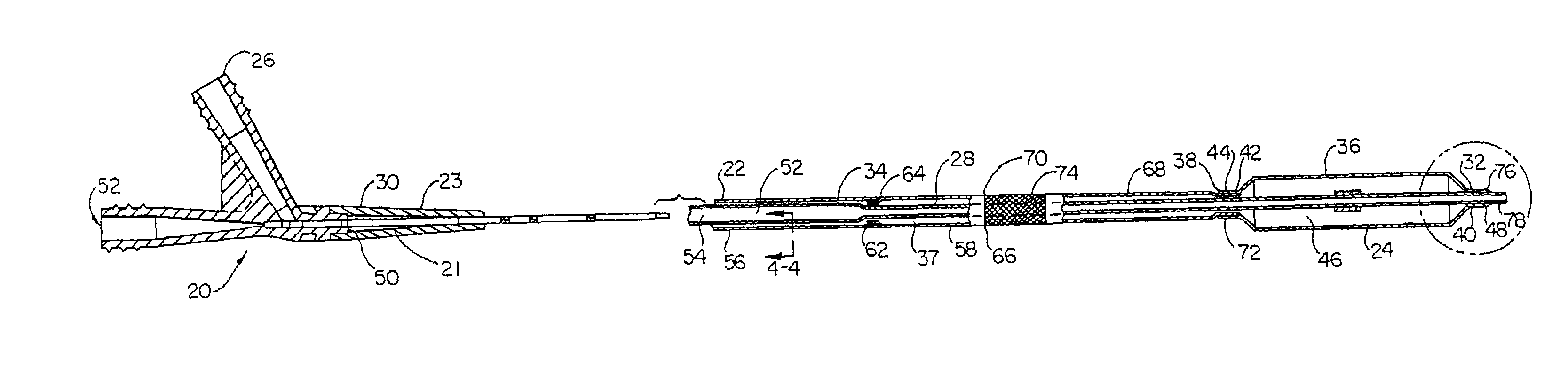
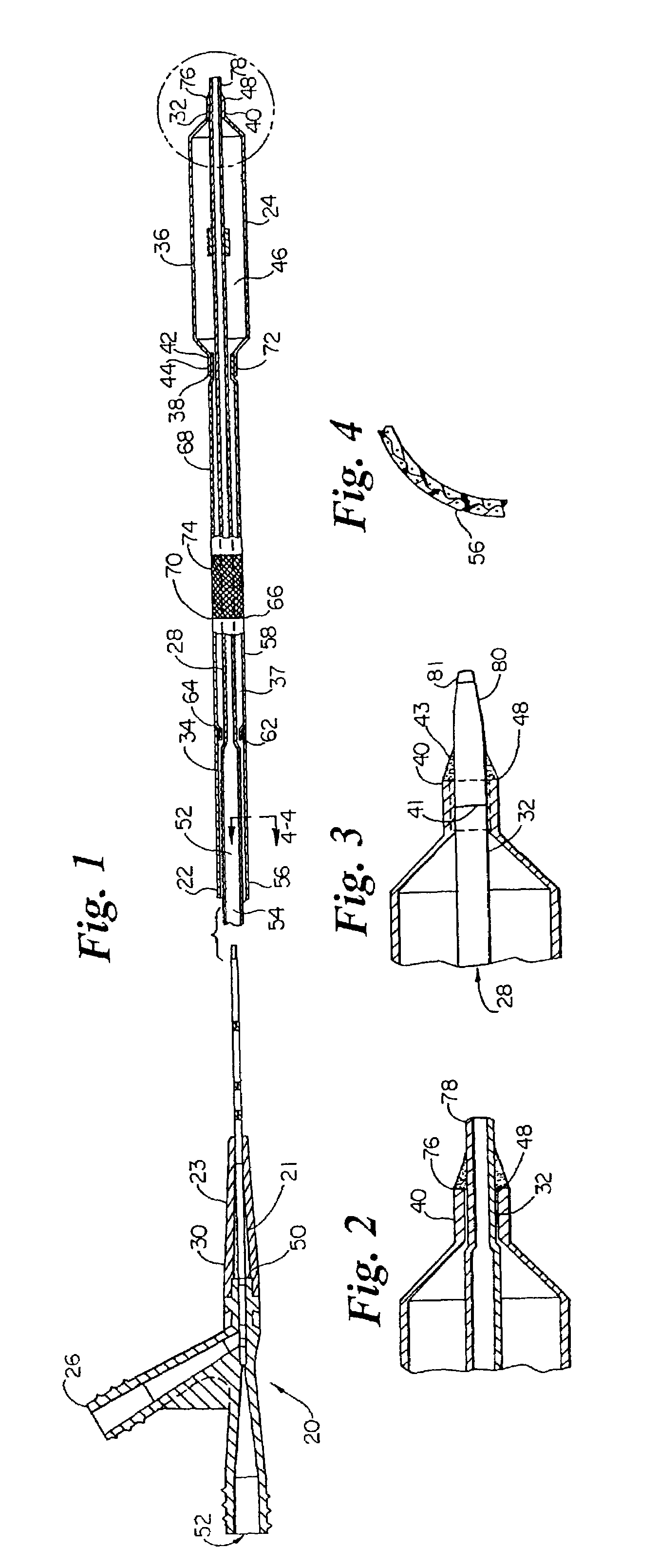
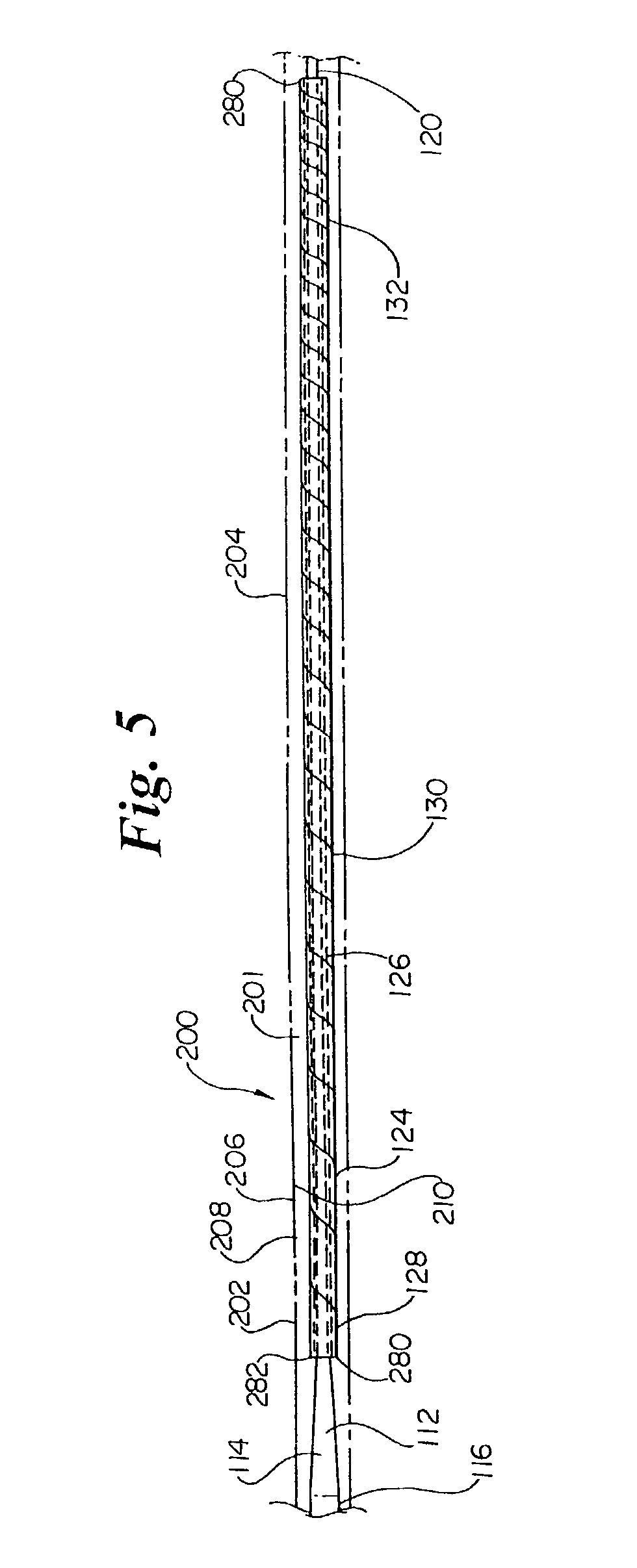
[0002] This invention relates to the field of intravascular medical devices, and more particularly, to intravascular catheters that use a relatively stiff proximal section and a more flexible distal section for improved pushability, trackability and crossability.BACKGROUND OF THE INVENTION

[0003] Intravascular diseases are commonly treated by relatively non-invasive techniques such as percutaneous transluminal angioplasty (PTA) and percutaneous transluminal coronary angioplasty (PTCA). These therapeutic techniques are well known in the art and typically involve the use of a balloon catheter with a guide wire, possibly in combination with oth...

Examples

Embodiment Construction

[0025]The following detailed description should be read with reference to the drawings in which like elements in different drawings are numbered identically. The drawings, which are not necessarily to scale, depict selected embodiments and are not intended to limit the scope of the invention.

[0026]Examples of constructions, materials, dimensions and manufacturing processes are provided for selected elements. All other elements employ that which is known to those skilled in the field of the invention. Those skilled in the art will recognize that many of the examples provided have suitable alternatives which may also be utilized.

[0027]Referring now to the drawings, FIG. 1 is a cross-sectional view of an over-the-wire balloon catheter showing a preferred embodiment of the present invention. The balloon catheter 20 includes a shaft assembly 22 and a balloon assembly 24 connected proximate its distal end. A conventional OTW-type manifold assembly 26 is connected to the proximal end of th...