
Positioning and motion control by electrons, ions, and neutrals in electric fields
a technology of electrons and ions, applied in mechanical devices, machines/engines, instruments, etc., can solve the problems of inability to manufacture devices, toxic in the environment of the earth's surface environment, and no prior art that utilized field emission for force production, etc., to achieve less cost and greater ease of manufacture
- Summary
- Abstract
- Description
- Claims
- Application Information
AI Technical Summary
Benefits of technology
Problems solved by technology
Method used
Image

Examples
Embodiment Construction
[0097]As is described here in detail, the objectives of the instant invention may be accomplished by any of a number of ways separately or in combination, as taught by our invention.
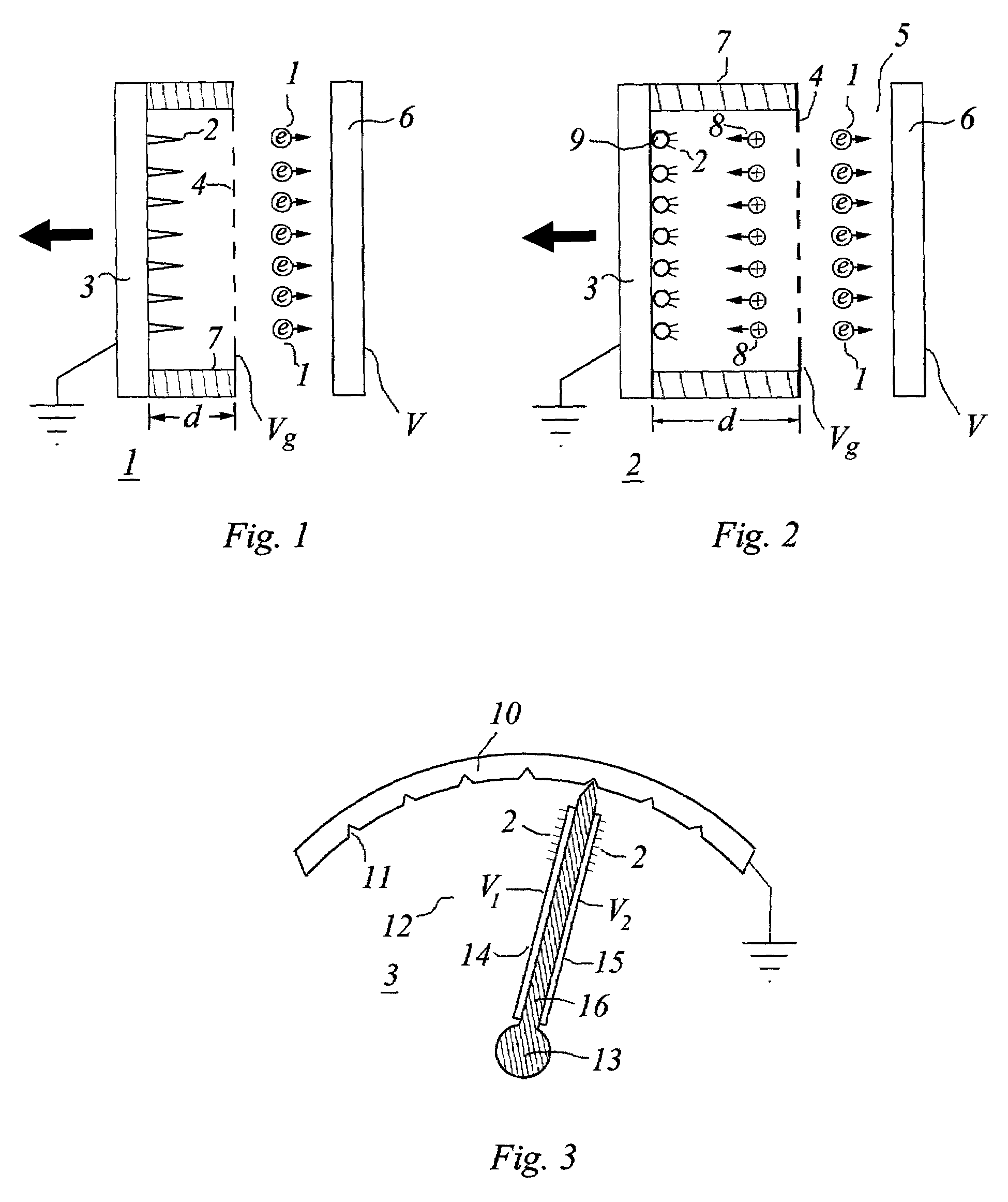
[0098]FIG. 1 shows a fundamental motive device 1, which in this case produces a force by the emission of electrons 1 from whiskers 2 on an electrode 3 that serves as cathode. Upon leaving the whiskers 2, the electrons 1 cross the gap d to pass through a grid 4 at voltage Vg to enter a region 5, and then are collected at the ultimate anode collector plate electrode 6 at voltage V≧Vg. When V=Vg, region 5 is field free. A dielectric 7 supports the grid 4 and electrically isolates the grid 4 from the electrode 3. The configuration of the grid 4 at fixed separation d from the electrode 3 serves to maintain an unchanging macroscopic electric field as motion is imparted to electrode 3. Otherwise the cathode-anode gap would change, requiring a modulation of the applied voltage to control the motive force. A repu...
PUM
 Login to View More
 Abstract
Description
Claims
Application Information
 Login to View More