Unlock instant, AI-driven research and patent intelligence for your innovation.

Variable rate speech coding

Inactive Publication Date: 2006-11-14
QUALCOMM INC
View PDF13 Cites 44 Cited by
  • Summary
  • Abstract
  • Description
  • Claims
  • Application Information

AI Technical Summary

Benefits of technology

[0011]An advantage of the present invention is that speech is coded at a low bit rate. Low bit rates translate into higher capacity, greater range, and lower power requirements.
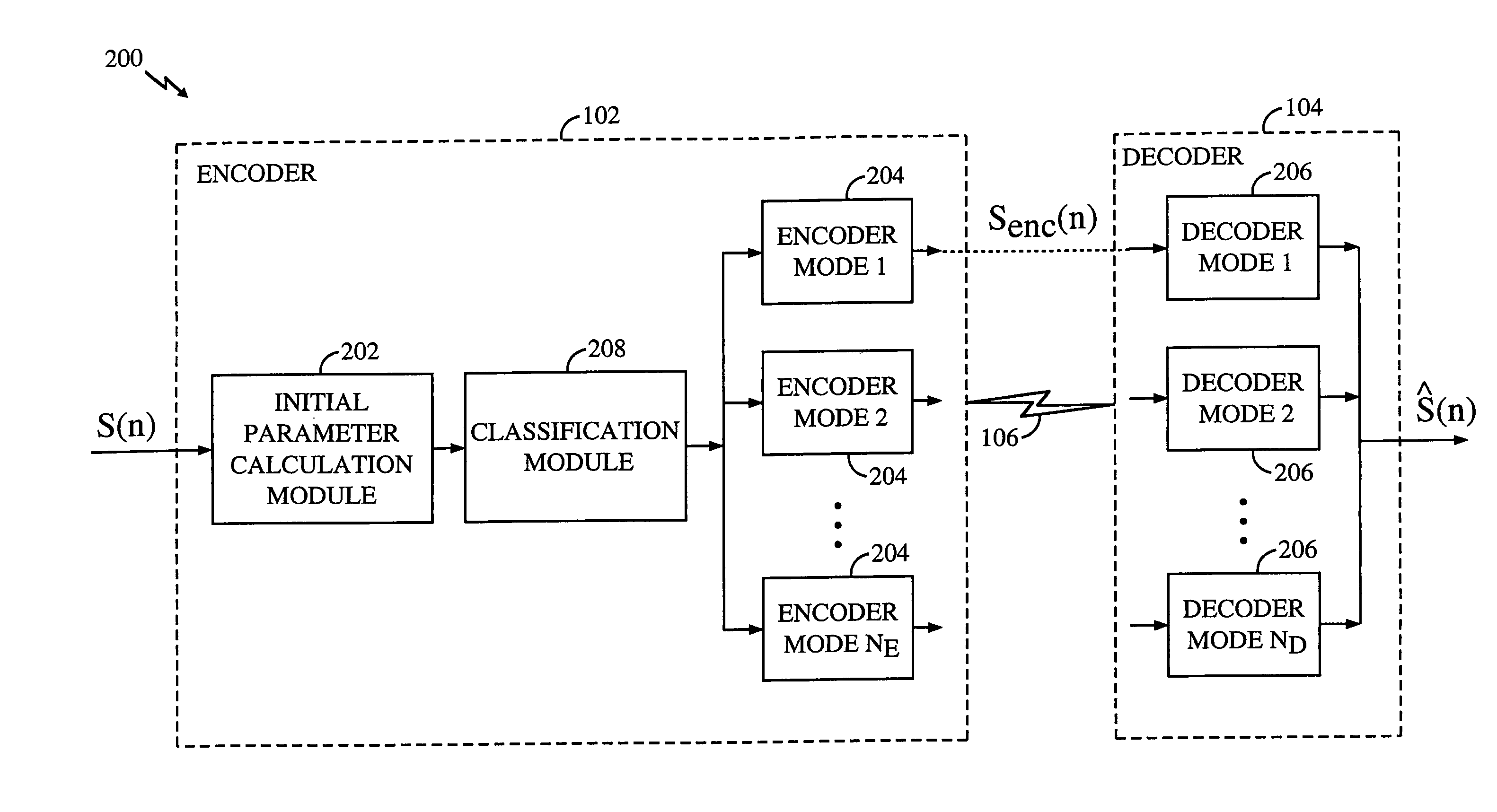
[0012]A feature of the present invention is that the input speech signal is classified into active and inactive regions. Active regions are further classified into voiced, unvoiced, and transient regions. The present invention therefore can apply various coding modes to different types of active speech, depending upon the required level of fidelity.
[0013]Another feature of the present invention is that coding modes may be utilized according to the strengths and weaknesses of each particular mode. The present invention dynamically switches between these modes as properties of the speech signal vary with time.
[0014]A further feature of the present invention is that, where appropriate, regions of speech are modeled as pseudo-random noise, resulting in a significantly lower bit rate. The present invention uses this coding in a dynamic fashion whenever unvoiced speech or background noise is detected.

Problems solved by technology

However, coding techniques are available that significantly reduce the data rate required for satisfactory speech reproduction.
However, even these reduced bit rates often exceed the available bandwidth where the speech signal must either propagate a long distance (e.g., ground to satellite) or coexist with many other signals in a crowded channel.

Method used

the structure of the environmentally friendly knitted fabric provided by the present invention; figure 2 Flow chart of the yarn wrapping machine for environmentally friendly knitted fabrics and storage devices; image 3 Is the parameter map of the yarn covering machine
View more

Image

Smart Image Click on the blue labels to locate them in the text.
Viewing Examples
Smart Image
  • Variable rate speech coding
  • Variable rate speech coding
  • Variable rate speech coding

Examples

Experimental program
Comparison scheme
Effect test

Embodiment Construction

[0046]I. Overview of the Environment[0047]II. Overview of the Invention[0048]III. Initial Parameter Determination[0049]A. Calculation of LPC Coefficients[0050]B. LSI Calculation[0051]C. NACF Calculation[0052]D. Pitch Track and Lag Calculation[0053]E. Calculation of Band Energy and Zero Crossing Rate[0054]F. Calculation of the Formant Residual[0055]IV. Active / Inactive Speech Classification[0056]A. Hangover Frames[0057]V. Classification of Active Speech Frames[0058]VI. Encoder / Decoder Mode Selection[0059]VII. Code Excited Linear Prediction (CELP) Coding Mode[0060]A. Pitch Encoding Module[0061]B. Encoding codebook[0062]C. CELP Decoder[0063]D. Filter Update Module[0064]VIII. Prototype Pitch Period (PPP) Coding Mode[0065]A. Extraction Module[0066]B. Rotational Correlator[0067]C. Encoding Codebook[0068]D. Filter Update Module[0069]E. PPP Decoder[0070]F. Period Interpolator[0071]IX. Noise Excited Linear Prediction (NELP) Coding Mode[0072]X. Conclusion

I. Overview of the Environment

[0073]The...

the structure of the environmentally friendly knitted fabric provided by the present invention; figure 2 Flow chart of the yarn wrapping machine for environmentally friendly knitted fabrics and storage devices; image 3 Is the parameter map of the yarn covering machine
Login to View More

PUM

No PUM Login to View More

Abstract

A method and apparatus for the variable rate coding of a speech signal. An input speech signal is classified and an appropriate coding mode is selected based on this classification. For each classification, the coding mode that achieves the lowest bit rate with an acceptable quality of speech reproduction is selected. Low average bit rates are achieved by only employing high fidelity modes (i.e., high bit rate, broadly applicable to different types of speech) during portions of the speech where this fidelity is required for acceptable output. Lower bit rate modes are used during portions of speech where these modes produce acceptable output. Input speech signal is classified into active and inactive regions. Active regions are further classified into voiced, unvoiced, and transient regions. Various coding modes are applied to active speech, depending upon the required level of fidelity. Coding modes may be utilized according to the strengths and weaknesses of each particular mode. The apparatus dynamically switches between these modes as the properties of the speech signal vary with time. And where appropriate, regions of speech are modeled as pseudo-random noise, resulting in a significantly lower bit rate. This coding is used in a dynamic fashion whenever unvoiced speech or background noise is detected.

Description

RELATED APPLICATIONS[0001]This application is a continuation of U.S. application Ser. No. 09 / 217,341, filed on Dec. 21, 1998, now U.S. Pat. No. 6,691,084, which is entitled “Variable Rate Speech Coding,” and currently assigned to the assignee of the present application.BACKGROUND OF THE INVENTION[0002]1. Field of the Invention[0003]The present invention relates to the coding of speech signals. Specifically, the present invention relates to classifying speech signals and employing one of a plurality of coding modes based on the classification.[0004]2. Description of the Related Art[0005]Many communication systems today transmit voice as a digital signal, particularly long distance and digital radio telephone applications. The performance of these systems depends, in part, on accurately representing the voice signal with a minimum number of bits. Transmitting speech simply by sampling and digitizing requires a data rate on the order of 64 kilobits per second (kbps) to achieve the spee...

Claims

the structure of the environmentally friendly knitted fabric provided by the present invention; figure 2 Flow chart of the yarn wrapping machine for environmentally friendly knitted fabrics and storage devices; image 3 Is the parameter map of the yarn covering machine
Login to View More

Application Information

Patent Timeline
no application Login to View More
IPC IPC(8): G10L19/12G10L19/14G10L21/00G10L19/18G10L11/02G10L19/04G10L19/24G10L25/90G10L25/93H03M7/30
CPCG10L19/20G10L19/24G10L2025/783G10L2025/935G10L19/18
Inventor MANJUNATH, SHARATHGARDNER, WILLIAM
Owner QUALCOMM INC