[0006]The invention provides methods of correcting misalignments between sequential images of a sample. The invention is particularly useful for correcting image misalignment due to movement of the sample between images and / or during
image acquisition. The invention also allows for real-time, dynamic
image alignment for improved
optical diagnosis and assessment.
[0007]In a preferred embodiment, the invention comprises determining an x-displacement and a y-displacement corresponding to a misalignment between two images of a
tissue sample, where the misalignment is caused by a shift in the position of the sample with respect to the
image frame field. For example, in obtaining a sequence of images of an in-situ
tissue sample, an embodiment of the invention makes it possible to correct for small image misalignments caused by unavoidable
patient motion, such as motion due to
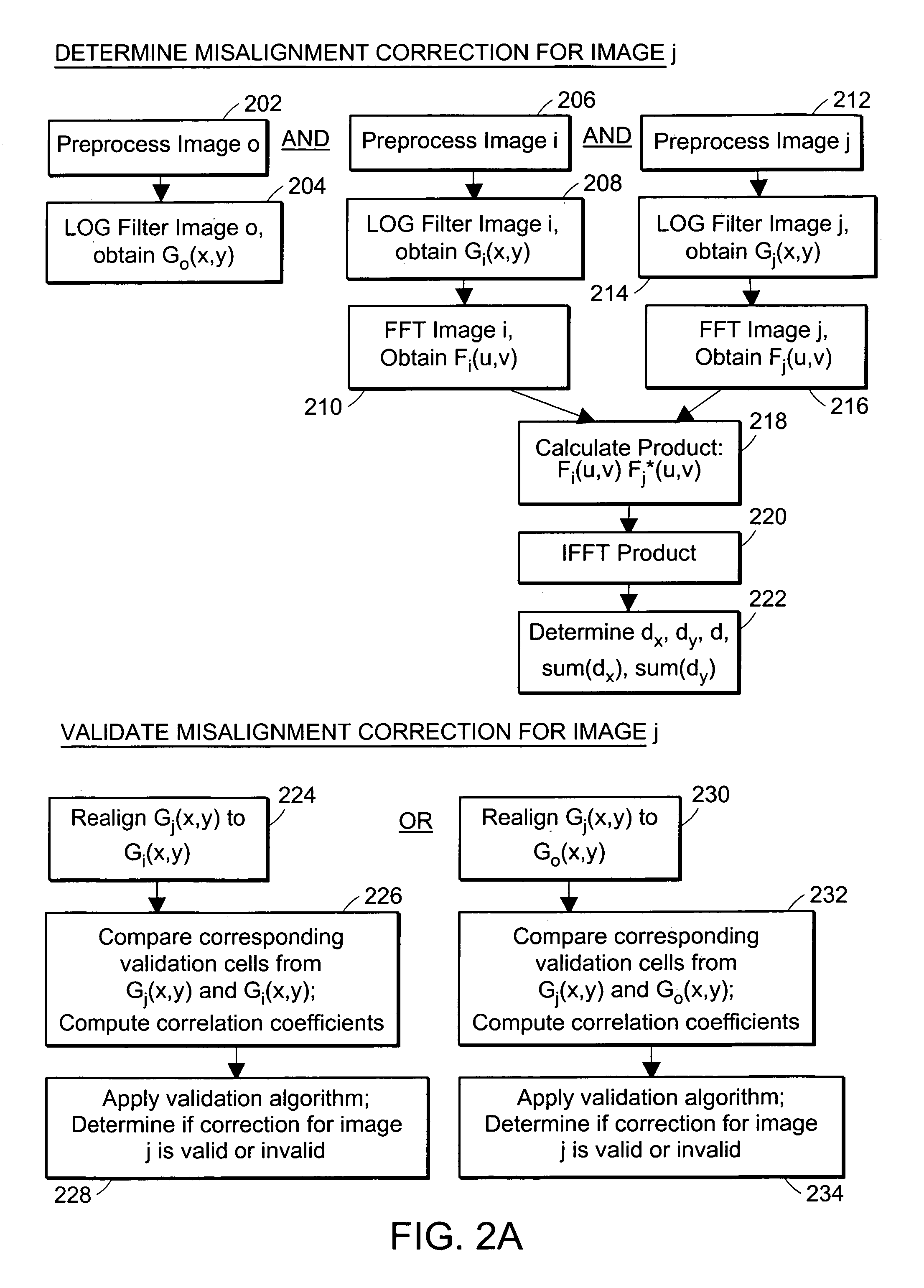
breathing. It has been discovered that validating misalignment corrections improves the accuracy of diagnostic procedures that use data from sequential images, particularly where the misalignments are small and the need for accuracy is great. Thus, methods of the invention comprise validating misalignment corrections by splitting individual images into smaller subimages, determining displacement between these subimages, and comparing the subimage displacements to the overall image displacement. Alternatively, validation may comprise adjusting two images according to a misalignment correction, then determining displacement between corresponding subimages and comparing these displacements with a threshold maximum value.
[0008]It has also been discovered that application of a chemical contrast agent, such as
acetic acid, prior to or during acquisition of a sequence of tissue images enhances the detection of small-scale image misalignment by increasing intra-
image contrast of the tissue images. The enhanced contrast of the tissue features recorded in the images allows for more accurate
motion correction determination, since enhanced features may serve as landmarks in determining values of displacement.
[0009]Both misalignment correction determination and validation may be performed such that an accurate adjustment is made for a misalignment before an entire sequence of images is obtained. This allows, for example, “
on the fly” adjustment of a camera while a diagnostic exam is in progress. Thus, corrections may be determined, validated, and accurately adjusted for as misalignments occur, reducing the need for retakes and providing immediate feedback as to whether an examination is erroneous. Automatic adjustment may be accomplished by adjusting aspects of the optical interrogation of the sample using a misalignment correction value. Adjustments may be performed, for example, by adjusting aspects of transmission and / or reception of electromagnetic energy associated with the sample. This may include, for example, transmitting a correction
signal to a
galvanometer system or a
voice coil to “null out” a misalignment by adjusting the position of a mirror or other component of the camera obtaining the images according to the correction
signal. Alternatively, or additionally, adjustments may be performed by electronically adjusting an aspect of an image, for example, the frame and / or bounds of an image, according to a misalignment correction value, or by performing any other appropriate adjustment procedure.
[0012]A misalignment correction determination may be inaccurate, for example, due to any one or a combination of the following: non-translational sample motion such as rotational motion, local deformation, and / or warping; changing features of a sample such as whitening of tissue; and
image recording problems such as focus adjustment, missing images, blurred or distorted images, low
signal-to-
noise ratio, and computational artifacts. Validation procedures of the invention identify such inaccuracies. The methods of validation may be conducted “on-the-fly” in concert with the methods of determining misalignment corrections in order to improve accuracy and to reduce the time required to conduct a given test.
[0013]Once an image misalignment is detected, an embodiment provides for automatically adjusting an optical signal detection device, such as a camera. For example, a camera may be adjusted “on-the-fly” to compensate for misalignments as images are obtained. This improves accuracy and reduces the time required to conduct a given test.


 Login to View More
  Login to View More