Supercharge Your Innovation With Domain-Expert AI Agents!

Alumina-based perovskite catalysts and catalyst supports

a technology of perovskite and catalyst, which is applied in the direction of catalyst activation/preparation, metal/metal-oxide/metal-hydroxide catalyst, metal/metal-oxide catalyst, etc., can solve the problem of slow and continuous loss of surface area, slow conversion to other polymorphs of alumina having much lower surface area, and the structure of alpha-alumina is less well suited to certain catalytic applications

Inactive Publication Date: 2009-03-17
BASF CATALYSTS LLC
View PDF24 Cites 10 Cited by
  • Summary
  • Abstract
  • Description
  • Claims
  • Application Information

AI Technical Summary

Benefits of technology

This approach results in a stable and porous catalyst support with a high surface area, enhancing catalytic activity and resistance to high-temperature deactivation, suitable for various catalytic reactions, including oxidation and reduction processes, while maintaining porosity and surface area, thus overcoming the limitations of traditional alumina and perovskite materials.

Problems solved by technology

This is especially true for systems using precious metal catalysts or other expensive catalysts.
Further heating may result in a slow and continuous loss of surface area and a slow conversion to other polymorphs of alumina having much lower surface areas.
Unfortunately, the structure of alpha-alumina is less well suited to certain catalytic applications because of a closed crystal lattice, which imparts a relatively low surface area to the alpha-alumina particles.
The prolonged exposure to high temperature typically up to 1,000° C., combined with a significant amount of oxygen and sometimes steam can result in catalyst deactivation by support sintering.
When an active species is supported on an oxide support, solid state reactions between the active species and the oxide support can take place at high temperature, creating some instability.
While perovskites are quite stable under harsh environments such as high temperatures, perovskites are not porous and, thus, have low surface area.
Accordingly, for use as catalytic supports, in particular, such materials have not found wide applications.

Method used

the structure of the environmentally friendly knitted fabric provided by the present invention; figure 2 Flow chart of the yarn wrapping machine for environmentally friendly knitted fabrics and storage devices; image 3 Is the parameter map of the yarn covering machine
View more

Image

Smart Image Click on the blue labels to locate them in the text.
Viewing Examples
Smart Image
  • Alumina-based perovskite catalysts and catalyst supports
  • Alumina-based perovskite catalysts and catalyst supports
  • Alumina-based perovskite catalysts and catalyst supports

Examples

Experimental program
Comparison scheme
Effect test

example 1

ABP with 24 wt % of La by incipient wetness on γ-alumina

[0037]416.5 g of La(NO3)3.6H 2O (Alfa Aesar, 99.9%) was dissolved in 500.0 g DI-water. This made Solution A. Solution A was added drop-wise to 421.0 g of γ-alumina powder (Sasol, 99.9%) while stirring the powder to make a uniform paste (the procedure is known as incipient wetness). The paste was dried at 110° C. in air overnight and the dried powder was ground briefly. The powder was heated to 1000° C. at a heating rate of about 10° C. / min and the temperature maintained at 1000° C. for 2 hours. The calcined sample was removed from the oven and cooled to ambient temperature.

[0038]The sample was submitted for XRD and BET surface area analyses.

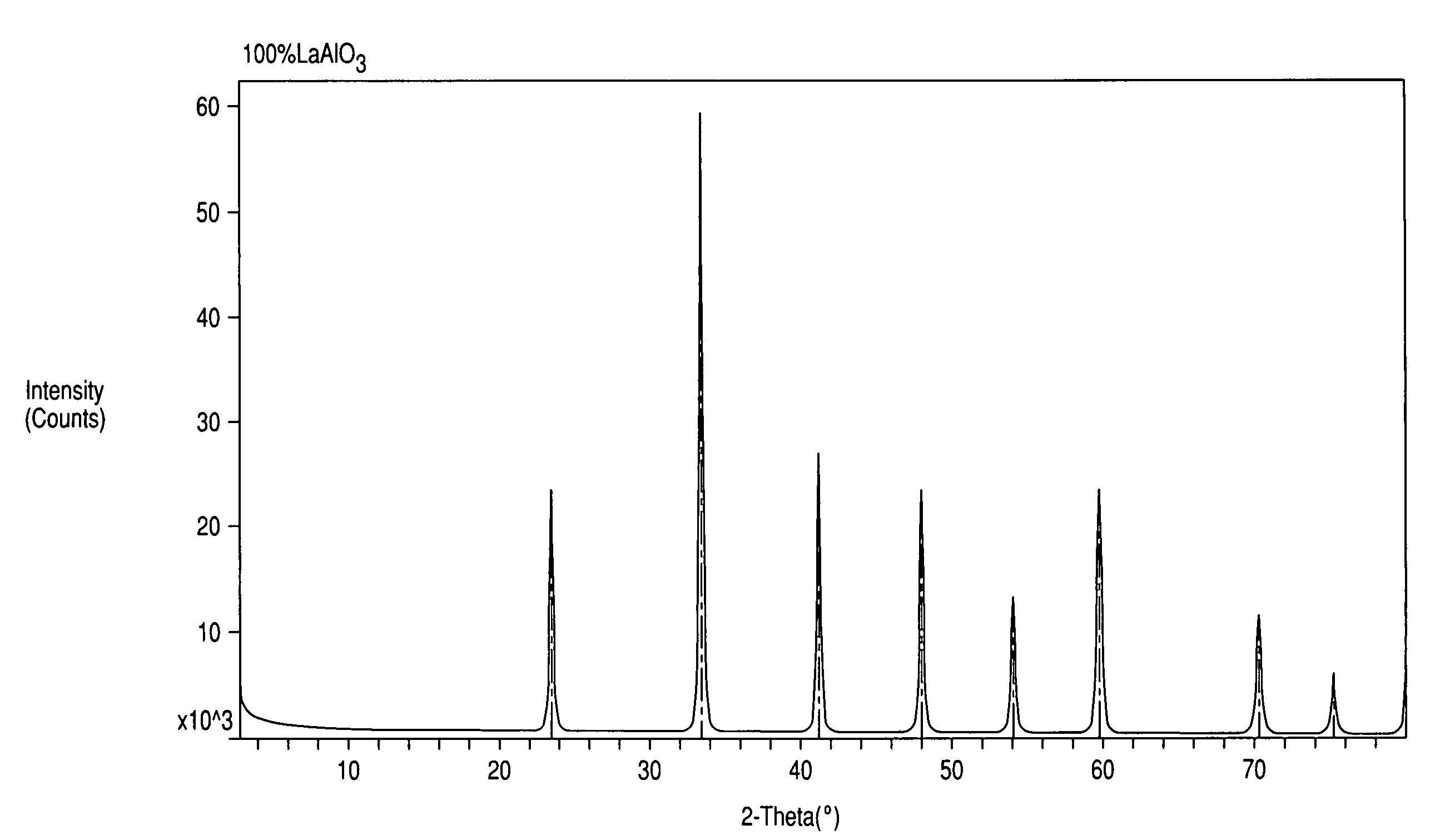
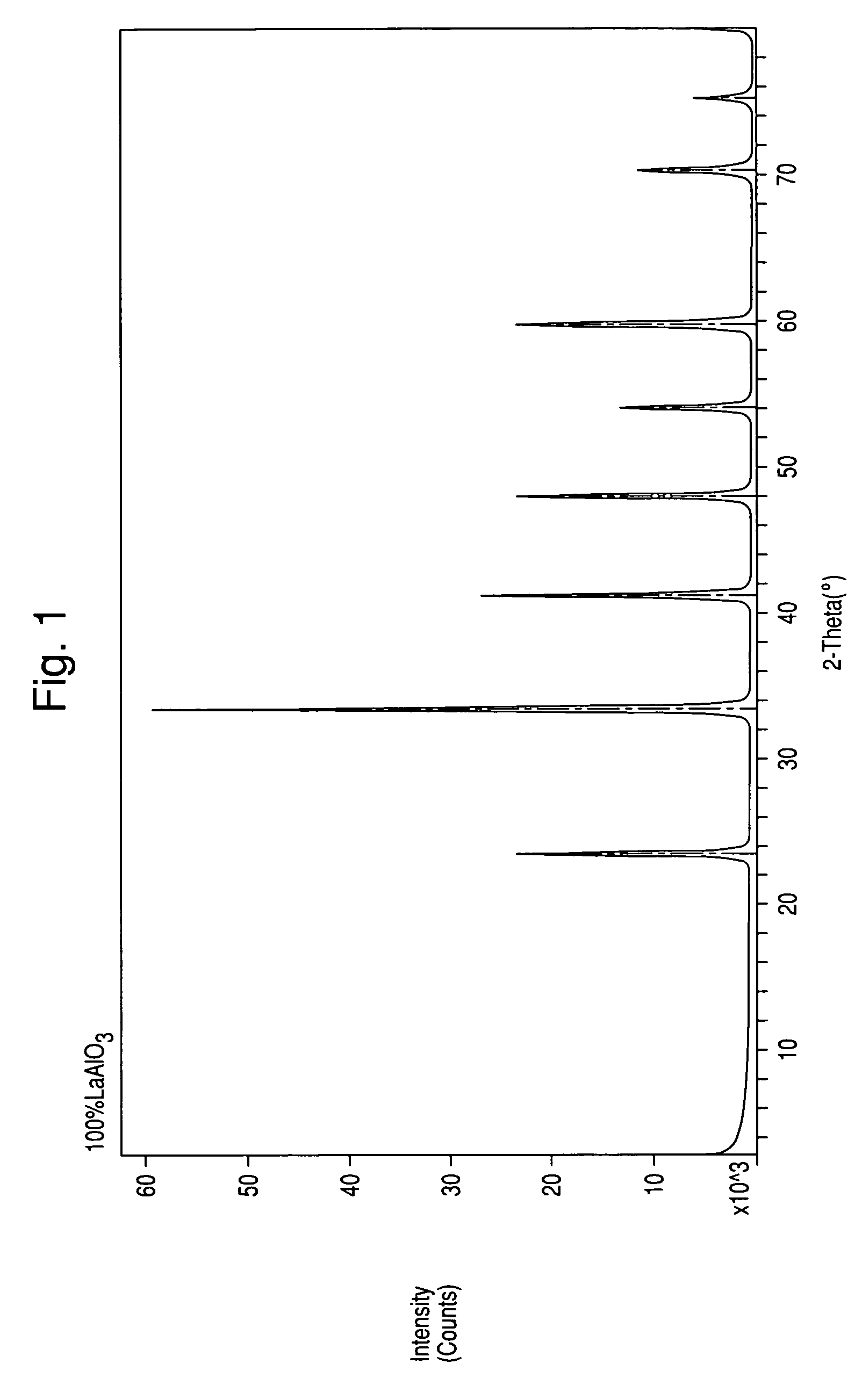
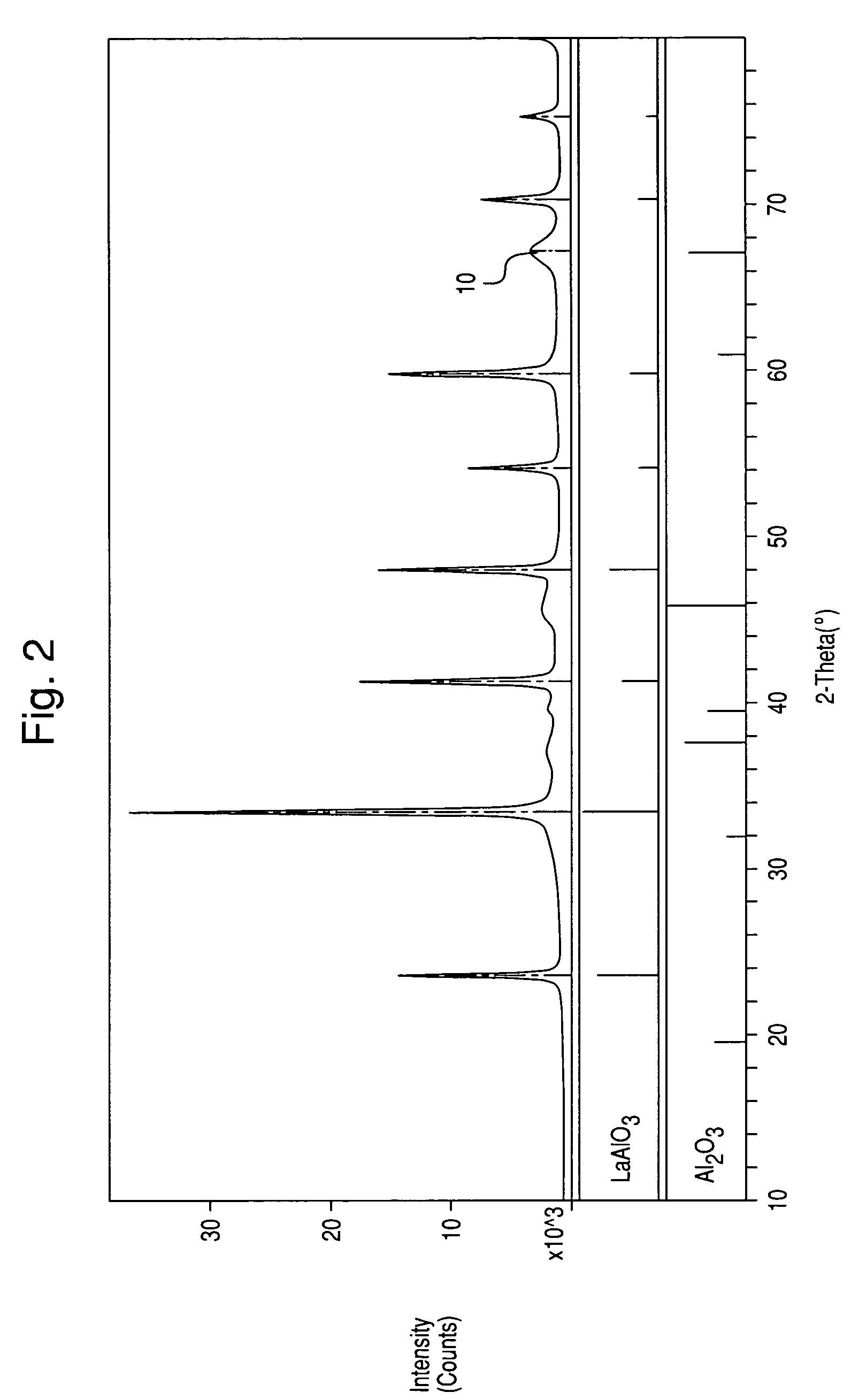
[0039]The XRD powder patterns indicated the sample contained a perovskite structure. FIG. 2 illustrates the XRD pattern of the sample produced by Example 1. FIG. 1 is the XRD of a commercial LaAlO3 perovskite. It can be seen that the ABP formed in Example 1 has an XRD pattern almost identica...

example 2

ABP with 24 wt % of La in γ-alumina by solid-state reaction

[0042]416.5 g of La(NO3)3.6H2O (Alfa Aesar, 99.9%) and 421g of γ-alumina (Sasol, 99.9%) was mixed and the mixture ground thoroughly. The mixture was dried overnight and the powder ground briefly. The ground mixture was heated to 1000° C. at a heating rate of about 10° C. / min and the temperature maintained at 1000° C. for 2 hours. The calcined sample was removed from the oven to cool to ambient temperature.

[0043]The sample was submitted for XRD and BET surface area analyses. The XRD powder patterns indicated the sample contained a perovskite structure. N2 porosity measurement gave a BET surface area of 58 m2 / g, a pore volume 0.25 cc / g, and an average pore width 17.2 nm.

example 3

ABP with 3 wt % of Pd and 24 wt % of La in γ-alumina

[0044]11.0 g of La(NO3)3.6H2O (Alfa Aesar, 99.9%) and 10.5 g of γ-alumina (Sasol, 99.9%) were mixed and the mixture ground thoroughly. 2.2 g of Pd(NO3)2 solution (20.5 wt % Pd, Engelhard) were added to above mixture dropwise while stirring the mixture. The paste was dried at 110° C. in air overnight and the dried powder ground briefly. The mixture was separated into two samples and the samples heated to 954° and 1093° C., respectively, at a heating rate of about 10° C. / min. The temperatures were maintained at 954° and 1093° C. for two hours, respectively. The calcined samples were removed from the oven and cooled to ambient temperature.

[0045]The samples were submitted for XRD and BET surface area analyses.

[0046]The XRD powder patterns indicated that both samples contained a perovskite structure. N2 porosity measurement gave the following data for the two samples, as shown in Table 1.

[0047]

TABLE 1Sample IDCalcination T (° C.)BET (m2...

the structure of the environmentally friendly knitted fabric provided by the present invention; figure 2 Flow chart of the yarn wrapping machine for environmentally friendly knitted fabrics and storage devices; image 3 Is the parameter map of the yarn covering machine
Login to View More

PUM

PropertyMeasurementUnit
wt. %aaaaaaaaaa
temperatureaaaaaaaaaa
wt. %aaaaaaaaaa
Login to View More

Abstract

An alumina-based perovskite is formed by mixing a lanthanide source with a transitional alumina to form a dual-phase composition comprising in-situ formed LnAlO3 dispersed in alumina. The lanthanide content of the composition ranges from 6-35 wt. % to yield a high surface area composition which is useful as a catalyst or catalyst support such as for precious metals.

Description

[0001]The present invention relates generally to novel perovskite-type supports and catalysts.BACKGROUND OF THE INVENTION[0002]It is well known that the efficiency of supported catalyst systems is often related to the surface area on the support. This is especially true for systems using precious metal catalysts or other expensive catalysts. The greater the surface area, the more catalytic material is exposed to the reactants and the less time and catalytic material is needed to maintain a high rate of productivity.[0003]Alumina (Al2O3) is a well-known support for many catalyst systems. It is also well known that alumina has a number of crystalline phases such as alpha-alumina (often noted as α-alumina or α-Al2O3), gamma-alumina (often noted as γ-alumina or γ-Al2O3) as well as a myriad of alumina polymorphs. Gamma-Al2O3 is a particularly important inorganic oxide refractory of widespread technological importance in the field of catalysis, often serving as a catalyst support. Gamma-A...

Claims

the structure of the environmentally friendly knitted fabric provided by the present invention; figure 2 Flow chart of the yarn wrapping machine for environmentally friendly knitted fabrics and storage devices; image 3 Is the parameter map of the yarn covering machine
Login to View More

Application Information

Patent Timeline
no application Login to View More
Patent Type & Authority Patents(United States)
IPC IPC(8): B01J21/04B01J23/10B01J23/42B01J23/44B01J23/46B01J23/56B01J23/63B01J37/04B01J37/08C01B13/18C01F1/00C01F17/00C01F7/00C01F7/02C01G55/00
CPCB01D53/945B01J23/002B01J23/10B01J23/63B01J35/0006B01J35/10B01J37/08B01D2255/102B01D2255/206B01D2255/402B01J23/02B01J35/1014B01J35/1038B01J35/1061B01J37/0201B01J37/04B01J2523/00B01J2523/31B01J2523/3712B01J2523/69B01J2523/3706B01J2523/822B01J2523/36B01J2523/22B01J2523/375B01J2523/25B01J2523/828B01J2523/824Y10S502/525Y02T10/22Y02T10/12B01J35/19B01J35/60B01J35/613B01J35/633B01J35/647B01D53/94B01J37/02
Inventor YANG, XIAOLIN DAVID
Owner BASF CATALYSTS LLC
Features
  • R&D
  • Intellectual Property
  • Life Sciences
  • Materials
  • Tech Scout
Why Patsnap Eureka
  • Unparalleled Data Quality
  • Higher Quality Content
  • 60% Fewer Hallucinations
Social media
Patsnap Eureka Blog
Learn More