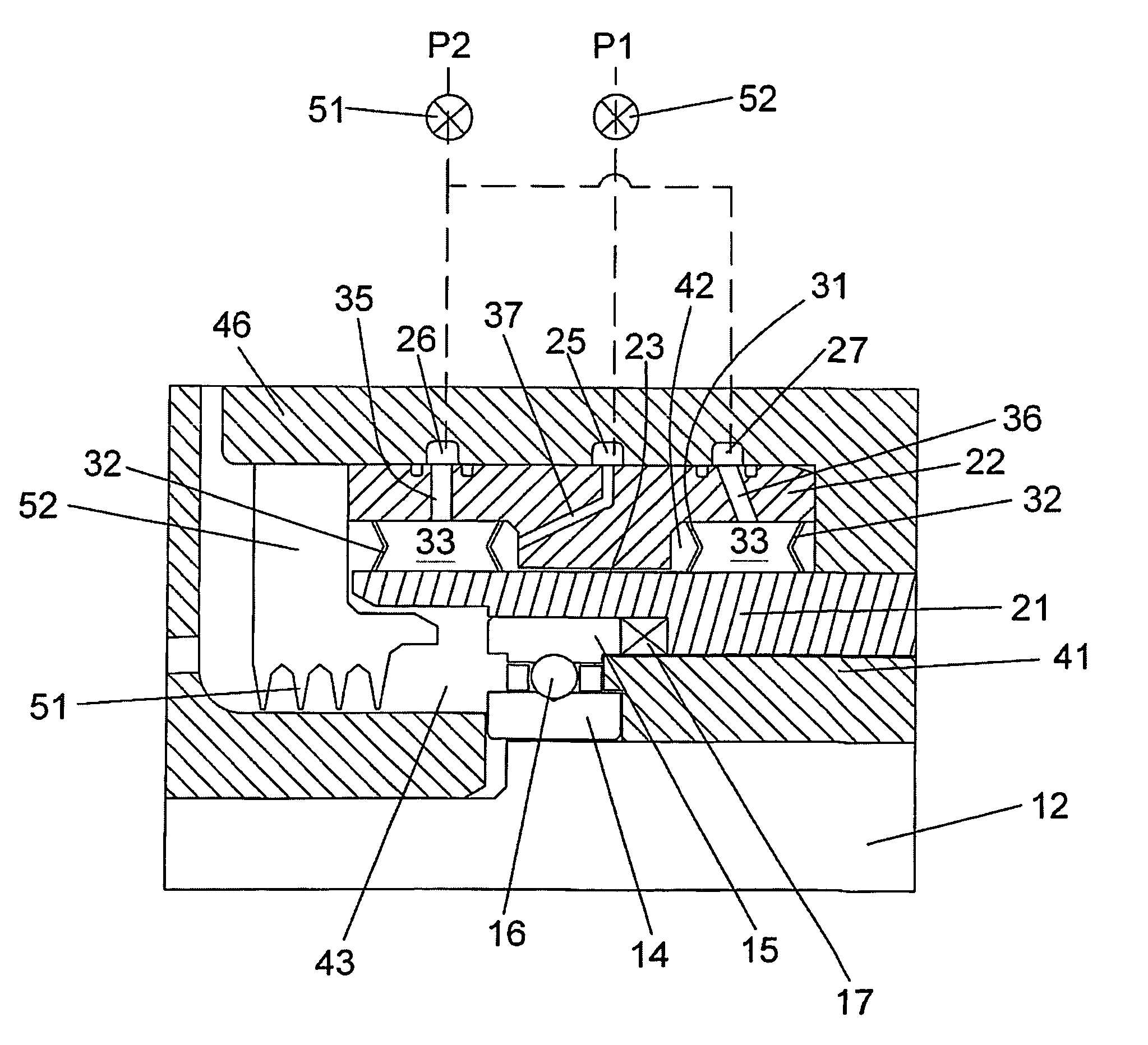
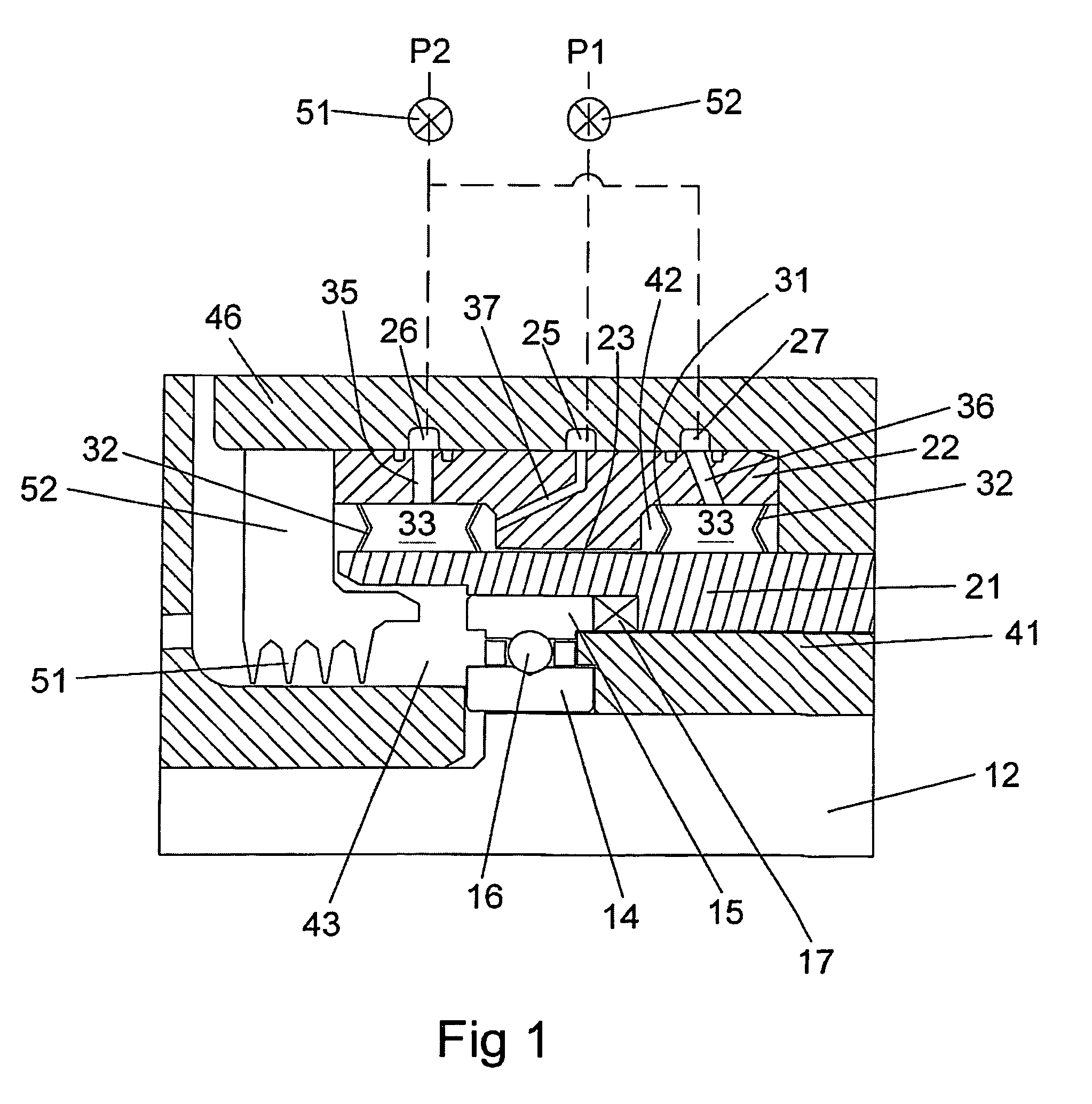
[0016]The present invention is a squeeze film damper located directly over the
rolling element bearing, in which the squeeze film damper is formed of two annuli of fluid contained by a
metal bellows located on either side of the squeeze film damper. The bellows forms an inner chamber that contains the damping fluid for the squeeze film damper, and an outer chamber in which the
fluid pressure is regulated to control the pressure in the squeeze film damper chamber. A first and a second pressure source is used to regulate the pressures in both of these chambers to control the damping and stiffness independently. The pressurized
metal bellows flexes inwardly to provide for a variable
spring force to center the bearing independent of the
operating speed, provides for the separation of the damper fluid and the secondary fluids with zero leakage, requires less
axial length leading to significant weight reduction and reducing the overall length and distance between bearings in order that the bending mode
natural frequency is higher, and reduces the overall size and weight of the turbomachine. The squeeze film damper will not allow
air entrainment because it will have fluid reservoirs on either side of the squeeze film damper. The squeeze film damper can be pressurized with the
working fluid or an alternative fluid separated from the
working fluid. The flexible bellow having the inward flexibility provides a higher variability in stiffness than the previous invention by this applicant while also providing for zero leakage.
[0017]By controlling the pressure in the bellows, the spring rate of the
support system can be changed rapidly and accurately. This variable spring rate can be leveraged to manipulate
rigid body critical speeds. The capability to move critical speeds is very important for several reasons. First, by moving the critical speeds around, the
modes can be avoided all together during startup. For instance, during startup, the bellows are pressurized to the highest pressure possible. By having the pressure high in the bellows, the spring rate is at its maximum, and therefore the
rigid body modes are also at their highest speed. When the first
rigid body is approached, the pressure in the bellows is suddenly reduced and therefore the spring rate is drastically reduced. By both accelerating and rapidly reducing the spring rate, the passage through the
critical speed is traversed extremely quickly. By limiting the time at the
critical speed, any rotor response from the
critical speed will be minimal. Another benefit to moving around the critical speeds is the ability to operate anywhere on the rpm scale to obtain extremely deep throttling capability. By either increasing or decreasing the stiffness at a given rpm, a critical speed can be moved so that operation at that speed is possible. This allows any rigid
body vibration mode to be relocated so that peak performance can be obtained and startup profiles are independent of rigid
body vibration modes.
[0018]The proposed configuration allows the pressurized bellows to provide a positive direct stiffness in series with the bearing. By directing the load through the bearing and then through the pressurized bellows and squeeze film damper in series instead of in parallel like most turbo-pumps, some of the load-carrying requirement is removed from the bearing, enhancing life. Since the pressurized bellows stiffness will be highly controllable and typically lower than the
bearing stiffness, the fluid film will respond to dynamic loads thereby decreasing the dynamic load on the bearing. The squeeze film damper will dissipate and dampen the vibrations that would normally be transmitted directly to the housing. The reduction of dynamic loads to the housing will increase the life of any HCF limited
turbopump component. Another benefit of the positive
load capacity of the pressurized bellows is that the bearing will no longer have to run with a
dead band clearance. Traditionally it is very difficult to predict the true
bearing stiffness when a dead-band clearance is used. The
elimination of this clearance linearizes the performance and characteristics of the
rolling element bearing and makes its behavior easier to predict.
[0019]The new configuration allows the stiffness to be varied significantly more than the previous configuration. The stiffness can vary by a minimum of 300% or more, allowing the rigid body modes to be moved around to any desired speed. The new configuration also lends itself to more applications.


 Login to View More
  Login to View More