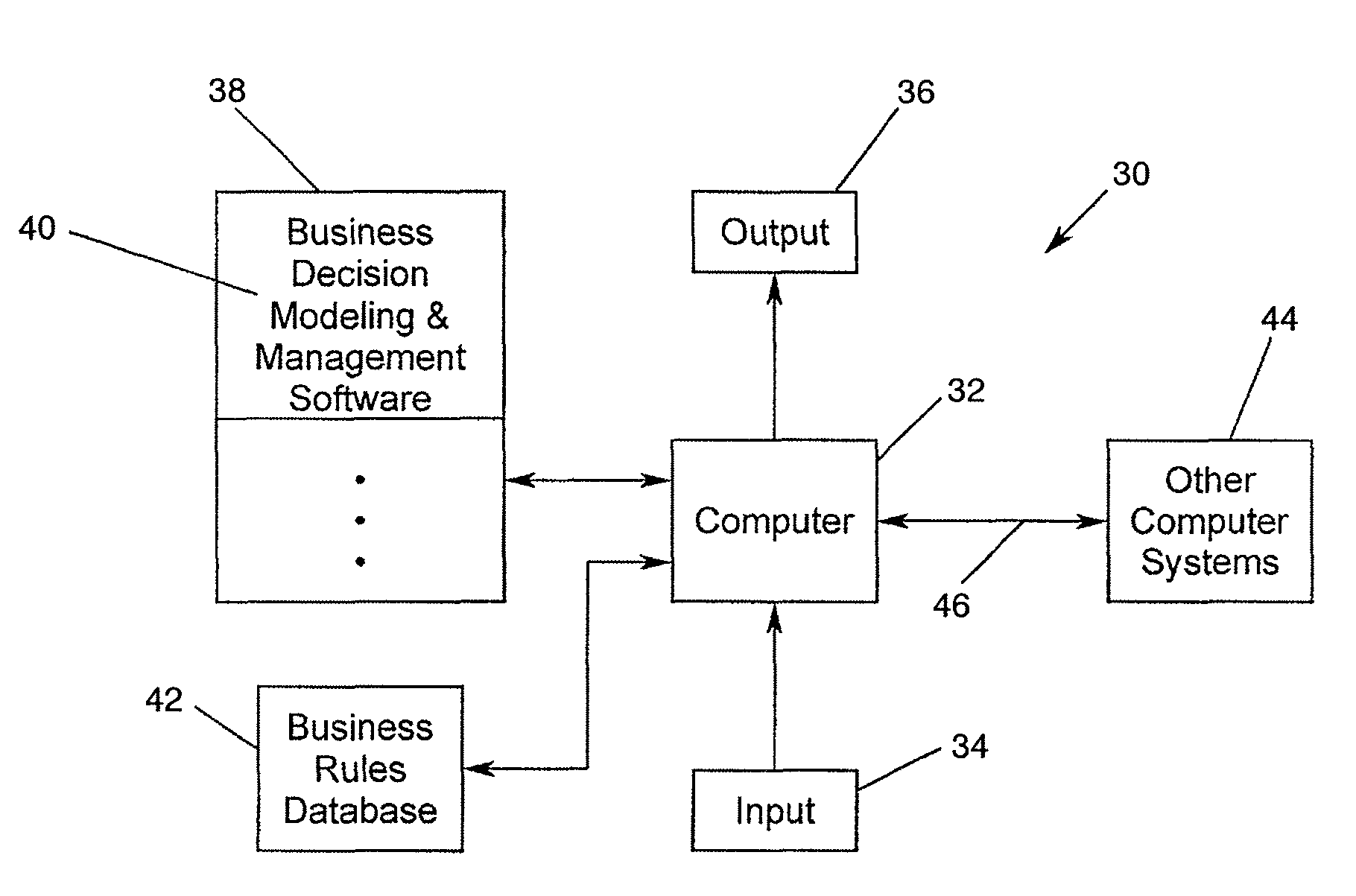
[0025]The present invention provides an automated computer implemented system and method for business decision modeling and management. A business decision modeling and
management system and method in accordance with the present invention enables business managers and decision makers, and others who may not have
computer programming skills, to gather, express in normal business language, organize, analyze, model, visually represent, and manage business rules grouped into business decisions, which is the logical business grouping of business rules or
business logic, with minimal assistance of technical staff.
[0027]The present invention provides a system and method for the authoring and management by a business user of the business decisions and the business rules in the repository. The present invention allows those business decisions and their business rules to be analyzed for semantic and business integrity in the context of the business organization and its strategies, and enables those business decisions and business rules to be traced to the
business objectives such that as those objectives change the business rules may be modified to be aligned with those changes. Furthermore, the present invention allows those business decisions and their business rules to be traced to those business systems, whether computerized or not, where those business rules are employed, so that as the business rules are changed in the repository they can be adjusted in the systems in which they are used.
[0029]A system and method for business decision modeling and management in accordance with the present invention is based upon a theory of the organization of business rules, called the
Decision Model, which organizes all business rules into structures called Business Decisions. Each Business Decision consists of the business rules that are used to determine the resolution of the Business Decision. In accordance with the
Decision Model of the present invention, each
business rule and each Business Decision complies with a series of principles. These principles ensure that the
business rule is correctly structured, and that none of the business rules in the entire business system duplicates, contradicts, or conflicts with another
business rule in the business system, and that each business rule appears in a single place, and one single place only, in its correct position within the business system. This formalism enables a system and method in accordance with the present invention to provide accurate visual models of the Business Decision and its business rules for ease of understanding, use, analysis and management.
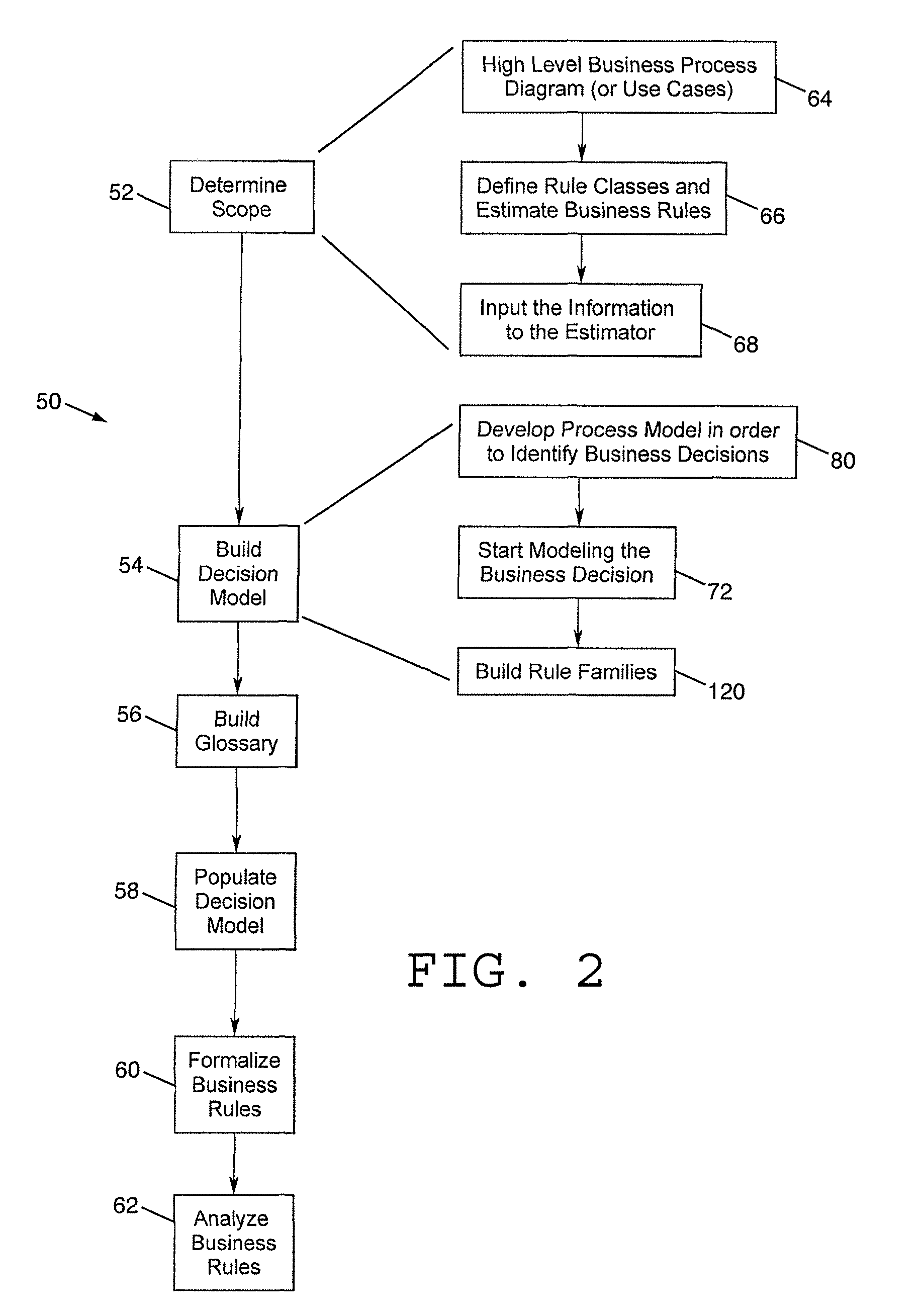
[0030]A system and method in accordance with the present invention provides for the tracing of the Business Decision models and their business rules to models of the business processes and use cases. Use cases are narratives, which describe the interaction between a primary system actor—the initiator of the interaction—and the system itself, represented as a sequence of simple steps. Actors are something or someone which exists outside the system under study, and who (or which) take part in a sequence of activities in a dialogue with the system, to achieve some goal. Actors may be end users, other systems, or hardware devices. Each use case is a complete series of events, from the point of view of the actor, which those Business Decisions support, as well as the relevant business strategies. A system and method in accordance with the present invention permits a graphical representation of the connection among Business Decisions, business rules, business strategies and business systems. It also enables a business organization to identify the business decisions, business rules and the business processes that need to be adjusted when business conditions or business strategies change. A system and method in accordance with the present invention preferably additionally provides for the tracing of those Business Decisions and their business rules to the business systems and business computer systems in which those business decisions and business rules are implemented. Thus, any changes that are made to the Business Decision and their business rules may be made efficiently in the business systems and business computer systems.


 Login to View More
  Login to View More